Skip to content
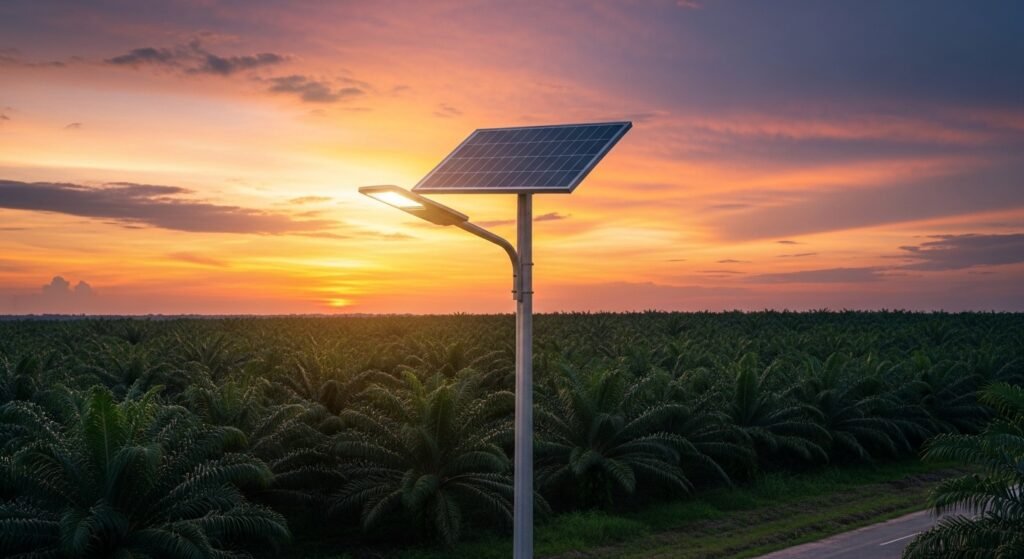
The bright sun of Africa is now doing more than growing crops. It is powering a huge change in how people work and live. In the middle of massive oil palm farms, a new kind of magic is happening. This change is not coming from oil or coal. It comes from the sky. This oil palm project involving streetlights uses the power of the sun to light up the woods. These are not just any lights. They are smart lights that clean themselves. This makes the palm belt in Africa a better place for everyone. It is a big step for farming and the planet. This new tech is making sure the roads stay bright even in the dirtiest places.
The Intersection of Agriculture and Smart Lighting: The Palm Belt Transformation
Farming has always been the heart of Africa. The oil palm regions are growing faster than ever before. But working in these areas was hard after the sun went down. Now, things are looking up. This oil palm project involving streetlights is bringing a fresh vibe to the farm. We are moving away from old, dirty fuels. Instead, we are using clean energy from the sun. This is a big win for the environment.
The palm belt is becoming a leader in smart tech. These lights are built to handle the tropical sun. They are also built to handle the mess that comes with farming. We call these “Smart & Eco” solutions. They do more than just shine a light. They help the whole farm run better. It is a new way to think about how we build things in rural areas. This project shows that even deep in the woods, we can have high-tech gear.
- Solar Power is the main engine for this new change.
- Sustainability is the goal for every single plantation.
- Infrastructure is being rebuilt to be smarter and tougher.
- Innovation helps workers stay safe at all hours.
Pain Points: Environmental Challenges in Oil Palm Plantation Landscapes
Growing palm oil is a messy business. The environment is very tough on equipment. It is very hot and very wet most of the time. The humidity in these areas can hit 80%. This makes everything damp and sticky. Traditional street lights just can’t handle it. They break down fast. They stop working when they get covered in grime. This oil palm project involving streetlights had to find a way to beat the heat and the rain.

There is also a lot of stuff flying in the air. Palm oil processing creates a thick oil mist. There is also a lot of pollen from the trees. This stuff sticks to everything. When it lands on a solar panel, it blocks the sun. If the sun is blocked, the light won’t charge. In just a few months, a normal light can lose 40% of its power. This is a huge problem for farmers.
- High Humidity makes parts rust and fail quickly.
- Oil Mist creates a sticky layer on the glass panels.
- Heavy Dust blocks the sunlight from reaching the cells.
- Remote Locations make it hard to send workers for repairs.
- Frequent Rain can cause water to leak into old light designs.
The Economic and Technical Solution: BOSUN’s Self-Cleaning Solar System
To fix these problems, a special kind of tech was needed. This oil palm project involving streetlights uses a system from BOSUN Lighting. This system is made for dirty places. It has a built-in robot that cleans the solar panel. This means humans don’t have to climb poles to scrub them. This is a smart and self-maintaining energy system. It keeps the panels clean so they always get the most power.
This tech is a game changer for the money side of things. It costs a lot to send people out to clean lights every month. With these lights, you don’t have to do that. The lights take care of themselves. This is great for plantations and long rural roads. It makes sure the lights stay on for a long time. It is the perfect fit for industrial agricultural estates.
| Feature | Standard Solar Light | BOSUN Self-Cleaning Light |
| Cleaning | Manual (Expensive) | Automated (Free) |
| Efficiency | Drops 30-40% fast | Stays at 95% or higher |
| Maintenance | Monthly checks needed | Quarterly or less |
| Lifespan | Shorter due to grime | Longer and more stable |
Technical Architecture: Components of a Self-Cleaning Solar Street Light
These lights are built like tanks. Every part has a special job to do. They use the best materials to fight the weather. The design is very clever. It combines power, storage, and cleaning in one unit. This oil palm project involving streetlights depends on these high-quality parts to keep working year after year.
High-Efficiency Solar Panel with Anti-Dust Technology
The solar panel is the most important part. It uses monocrystalline cells. These are the best at catching light. But they also have a secret weapon. The glass has a nano-hydrophobic layer. This layer makes it hard for dust to stick. It also stops water from leaving marks. This keeps the panel clear even before the cleaning brush moves.
The Automated Cleaning Mechanism
This is where the magic happens. Every light has a robotic cleaning arm. It has a brush that sweeps across the panel. This system does not use any water. That is very important because water is hard to find in some areas. The arm is programmed to move at certain times. It clears away the oil, dust, and pollen. This keeps the energy flow steady.

Advanced Energy Storage: Lithium Battery Pack
The energy is stored in a LiFePO4 battery. These are much better than old lead batteries. They last for 8 to 12 years. These are very stable even in the tropical heat. They hold enough power to light the road all night. They also provide the extra juice needed for the cleaning arm to move.
- Long Life means fewer battery changes over time.
- Heat Resistance keeps the battery from swelling or dying.
- High Density allows more power in a smaller space.
Intelligent Control Systems: The Pro-Double MPPT Solar Charge Controller
The brain of the light is the MPPT controller. It manages the power perfectly, and makes sure the battery doesn’t get too full or too empty. It also tells the cleaning arm when to wake up. This controller can even connect to the internet. This lets the farm owners check on the lights from their phones.

Industrial-Grade LED Light Fixtures
The lights themselves are very bright. They use LED tech that gives off a lot of light for very little power. The casing is made of strong aluminum. It has an IP66 rating. This means no water or dust can get inside. This is vital for the humid palm belt.
Structural Integrity: The Self-Cleaning Pole Structure
The poles are built to stay up for decades. They are made of galvanized steel or tough aluminum that stand about 7 to 9 meters tall. They have a special coating to stop them from rusting. Even the cables are hidden inside the pole. This keeps them safe from the local animals.
- Marine-Grade Coating fights off the sticky oil mist.
- Tall Height ensures the light reaches a wide area.
- Animal Protection stops monkeys from chewing on wires.
The Working Principle: Autonomous Operation and Energy Management
These lights are totally independent. They don’t need to be plugged into a power grid. They do everything on their own. This makes them perfect for the oil palm project involving streetlights. They follow a simple daily routine to keep things running smoothly.
Daytime Performance and Cleaning Cycles
During the day, the panels soak up the sun. The controller sends this energy into the battery. Around midday, the cleaning system starts up. It only takes about 30 to 60 seconds to wipe the panel clean. It does this while the sun is out so the panel stays clear for the peak charging hours.
Nighttime Illumination Strategies
When the sun goes down, the lights turn on automatically. They don’t just stay at one brightness. They can be 100% bright early in the night when workers are moving. Later at night, they can dim down to 50% to save power. This makes sure they never run out of juice before morning.
Continuous System Monitoring and Diagnostics
The lights are always checking themselves. They watch the temperature and the battery level. If something is wrong, they can send an alert. With the IoT modules, owners can see everything on a map. They can even change the cleaning schedule without leaving their office. This is the future of farm management.
Project Case Study: Port Harcourt, Nigeria — The Palm Belt Lighting Initiative
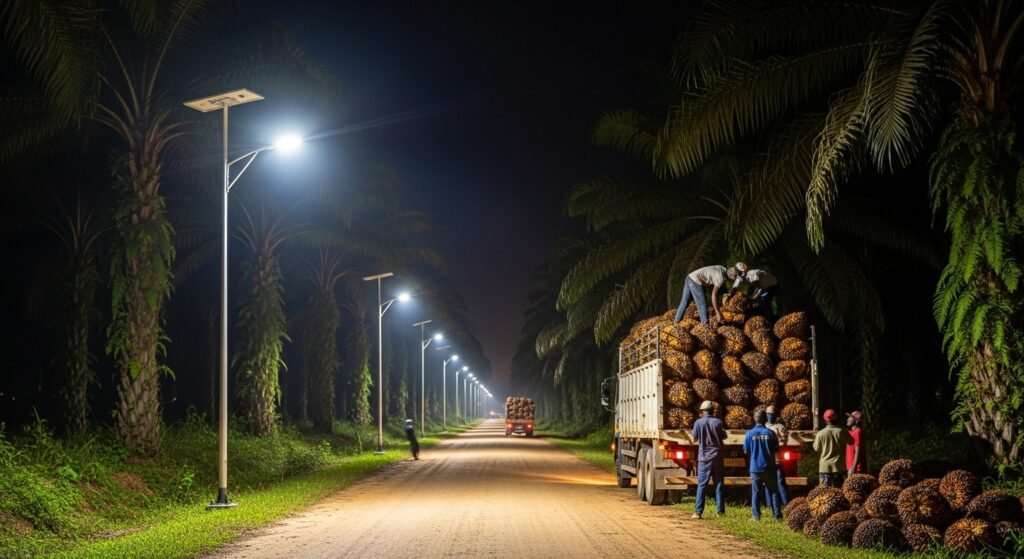
Port Harcourt is a huge hub for palm oil in Nigeria. It is full of large estates and processing plants. The area is very humid and dusty. Traditional lights were failing left and right. The local leaders wanted something better. They needed a lighting plan that wouldn’t break the bank. This oil palm project involving streetlights was the answer.
Local Government and Industrial Requirements
The goal was to make the roads safer for workers at night. Many people move palm fruit and oil after dark. The roads were dangerous without light. The government wanted a system that was easy to maintain. They didn’t want to spend all their time fixing broken lamps. They chose the self-cleaning system because it was the most reliable choice.
Preparation and Engineering Survey
Before any poles went up, the team did their homework. They checked how much sun the area gets. These found it gets about 5.1 units of sun per day. They also measured the humidity. At 80% humidity, they knew they needed the best rust protection. They mapped out 9 kilometers of road to cover.
Custom Solution Deployment
The team decided on 180W LED lights. These were put on 6.5-meter poles. They spaced the poles 40 meters apart. This gave a nice, even light on the road. The robotic arms were set to sweep twice every day. This was the perfect setup for the dirty environment in Port Harcourt.
Planning Considerations for Large-Scale Agricultural Lighting Projects
Setting up a big project like this takes careful thought. You can’t just stick poles in the ground. You have to understand the land and the weather. This oil palm project involving streetlights worked because it was planned well. The engineers looked at every detail to ensure success.
- Dust and Oil Mapping helps decide how often to clean the panels.
- Maintenance Logistics are planned to keep costs low.
- Drainage Channels are built into the frames to stop water from sitting.
- Heat Testing ensures the parts can handle the 60°C tropical sun.
- Power Autonomy means the lights stay on for 3 to 5 rainy days.
Comprehensive Advantages of Installing Self-Cleaning Solar Technology
The benefits of these lights are massive. They help the pocketbook and the planet at the same time. This oil palm project involving streetlights has shown everyone what is possible. It is a win-win for everyone involved.
- Huge Cost Savings come from not needing manual cleaning crews.
- Longer Equipment Life means the farm doesn’t have to buy new lights often.
- Constant Light makes the plantation much more productive.
- No Water Wasted is great for areas where water is scarce.
- Lower Carbon Footprint helps the farm be green and eco-friendly.
- Better Safety means fewer accidents and less theft at night.
Broader Impact: Scaling Across Africa and the Global Palm Industry
The success in Port Harcourt is just the start. Other regions are seeing the results and they want in. This oil palm project involving streetlights is spreading fast. It is helping Africa reach its goals for green energy and industrial growth.

Places like Abia and Akwa Ibom are already planning their own systems. Countries like Ghana and Cameroon are also looking at this tech. Even in Asia, big palm oil producers are interested. This tech is solving a global problem for farmers. It is helping create a safer and more efficient world.
Lighting the Future of Agricultural Sustainability
The oil palm project involving streetlights is a peek into the future. It shows how we can use smart tools to fix old problems. By mixing robotics with solar power, we can light up the world’s toughest places. This is more than just a light pole. It is a way to make farming better for the people and the earth.
This project proves that the right tech can handle any environment. Whether it is sticky oil or heavy dust, these lights keep shining. As more farms join in, the whole palm belt will become a brighter, safer place. It is a great story of how human smarts can work with nature to build a better tomorrow.
FAQ: Common Concerns Regarding Plantation Solar Lighting
Can the self-cleaning system handle heavy tropical rainstorms?
Yes, the system is designed to thrive in tropical weather. The light fixtures and battery compartments have an IP66 or IP68 waterproof rating. This means they are completely sealed against heavy rain and dust. The solar panel frames also include special drainage channels. These channels prevent water from pooling on the glass, which stops moss and algae from growing.
How does the solar panel stay clean without using any water?
The robotic cleaning arm uses a high-density, dry-brush system. It sweeps across the panel at high speed to flick away dust, sand, and dried oil mist. Because the glass has a nano-hydrophobic coating, the dirt doesn’t stick strongly. This waterless design is perfect for remote plantations where bringing in water trucks would be too expensive and difficult.
What happens if the robotic cleaning arm gets stuck?
The system has a built-in “anti-stuck” protection feature. If the brush hits a large branch or a thick patch of debris, the intelligent controller detects the resistance. It will try to reverse the motor to clear the block. If it still can’t move, it sends an alert to the management app via the IoT module so a worker can go check on it.
Do I need to hire an electrician to install these lights?
Actually, you usually don’t. Since these lights are “off-grid,” they don’t connect to high-voltage power lines. They run on low-voltage DC power. This makes them much safer to install. A local team can follow a simple manual to bolt the poles and mount the light units. You don’t need to dig long trenches for expensive copper wires.
How do the lights resist the strong winds and typhoons in Africa?
The poles are built with a “round tapered” design. This shape is much better at letting wind flow around it rather than pushing against it. Most systems are tested to handle winds up to 145 mph. In areas where hurricanes are common, the poles can be reinforced to withstand 180 mph winds.
Can the lights still charge on a very cloudy or hazy day?
Yes. The monocrystalline solar panels are very sensitive. They can still catch “diffuse light” that comes through the clouds. While they charge slower than on a sunny day, the large LiFePO4 battery stores enough backup power to keep the light on for 3 to 5 nights without any direct sun.
Is the battery safe to use in the extreme heat of the palm belt?
The LiFePO4 batteries are the safest choice for hot climates. Unlike old lithium-ion batteries used in phones, these don’t catch fire or explode easily. The smart controller also has a “thermal cutoff.” If the battery gets too hot during the day, the system stops charging until the temperature drops back to a safe level.
How long does the robotic brush itself last?
The cleaning brush is made of high-quality, weather-resistant materials. It is designed to work for about 3 to 5 years before it needs to be replaced. Changing the brush is a simple 10-minute job that can be done during a regular yearly inspection.
Does the cleaning system waste too much battery power?
Not at all. The cleaning cycle only runs for about 30 to 60 seconds once or twice a day. This uses less than 2% of the total energy the panel collects in a single day. The benefit of having a clean panel far outweighs the small amount of power used to run the motor.
Can I control the lights from a long distance?
Yes, if you choose the IoT (Internet of Things) option. These lights use “LoRa” or 4G technology. LoRa is great for big farms because it can send signals up to 10 kilometers away. You can use a computer or a phone app to see if a light is broken or to change how bright it shines.
What stops people from stealing the batteries or solar panels?
Security is a big part of the design. The battery is usually locked inside a metal compartment high up on the pole or buried deep underground in a concrete box. The solar panels are mounted with “anti-theft” bolts that require a special tool to remove. This makes it very hard for thieves to take the parts quickly.
Will the oil mist from the palm mill ruin the LED lenses?
The LED light fixture is protected by a tough, tempered glass lens. Just like the solar panel, it can be coated with a special layer that resists oil and grease. Because the light points down, the oil mist is less likely to settle on it compared to the solar panel that points up at the sky.
Is there a risk of birds or monkeys damaging the lights?
The design includes “wildlife protection.” All the wires are hidden inside the metal pole so monkeys can’t chew on them. The top of the light is often shaped to make it uncomfortable for large birds to nest on. The smooth surface of the solar panel also makes it hard for animals to get a grip.
How often should a manual inspection be done?
Even though the lights clean themselves, we recommend a “walk-by” check every three months. A worker just needs to look at the lights to make sure none were hit by a truck or damaged by a storm. A full technical check with a multimeter is usually only needed once a year.
What is the ROI (Return on Investment) for this oil palm project involving streetlights?
Most plantations see the system pay for itself in about 2 to 3 years. This happens because you stop paying for electricity and you stop paying for cleaning crews. Since the lights last for over 10 years, the farm gets many years of “free” lighting after the initial cost is covered.
Can the cleaning schedule be adjusted for different seasons?
Yes. During the dry season, when there is a lot of dust in the air, you can set the brush to run three times a day. During the rainy season, when the rain helps wash the panels, you can set it to run just once a day or turn it off to save energy.
Does the light attract insects that might clog the system?
LED lights can be tuned to a “warm” color (around 3000K). Insects are much less attracted to warm yellow light than to blue or white light. The cleaning brush will also sweep away any spider webs or dead bugs that might land on the solar panel during the night.
Are there any toxic chemicals in these solar lights?
No. Unlike old fluorescent bulbs that have mercury or lead-acid batteries that have toxic acid, these lights use clean tech. The LEDs are safe, and the LiFePO4 batteries are much more environmentally friendly. When the battery eventually dies after 10 years, it can be recycled.
What is the best height for the poles on a plantation road?
For most internal plantation roads, a pole height of 6 to 8 meters is best. This is high enough to spread light across the whole road but low enough that the cleaning arm can be easily reached with a ladder if it ever needs a new brush.
Can these lights be moved if the farm layout changes?
Yes! One of the best things about this oil palm project involving streetlights is that the lights are not tied to the ground with wires. If a road is closed or a new mill is built, you can unbolt the poles and move them to a new location in just a few hours.
Do the lights turn on instantly when it gets dark?
The system uses a “light sensor” on the solar panel. When the sun goes down and the panel stops making power, the controller knows it is night. It can turn the light on instantly, or you can program a “delay” if you want the light to wait until it is completely pitch black.