Skip to content
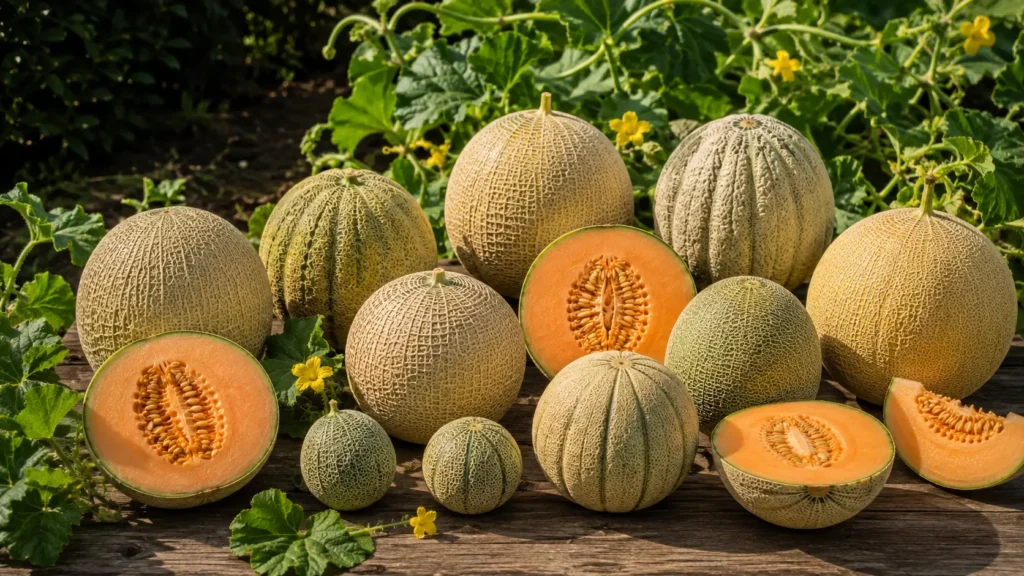
Choosing the right cantaloupe variety can make a big difference in a home garden. A variety that performs well in a long, hot growing season may be a poor choice if your summer is short.
I would look at days to maturity, disease resistance, fruit size, vine habit, flavor, and your local growing season before choosing seeds. There is no single best cantaloupe for every garden.
Some varieties are better for small spaces. Others are better for short growing seasons, disease-prone gardens, large harvests, or gardeners who want small, sweet melons.
In this guide, I’ll compare popular cantaloupe varieties and show you how to choose one that fits your garden.
What Are Cantaloupe Varieties?
Cantaloupe varieties are different cultivars of melon grown for their fruit. In the U.S., the terms cantaloupe and muskmelon are often used for the same group of netted melons, although the broader muskmelon group contains several different types.
The varieties can differ in:
- Days to maturity
- Fruit size
- Flesh color
- Flavor
- Aroma
- Vine size
- Yield
- Disease resistance
- Growing-season needs
- Best use in the garden
That is why I would not choose a variety just because a seed packet calls it sweet or easy to grow.
Your local conditions matter.
Best Cantaloupe Varieties for Home Gardens

Several varieties stand out for different reasons. Recommend varieties such as Ambrosia, Classic Hybrid, Hale’s Best, Mission, Rocky Sweet, and Summit Hybrid for home gardens.
Other varieties, including Athena, Sugar Cube, Accolade, and Da Vinci, are also worth considering because they offer useful traits for specific gardeners.
Here are the varieties I would put on a home-garden shortlist.
| Variety | Approx. maturity* | Best reason to grow it |
| Ambrosia | Varies by source | Strong general-purpose choice |
| Athena | About 75 days | Eastern U.S. and disease resistance |
| Sugar Cube | About 80 days | Small, sweet fruit |
| Hale’s Best | Varies | Classic variety |
| Mission | About 85 days in USU data | Established home-garden option |
| Rocky Sweet | About 80 days in USU data | General home-garden use |
| Summit Hybrid | About 78 days in USU data | Early-to-midseason option |
| Minnesota Midget | Short/small-fruited type | Small gardens |
| Accolade | Varies | Strong regional trial performance |
| Da Vinci | Varies | Tuscan-style specialty melon |
*Days to maturity can vary with seed source, growing method, weather, and planting date. Treat the number on the current seed packet as the best guide for that specific cultivar.
1. Ambrosia

Ambrosia is one of the first varieties I would consider for a general home garden.
USU lists Ambrosia among its recommended cantaloupe varieties. Utah’s home vegetable recommendations list it at about 86 days when transplanted.
It also has useful regional trial data. Oregon State University reported Ambrosia as a familiar cantaloupe that produced a strong yield in its 2022 western Oregon trial.
Why choose Ambrosia?
I would consider it if you want:
- A familiar cantaloupe type
- A general home-garden variety
- A proven option included in expert’s recommendations
- A variety with regional trial data behind it
It is not automatically the best choice for every climate, though. If your growing season is short, I would compare its maturity time with shorter-season options.
2. Athena

Athena is especially interesting for gardeners in the eastern United States.
Syngenta describes Athena as a hybrid cantaloupe with sweet flavor and juicy texture. Its listed average maturity is 75 days, and the company reports high resistance to several races of Fusarium wilt and powdery mildew, with intermediate resistance to additional powdery mildew races.
Why choose Athena?
I would look closely at Athena if:
- You garden in the eastern U.S.
- You want a hybrid
- Disease resistance is important
- You want a variety listed around 75 days
- You value sweet, juicy fruit
One point matters here: disease resistance is specific to certain diseases and races. I would always check the current seed description instead of treating a resistant variety as immune to disease.
3. Sugar Cube

Sugar Cube is one of my favorite types to include in a home-garden comparison because it gives gardeners a smaller-fruited option.
University of Delaware lists Sugar Cube as a cantaloupe that matures in about 80 days, with deep orange flesh and some disease resistance.
Oregon State also included Sugar Cube in its melon trials and described it as producing smaller cantaloupes.
Why choose Sugar Cube?
It can make sense if you want:
- Smaller melons
- Deep orange flesh
- A sweet eating melon
- A variety suitable for a home garden
- A relatively short maturity period
For a small household, smaller melons can also be easier to use before the cut fruit sits in the refrigerator for too long.
4. Hale’s Best

Hale’s Best is a classic cantaloupe variety that continues to appear in Authority recommendations.
USU lists Hale’s Best among its recommended varieties, and Utah’s home vegetable recommendations list it at about 85 days when transplanted.
Why choose Hale’s Best?
I would consider it if you want:
- A classic variety
- An established cultivar
- A traditional option rather than a newer hybrid
This is one variety where I would avoid making exaggerated claims about sweetness, disease resistance, or yield unless the current seed source provides those details.
5. Mission

Mission is another established cantaloupe variety found in recommendations.
USU lists Mission among its recommended varieties, while its Utah variety recommendations give it about 85 days when transplanted. Oklahoma State also lists Mission among varieties that have performed well in Oklahoma.
Why choose Mission?
Mission may suit gardeners who want:
- A proven cantaloupe type
- A variety with trusted recommendations
- A traditional home-garden option
Before buying it, I would still compare its maturity period and disease traits with varieties available for your specific region.
6. Rocky Sweet
Rocky Sweet is another variety recommended by USU.
USU’s home vegetable recommendations list it at around 80 days when transplanted.
Why choose Rocky Sweet?
It can be a good option for gardeners who want:
- A recommended home-garden cultivar
- An approximately 80-day maturity period
- A traditional cantaloupe type
If your growing season is short, I would still compare that maturity period with varieties listed at fewer days.
7. Summit Hybrid
Summit Hybrid is included in USU’s recommended cantaloupe varieties. Utah’s home vegetable recommendations list it at about 78 days when transplanted.
Why choose Summit Hybrid?
I would consider it if:
- You prefer a hybrid
- You want a variety around the 80-day range
- You are comparing several general-purpose cultivars
The biggest point is that a 78-day estimate is still an estimate. Weather and planting conditions can change how quickly the fruit matures.
8. Minnesota Midget

Minnesota Midget is worth considering for gardeners with limited space or an interest in small-fruited melons.
The name can make it sound like a variety intended only for Minnesota, but I would not make that assumption. The useful trait for a home gardener is its small-fruited nature and suitability for situations where large melons may be inconvenient.
For small gardens, I would focus on the size of the fruit and vine habit, rather than the name alone.
If you plan to grow the vines vertically, remember that developing melons may need support.
9. Accolade

Accolade gives this list a useful regional-trial option.
In Oregon State University’s 2023 variety trial, Accolade was the second-highest-yielding cantaloupe, with 13.6 tons of marketable fruit per acre in that trial.
That result does not mean Accolade will produce the same yield in your backyard.
Trial results depend on the location, weather, soil, management, and other conditions.
Why consider Accolade?
I would put it on the shortlist for gardeners who:
- Want to try a newer hybrid
- Garden in an area where it has shown good performance
- Like using regional trial results when selecting seeds
10. Da Vinci

Da Vinci is a good choice if you want something different from a standard cantaloupe.
Oregon State identifies Da Vinci as a Tuscan cantaloupe variety and reported 12.6 tons of marketable fruit per acre in its 2023 trial.
Why choose Da Vinci?
I would consider it if you want:
- A specialty cantaloupe
- A Tuscan type
- Something different from common garden varieties
- A variety with regional trial data
Again, I would use the OSU trial as evidence of performance in that trial, not as a guarantee for every garden.
Best Cantaloupe Varieties by Garden Need
Instead of asking which cantaloupe is number one, I think it makes more sense to ask:
Which variety fits my garden best?
That gives you a much better answer.
Best Cantaloupe Varieties for Short Growing Seasons
If your summer is short, I would make days to maturity one of the first things you check.
University of Minnesota recommends varieties with fewer days to maturity for northern gardens. It notes that varieties in the 65-to-80-day range give gardeners a better chance of harvesting ripe fruit before the growing season ends.
This does not mean an 80-day cantaloupe will always ripen in 80 days.
Cold weather, low sunlight, plant stress, and other conditions can slow fruit development.
What I would look for
For a short-season garden:
- Check the current seed-packet maturity date
- Prefer shorter maturity periods
- Start with varieties proven in your region
- Avoid choosing only by fruit size or flavor
- Give the plants a warm, sunny location
If your season is especially short, I would rather grow one well-matched early variety than several long-season varieties that may never finish.
Best Cantaloupe Varieties for Small Gardens
Garden space changes the decision.
Cantaloupe vines can take up considerable ground space, so I would look at both fruit size and vine habit.
Small-fruited varieties can be easier to manage in a limited garden. University of Minnesota also notes that small-fruited melon plants can be trained on a fence or trellis in small gardens, although the fruit needs support.
Varieties to consider
- Sugar Cube
- Minnesota Midget
- Other small-fruited cultivars listed by reputable seed suppliers
Before buying, check the current seed description for vine length and fruit weight.
A small fruit does not always mean a compact vine.
That distinction is easy to miss.
Best Cantaloupe Varieties for Disease Resistance
If your garden has a history of melon diseases, I would put disease resistance high on the list.
Oklahoma State University notes that cantaloupe varieties differ greatly in disease resistance and recommends considering resistance to problems such as powdery mildew and Fusarium wilt where these diseases have been a concern.
Athena is one example with documented resistance information from the seed company.
Sugar Cube is another variety for which University of Delaware reports some disease resistance.
One warning about disease resistance
I would never read “disease resistant” as “disease proof.”
Resistance may apply to a particular disease, race, or strain.
The seed packet or current breeder information should tell you exactly what resistance is claimed.
Best Cantaloupe Varieties for Small Households
If you are growing for one or two people, I would consider smaller fruit.
A large melon can be difficult to use quickly once cut.
Sugar Cube is a useful example because it produces smaller cantaloupes. Oregon State’s trial data also recorded smaller fruit for Sugar Cube.
Minnesota Midget is another option worth researching for gardeners who want small fruit.
The right choice depends on whether you care more about fruit size, plant size, maturity time, or flavor.
Best Cantaloupe Varieties for Large Harvests
For larger households, I would focus less on finding the biggest individual melon and more on productive varieties that perform well in your area.
Regional trial results can help here, but they should be treated as local evidence rather than a promise.
For example, Oregon State reported strong yields from Ambrosia and Accolade in its trials.
For a home garden, though, total harvest depends on much more than the cultivar.
Weather, pollination, disease pressure, soil, water, plant spacing, and general plant health all affect the final crop.
How to Choose a Cantaloupe Variety
If I were choosing seeds for a new garden, I would use this order.
1. Start With Your Growing Season
First, check how long your reliable warm growing season is.
Cantaloupes need warm conditions to grow well. University of Minnesota notes that cold soils can make melon production difficult and that shorter-season varieties improve the odds of getting ripe fruit in northern areas.
If your season is short, I would put maturity time near the top of the list.
2. Check Days to Maturity
Seed packets usually give a maturity estimate.
This number tells you roughly how long the variety needs under suitable growing conditions.
Do not treat it as a countdown clock.
A 75-day variety can take longer if the plants face cool weather, cloudy conditions, disease, pests, poor nutrition, or water stress.
3. Look at Disease Resistance
If you have had powdery mildew, Fusarium wilt, or another melon disease before, check the resistance information.
I would choose a variety with useful resistance when it is available for the disease affecting your garden.
4. Consider Fruit Size
Ask yourself how much melon you actually want.
Do you want:
- Small personal-size fruit?
- Medium melons?
- Larger fruit for a family?
- Specialty fruit?
There is no benefit in choosing a very large variety if you would rather harvest smaller melons.
5. Check the Vine Habit
This matters more than many new gardeners expect.
A small fruit does not necessarily mean a small plant.
Check the seed supplier’s description for:
- Vine length
- Plant habit
- Recommended spacing
- Trellising suitability
This is especially useful for raised beds and small gardens.
6. Think About Flavor
Flavor is one of the main reasons to grow your own cantaloupes.
But I would not rely on a seed catalog’s claim alone.
Fruit quality depends on growing conditions. University of Minnesota notes that flavor, aroma, texture, and sweetness are affected by sunlight, temperature, water, disease, insects, and other forms of plant stress.
So a variety known for good flavor still needs good growing conditions.
7. Look for Regional Evidence
A variety tested in your region gives you more useful information than a variety that simply has a long list of positive claims.
Universities trial data can be especially helpful.
For example, Oregon State’s melon trials provide performance information from western Oregon rather than simply repeating seed-company descriptions.
What Does Days to Maturity Mean for Cantaloupe?
Days to maturity is one of the most useful numbers on a cantaloupe seed packet.
But it can also be misunderstood.
A variety listed at 75 days does not mean you will harvest exactly 75 days after planting.
The starting point can vary. Some sources count from direct seeding, while others use transplanting or another reference point.
For example, USU’s vegetable recommendations list maturity figures for transplanted melons, while University of Minnesota focuses on maturity length as a way to select varieties for short growing seasons.
That is why I would compare varieties using the same seed supplier or trial source whenever possible.
Are Earlier Cantaloupes Always Better?
No.
An early variety can be a better choice for a short growing season, but an earlier maturity date does not automatically mean better flavor, larger fruit, higher yield, or better disease resistance.
I would match the variety to the garden rather than simply choosing the smallest number.
Hybrid vs Heirloom Cantaloupe Varieties
You may also need to choose between a hybrid and an open-pollinated or heirloom type.
Hybrid varieties
Hybrid cantaloupes are produced by crossing selected parent lines.
They may be bred for traits such as:
- Disease resistance
- Maturity
- Fruit quality
- Yield
- Uniformity
- Specific market traits
Athena is one example of a hybrid cantaloupe with documented maturity and disease-resistance traits.
Heirloom and open-pollinated varieties
These can appeal to gardeners who value:
- Traditional varieties
- Seed saving
- Older cultivars
- Distinctive fruit traits
- Historical garden varieties
If saving seed is important to you, I would check whether the variety is open-pollinated before buying.
Seed saved from a hybrid may not produce plants with the same characteristics as the original hybrid.
Cantaloupe Varieties vs Muskmelon Types
The terms can get confusing.
In U.S. gardening and agricultural sources, cantaloupe and muskmelon are often used interchangeably. Oklahoma State explains that the terms are used loosely, while also noting that Cucumis melo contains different types and botanical groups.
For a home gardener, the easiest approach is to check the actual cultivar description.
If the seed packet says cantaloupe, muskmelon, Tuscan melon, or another specialty melon type, look at the fruit description and growing requirements before deciding whether it fits your garden.
How Many Cantaloupe Varieties Should You Grow?
For most home gardens, I would start with one or two varieties.
Growing several varieties can be useful if you have enough space and want to compare them.
For example, you could grow:
- One early variety
- One later or specialty variety
Or:
- One standard cantaloupe
- One small-fruited variety
This gives you a useful comparison without filling the garden with too many vines.
If you have limited space, I would rather grow one variety that fits your growing season and garden size than plant five varieties at random.
My Cantaloupe Variety Selection Guide
If I had to simplify the decision, I would use this checklist:
Choose a short-season variety if:
- Your summer is short
- Frost arrives early
- Your garden has limited heat
- You often struggle to ripen melons
Choose a small-fruited variety if:
- You have a small household
- You want smaller portions
- You have limited space
- You plan to grow the fruit on a support
Prioritize disease resistance if:
- Your garden has recurring melon diseases
- Powdery mildew is common in your area
- Fusarium wilt has affected previous crops
- The variety has documented resistance to your specific problem
Choose a specialty variety if:
- You want a different fruit type
- You enjoy trying unusual melons
- You have enough space for an experimental plant
Choose a general-purpose variety if:
- This is your first cantaloupe crop
- You have a reasonably long growing season
- You want a straightforward home-garden option
Are the Most Popular Cantaloupe Varieties Always the Best?
No.
Popularity can be useful, but it does not tell you whether a variety fits your garden.
A popular variety may have been selected for:
- Commercial production
- A particular climate
- Shipping
- Large harvests
- Disease resistance
- Specific fruit characteristics
Your needs may be different.
For example, a gardener in Minnesota may benefit more from a shorter-season variety than from a popular long-season cultivar. University of Minnesota specifically recommends shorter maturity periods for northern growing conditions.
A gardener in a disease-prone area may also get better results from a variety with documented resistance.
That is why I would choose based on fit rather than popularity.
Final Thoughts
The best cantaloupe variety is the one that fits your garden, not the one with the longest list of positive claims.
If I had a short growing season, I would start with days to maturity. If disease has been a repeated problem, I would check resistance. If space is limited, I would look at fruit size and vine habit. If flavor is the main goal, I would choose a variety with a good reputation and then give it the warm, sunny growing conditions it needs.
For a general home garden, varieties such as Ambrosia, Athena, Sugar Cube, Hale’s Best, Mission, Rocky Sweet, and Summit Hybrid give you a useful starting point. Specialty options such as Accolade and Da Vinci are worth considering if they suit your region and growing goals.
I would not plant a long list of varieties just because they are available. Start with one or two that match your climate, space, and goals.
That gives you a much better chance of growing cantaloupes that actually ripen well in your garden.
Cantaloupe Variety FAQs
What is the best cantaloupe variety?
There is no single best variety for every garden. I would choose based on growing-season length, disease pressure, garden space, fruit size, flavor, and local performance.
What is the sweetest cantaloupe variety?
It is difficult to name one variety as the sweetest in every garden. Sweetness depends on cultivar and growing conditions. Sunlight, temperature, water, plant health, and fruit maturity can all affect melon quality.
What is the best cantaloupe variety for a small garden?
I would start by looking at small-fruited varieties such as Sugar Cube or Minnesota Midget, then check the actual vine size and spacing requirements before buying.
Which cantaloupe varieties mature fastest?
Look for varieties with lower days-to-maturity numbers. For short growing seasons, University of Minnesota recommends varieties in roughly the 65-to-80-day range to improve the chance of getting ripe fruit.
Is Athena a good cantaloupe variety?
Athena is a strong option to consider, especially for eastern U.S. gardeners. Syngenta lists an average maturity of about 75 days and documents resistance to several Fusarium wilt and powdery mildew races.
Is Sugar Cube a good cantaloupe variety?
Yes, it is worth considering for home gardens if you want smaller fruit. University of Delaware lists Sugar Cube at about 80 days, with deep orange flesh and some disease resistance.
Which cantaloupe varieties are good for disease resistance?
The answer depends on the disease. Athena has documented resistance to several Fusarium wilt and powdery mildew races, while University of Delaware lists some disease resistance for Sugar Cube.
Always check the current resistance information for the exact seed variety.
Are cantaloupe varieties different from muskmelon varieties?
The terminology overlaps heavily in U.S. gardening. Cantaloupe is commonly used for netted muskmelon types, but Cucumis melo contains many different melon types.
Should I grow hybrid or heirloom cantaloupe?
Choose based on your goal. Hybrids may offer specific traits such as disease resistance or uniformity, while open-pollinated and heirloom varieties can appeal to gardeners who want traditional cultivars or want to save seed.
How many cantaloupe plants should I grow?
That depends on your household and available space. For most home gardeners, starting with one or two well-matched varieties is more practical than planting many cultivars.