Skip to content
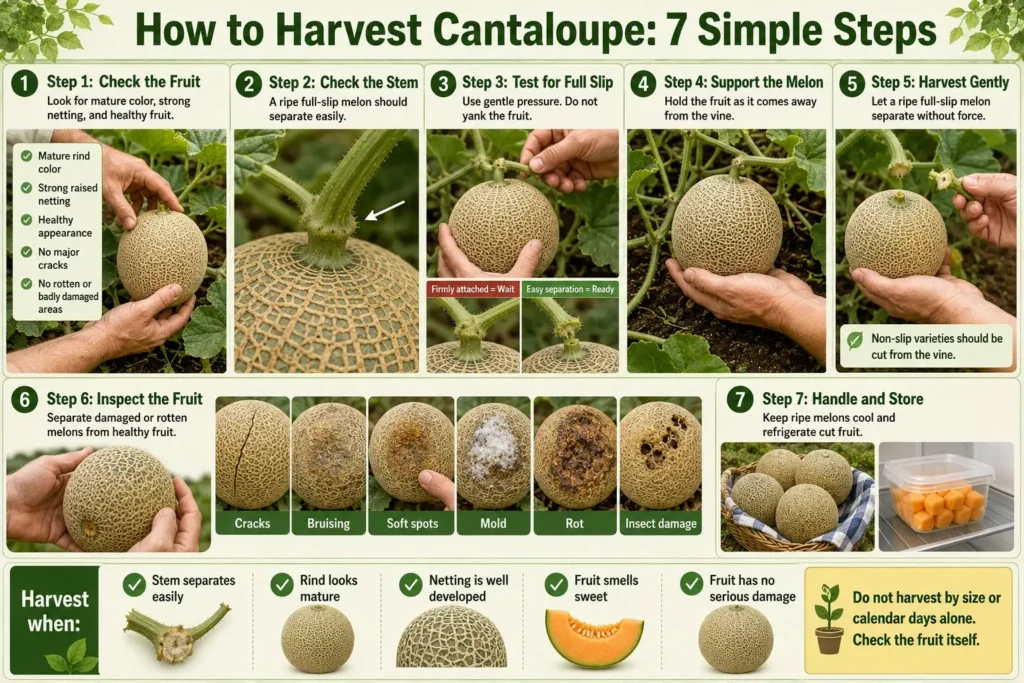
Harvesting cantaloupe at the right time makes a huge difference in flavor.
I don’t like to guess based on size alone. A big melon is not always a ripe melon. Instead, I look at the stem, rind, netting, color, and smell. For most slip-type cantaloupes, the stem gives me the best clue.
The goal is simple: pick the melon when it has reached the right stage of maturity, but before it becomes overripe.
Here’s how I check a cantaloupe before I harvest it.
When Is Cantaloupe Ready to Harvest?
For most common cantaloupe varieties, I look for the fruit to reach the full-slip stage. This means the melon separates easily from the vine with very little pressure.
I don’t yank the fruit from the plant. Instead, I gently test the stem connection. If the melon is mature and the variety is a full-slip type, the stem should separate cleanly.
The rind also gives me useful clues. Mature fruit usually has well-developed netting, and the background color begins changing from green toward a more yellow or tan shade, although the exact color varies by variety.
I use several signs together rather than relying on one.
My quick harvest check
Before picking, I look for:
- A stem that is beginning to separate
- Easy stem slip with gentle pressure
- Well-developed raised netting
- A mature background color
- A sweet melon aroma
- No major soft spots, cracks, or rot
If most of these signs line up, I know I’m close to harvest time.
The Most Reliable Sign: Full Slip

If I had to choose one harvest sign for a typical full-slip cantaloupe, I’d choose stem slip.
Full slip means the stem has formed a natural separation point from the fruit. When the melon is ready, it can come away from the vine with a gentle push or slight tug.
You should not need to pull hard.
A ripe cantaloupe may even separate from the vine on its own. This is why the term “full slip” is so useful for home gardeners.
I would never use force to remove a melon that is still firmly attached. If it refuses to slip, I check the other signs and consider the variety before picking it.
What does full slip look like?
Look closely at the point where the stem joins the melon.
On an unripe fruit, the stem is firmly attached.
As the melon matures, the attachment starts to loosen. At full slip, the stem separates easily and leaves a clean depression or scar at the stem end.
That is the signal I trust most for a standard slip-type cantaloupe.
5 Signs Your Cantaloupe Is Ready to Pick

The stem is my main test, but I don’t ignore the other signs.
1. The stem starts to separate
This is the first thing I check.
If the stem is still firmly attached, I usually give the melon more time.
If it separates with very little effort, the fruit is likely at or close to full maturity.
2. The rind changes color
Look at the background color between the raised netting.
An immature melon often has a stronger green background. As it matures, that color can shift toward yellow, tan, or another lighter mature shade depending on the variety.
Color is helpful, but I don’t use one exact shade as a universal rule because cantaloupe varieties can look different at maturity.
3. The netting becomes well developed
The rough, raised netting becomes more pronounced as the fruit matures.
A mature cantaloupe usually has strong, well-rounded netting over much of the surface.
Again, I treat this as a supporting sign rather than the final test.
4. The melon develops a sweet smell
A ripe cantaloupe often develops a noticeable sweet, musky smell.
I usually check around the stem and blossom ends.
A strong sweet aroma tells me the fruit is getting close to eating maturity. University of Maryland Extension also lists aroma, color, and stem detachment as useful maturity indicators.
5. The fruit feels mature
A ripe cantaloupe should feel firm rather than rock hard.
I don’t squeeze it hard because bruising the fruit can create problems later.
If I notice a very soft spot, especially around a crack or damaged area, I check the fruit closely rather than assuming it is perfectly ripe.
Full Slip vs. Half Slip

This is one of the most useful things to know before harvesting cantaloupe.
| Harvest stage | What happens at the stem | Best use |
| Firmly attached | Stem does not separate | Usually too early |
| Half slip | Stem has started separating | Earlier harvest and longer handling |
| Three-quarter slip | Most of the stem separates | Near mature |
| Full slip | Stem separates easily | Best stage for eating soon |
A half-slip cantaloupe has started separating from the vine but is not fully detached.
A full-slip cantaloupe comes away easily.
For home growing, I prefer full slip when I want the best eating quality and can use the fruit soon. Commercial growers may harvest earlier because the fruit needs to survive handling and transport.
Should I Pick Cantaloupe at Half Slip?
Sometimes, yes.
If I need the melon to last longer before eating, harvesting at an earlier maturity stage can make sense.
But there is a tradeoff.
A melon picked closer to full slip generally has better eating quality than one picked much earlier. Cantaloupes can soften after harvest, but they do not keep increasing their sugar content after they are removed from the vine.
So if I am growing cantaloupes for my own table and plan to eat them soon, I would rather wait for a proper ripe fruit than pick it early just to make storage easier.
What About Non-Slip Cantaloupe Varieties?

This is where a simple “wait until it slips” rule can cause trouble.
Not every cantaloupe variety behaves the same way.
Some types are non-slip varieties, which means the fruit does not naturally separate from the vine at full maturity in the same way as a typical slip melon.
For those varieties, I cannot depend on full slip as my only harvest test.
Instead, I pay more attention to:
- Variety information
- Rind color
- Netting
- Aroma
- Fruit maturity
- Stem condition
Some cantaloupes are also harvested by cutting them from the vine rather than waiting for the stem to detach.
This is one reason I always check the variety before deciding exactly how I will harvest it.
How Long Does Cantaloupe Take to Mature?
There is no single number of days that works for every cantaloupe.
The variety, planting date, temperature, and growing conditions can all affect harvest timing.
As a rough guide, cantaloupes may become ready around 35 to 45 days after pollination, depending on the variety and summer temperatures.
I treat this as a guide rather than a harvest date.
For example, if the seed packet says the variety matures in 80 days, I would not automatically harvest on day 80.
Instead, I use the expected maturity period to start checking the fruit closely.
Once the melons are getting close, I check them regularly.
How to Harvest Cantaloupe

Once I know a melon is ready, harvesting it is simple.
Step 1: Check the fruit
I look over the entire melon for:
- Cracks
- Soft spots
- Rot
- Insect damage
- Sun damage
- Unusual discoloration
If the fruit looks healthy, I move to the stem.
Step 2: Check the stem
I gently test the connection between the melon and the vine.
If it is a full-slip variety and the melon comes away easily, it is ready.
I do not pull hard.
Step 3: Support the melon
I support the fruit with one hand while checking the stem.
This prevents the melon from dropping onto the soil.
Step 4: Let the ripe fruit slip
If the melon is at full slip, gentle pressure should be enough.
A ripe cantaloupe should not require force.
Step 5: Cut non-slip varieties
If the variety is not supposed to slip from the vine, I use a clean, sharp tool to cut the stem.
I leave a small amount of stem attached rather than damaging the fruit.
Step 6: Move it out of direct sun
After picking, I avoid leaving the melon sitting in strong, hot sunlight for a long time.
Harvested melons can suffer quality loss when exposed to excessive heat and sun.
Should I Pull or Cut Cantaloupe From the Vine?
It depends on the variety and its maturity behavior.
For a full-slip variety, I let the melon separate naturally when it is ready.
I don’t pull a firmly attached melon because that can damage the fruit or vine.
For non-slip varieties, cutting is the better approach.
The key point is this:
Don’t force a cantaloupe to slip if its variety is not meant to do that.
Can I Harvest Cantaloupe Before Full Slip?
Yes, but I would only do it for a good reason.
A half-slip or three-quarter-slip melon can be harvested earlier when longer storage or handling is needed.
For the best flavor at home, though, I prefer a properly mature melon.
Cantaloupe develops much of its final sugar content before full ripeness, and removing it too early means I cannot simply leave it on the counter and expect the sweetness to keep increasing.
This is an easy mistake to make.
A melon can become softer after harvest without becoming sweeter.
Does Cantaloupe Ripen After Picking?
This question causes a lot of confusion.
Cantaloupe can continue to soften and develop some changes after harvest, but it does not keep increasing its sugar content once it has been removed from the vine.
That means I don’t use room-temperature storage as a way to turn a very immature melon into a sweet one.
The best flavor comes from harvesting at the proper maturity stage.
So if a melon is still very green, extremely firm, and firmly attached to the vine, I would rather give it more time if conditions allow.
How to Tell If I Picked Cantaloupe Too Early

An underripe cantaloupe may have several clues.
I look for:
- A stem that was very firmly attached
- Little or no sweet aroma
- Hard flesh
- Weak flavor
- A greener background color
- Less developed netting
- A fruit that does not look fully mature
The biggest clue is often the stem.
If I had to force the melon away from the vine, I ask myself whether the variety was actually ready.
A very firm stem connection is usually a reason to wait on a typical full-slip variety.
How to Tell If I Left Cantaloupe on the Vine Too Long
Waiting too long can create a different set of problems.
An overripe cantaloupe may develop:
- Very soft areas
- Cracks
- Fermented or unpleasant smells
- Mushy flesh
- Mold
- Rot
- Fruit damage
This is why I start checking ripe-looking cantaloupes every day.
Once a melon reaches full slip, the window for peak quality can be short. Penn State Extension recommends checking and harvesting cantaloupes daily as they approach full ripeness because they can move from ripe to overripe quickly.
I would rather check a melon one extra time than discover that it has started rotting on the vine.
When Should I Harvest Cantaloupe in the Garden?
I don’t use a fixed calendar date.
Instead, I work from the expected maturity period and then watch the individual fruits.
For each melon, I check:
1. Variety
Know whether it is full-slip or non-slip.
2. Stem
Check whether it is beginning to separate.
3. Rind
Look for the mature background color.
4. Netting
Look for well-developed netting.
5. Aroma
Check for the sweet smell associated with ripeness.
6. Fruit condition
Make sure there are no serious cracks, soft spots, or rot.
This approach works better than saying something like “all cantaloupes should be picked after 80 days.”
Should I Stop Watering Before Harvesting Cantaloupe?
I would not completely stop watering just because harvest is getting close.
The plant still needs reasonable moisture while the fruit finishes developing.
At the same time, I avoid creating large swings between very dry soil and heavy watering.
Too much water close to maturity can contribute to fruit problems such as splitting. Penn State also recommends reducing watering as fruit approaches maturity to improve flavor and help prevent splitting.
So I focus on steady, sensible moisture rather than trying to stress the plant before harvest.
How Often Should I Check Ripe Cantaloupes?
Once the fruit starts showing several maturity signs, I check it every day.
This is especially useful during hot weather.
A melon that looked almost ready yesterday may be ready today.
I pay particular attention to the stem because the transition from firmly attached to full slip can happen quickly.
Daily checks also help me catch cracking, rot, insects, or animal damage before the fruit is ruined.
What Should I Do With Cantaloupe After Harvest?
I handle freshly harvested melons gently.
First, I inspect each one.
I look for:
- Cracks
- Bruising
- Soft spots
- Rot
- Mold
- Insect damage
I separate damaged fruit from healthy fruit.
For whole ripe cantaloupes, refrigeration can help slow quality loss. Cantaloupe has a relatively short shelf life, so I don’t leave ripe fruit sitting around for too long.
Once I cut a melon, I refrigerate the unused pieces promptly in a clean, covered container.
I also wash the outside of the melon before cutting it. The knife passes through the rind, so cleaning the surface first is a simple step I would not skip.
Common Cantaloupe Harvesting Mistakes
Picking by size alone
Size tells me very little about exact maturity.
Different varieties produce different-sized fruit.
Waiting for the melon to fall off completely
A full-slip cantaloupe may separate easily without falling to the ground.
I don’t wait for the fruit to become damaged just because I want to see it detach by itself.
Pulling a firmly attached melon
If I have to yank it, I stop.
I check the variety and other maturity signs instead.
Trusting days to maturity alone
Days to maturity are useful for planning, but they are not a guarantee that every fruit is ready on the same day.
Using smell as the only test
A sweet aroma is helpful, but I combine it with the stem, color, netting, and variety.
Treating every variety the same
This is one of the easiest mistakes to make.
A full-slip cantaloupe and a non-slip variety may need different harvest methods.
Leaving ripe melons unchecked
Once the fruit gets close to full maturity, I check it often.
A ripe cantaloupe can become overripe surprisingly quickly.
My Simple Cantaloupe Harvest Checklist
When I walk through the garden, this is the quick checklist I use:
Is the variety full-slip?
If yes, I can use stem slip as my main test.
Is the stem still firmly attached?
If yes, I usually wait.
Does the stem separate easily?
If yes, the fruit may be ready.
Has the rind reached its mature color?
I use this as a supporting clue.
Is the netting well developed?
Another useful maturity sign.
Does the fruit smell sweet?
A good final clue.
Is the fruit free from serious damage?
If yes, I can harvest it.
Will I eat it soon?
If yes, I prefer harvesting at a more mature stage for better eating quality.
Final Thoughts
For me, harvesting cantaloupe is much easier once I stop trying to find one perfect number of days.
I look at the fruit itself.
The stem is where I start. If I am growing a full-slip variety, I want the fruit to separate easily without force. Then I use the rind color, netting, aroma, and overall condition to confirm what I am seeing.
I also keep the variety in mind because not every cantaloupe behaves the same way.
The biggest lesson is simple: don’t pick by size or calendar alone. Learn how your particular variety signals maturity.
When the fruit is properly ripe, the stem, appearance, aroma, and overall condition begin telling the same story. That is when I know it is time to harvest cantaloupe and enjoy it at its best.
Frequently Asked Questions
How do I know when a cantaloupe is ready to harvest?
For a typical full-slip variety, the best sign is that the stem separates easily from the fruit with very little pressure. I also check the rind color, netting, aroma, and overall condition.
What does full slip mean on a cantaloupe?
Full slip means the stem separates cleanly from the melon when the fruit has reached the proper maturity stage. It is one of the most useful harvest signs for slip-type cantaloupes.
Can you pick cantaloupe before it slips?
Yes. Cantaloupes can be harvested at an earlier stage, such as half slip, when longer storage or handling is needed. For the best home eating quality, I prefer to let a full-slip variety reach proper maturity when possible.
Does cantaloupe get sweeter after picking?
No. Cantaloupe can soften after harvest, but it does not keep increasing its sugar content after it has been picked.
How long does cantaloupe take to mature?
It depends on the variety and growing conditions. A useful guide is around 35 to 45 days after pollination, but I use actual fruit maturity signs rather than relying on a fixed number.
What if my cantaloupe does not slip from the vine?
First, check the variety.
If it is a full-slip variety and the stem is still firmly attached, it may need more time. If it is a non-slip variety, use other maturity signs and follow the expected harvest method for that variety.
Should I cut cantaloupe from the vine?
For a full-slip variety, I prefer to let the fruit separate naturally when it is ripe. For non-slip varieties, cutting the stem is appropriate.
How often should I check cantaloupes before harvest?
I check them daily once they begin showing several signs of maturity. This helps me catch the short window between ripe and overripe fruit.