Skip to content
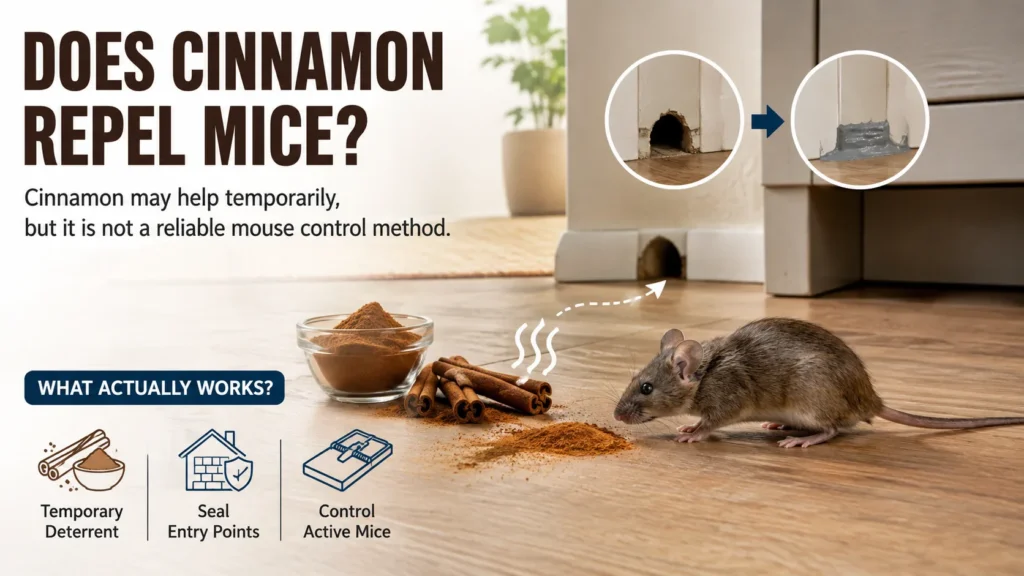
If you are dealing with mice, you may have heard that cinnamon can keep them away. The strong smell makes this idea sound reasonable, but I would not treat cinnamon as a reliable mouse repellent.
Cinnamon may make a small area less appealing to some mice for a short time. However, it does not seal entry points, remove food, or eliminate an active mouse infestation. For lasting mouse control, I would focus on blocking entry points, removing food and shelter, and using suitable traps.
Quick Answer: Does Cinnamon Repel Mice?
Cinnamon may discourage mice from a small area because of its strong scent, but it is not a proven or reliable way to get rid of mice. Ground cinnamon, cinnamon sticks, and cinnamon oil may have different effects. If mice are already inside your home, sealing gaps, removing food sources, and using traps are much more dependable steps.
Does Cinnamon Actually Repel Mice?

Cinnamon has a strong smell, and mice have a keen sense of smell. That is why cinnamon is often listed among natural mouse repellents.
But there is a big difference between a strong smell and a proven mouse-control method.
I would describe cinnamon as a possible temporary deterrent, rather than a true solution. A mouse may avoid a strongly scented spot, but it can simply find another route around it.
Research on cinnamon-related compounds also gives a mixed picture. Some compounds connected to cinnamon have shown repellent effects in mouse studies, but that does not prove that placing cinnamon powder or sticks around a home will keep mice away.
Why Do People Think Cinnamon Repels Mice?
The main reason is the smell.
Cinnamon contains aromatic compounds, including cinnamaldehyde, that create its strong scent. Mice use smell to locate food, identify their surroundings, and respond to possible threats.
So it is reasonable to ask whether a strong cinnamon smell might make an area less attractive.
The problem is that mouse behavior depends on more than smell. If a mouse finds food, water, warmth, or shelter in the same area, it may continue using that space despite an unpleasant scent.
That is why I would not rely on cinnamon alone.
Does Ground Cinnamon Repel Mice?
Ground cinnamon may make a small area less appealing because of its scent, but there is not strong evidence that sprinkling cinnamon around a house will prevent or remove mice.
Its smell also becomes weaker with time.
If you place ground cinnamon near a suspected mouse route, you may notice less activity in that exact spot. But that does not prove the mouse has left the building.
It may simply have changed its route.
Can You Sprinkle Cinnamon Around the House?

You can place a small amount in a specific area you want to test, but I would not cover your floors, cabinets, or rooms with cinnamon.
A better approach is to first find out why mice are entering the space.
Look for gaps around:
- Doors
- Pipes
- Utility cables
- Windows
- Foundations
- Vents
- Garage doors
- Wall openings
House mice can enter through openings around 1/4 inch wide, so even a small gap can matter.
Does Cinnamon Oil Repel Mice?

Cinnamon oil has a much stronger scent than ground cinnamon, so it is often suggested as a stronger mouse deterrent.
However, stronger does not mean proven.
Research on cinnamon-related compounds has found that some can affect mouse feeding behavior. But the results do not support a simple claim that cinnamon oil reliably drives house mice away from homes.
I would therefore avoid claims such as cinnamon oil will definitely repel mice or keep them away for a set number of days.
If you decide to try cinnamon oil as a temporary scent deterrent, use it carefully. Essential oils are highly concentrated and should be kept away from children and pets.
Do Cinnamon Sticks Keep Mice Away?
Cinnamon sticks have a noticeable smell, but the scent is usually less intense than concentrated cinnamon oil.
You can place a few sticks in a small area where you have noticed mouse activity, but I would not expect them to solve a mouse problem.
A cinnamon stick cannot stop a mouse from entering through a wall opening.
It also cannot remove a nest or eliminate a food source.
So I would treat cinnamon sticks as a possible short-term deterrent, not a mouse-control method.
How Long Does Cinnamon Repel Mice?
There is no reliable time period that I would give for cinnamon.
The scent can weaken as the cinnamon dries, becomes exposed to air, or is spread through a larger area. Mouse behavior can also change depending on food, shelter, and access to the building.
Because of this, I would avoid claims that cinnamon will repel mice for 24 hours, 48 hours, or a specific number of days.
If mouse activity continues, the scent is clearly not solving the main problem.
Can Cinnamon Get Rid of a Mouse Infestation?
No.
Even if cinnamon causes a mouse to avoid one location, it does not remove the mouse population.
An active infestation usually means mice have found enough food, shelter, or access to survive inside the building. Effective control focuses on removing those conditions and reducing the number of mice already inside.
This is where many natural mouse-repellent tips fall short.
They focus on making an area smell unpleasant instead of stopping mice from getting inside.
Why Cinnamon May Not Work
There are several reasons cinnamon may fail to keep mice away.
Mice Can Find Another Route
A mouse does not have to cross a cinnamon-treated area.
If it finds another path along a wall, behind an appliance, or through a cabinet, it can continue moving through the building.
Food Can Matter More Than Smell
Mice are attracted to available food.
Open bags, crumbs, pet food, bird seed, garbage, and food stored in weak packaging can give them a reason to stay.
Removing these food sources is more useful than trying to overpower them with a strong scent.
The Scent Fades
Cinnamon does not produce an equally strong smell forever.
As the scent becomes weaker, any possible deterrent effect can also become weaker.
Mice May Adapt
A scent that causes some initial avoidance may become less important over repeated exposure.
This is another reason I would not depend on cinnamon as a long-term barrier.
An Infestation Needs More Than a Repellent
If mice are already nesting inside a building, a scent alone is unlikely to solve the problem.
You need to deal with the entry points, food, shelter, and mice already inside.
How to Use Cinnamon as a Temporary Deterrent

If you still want to test cinnamon, I would use it as a small part of a wider plan.
1. Find Signs of Mouse Activity
Look for:
- Droppings
- Gnaw marks
- Scratching sounds
- Chewed food packaging
- Shredded nesting material
- Greasy marks along walls
- Mouse sightings
Fresh droppings and new gnaw marks can help show where mice are active.
2. Clean the Area Safely
Do not simply sweep or vacuum dry mouse droppings.
Rodent waste can carry harmful germs, so clean contaminated areas with the proper precautions.
3. Test a Small Area
You can place a small amount of ground cinnamon or a cinnamon stick near a suspected route.
Do not assume that a reduction in activity proves the cinnamon worked.
4. Watch for New Signs
Check the area again after some time.
If you continue to find fresh droppings or new damage, the mice are still active.
5. Deal With the Entry Point
This is the step I would prioritize.
If you find a gap, seal it with a material mice cannot easily chew through.
What Actually Works to Keep Mice Away?

If your goal is to keep mice out of the house, I would focus on four main areas.
Seal Mouse Entry Points
Exclusion is one of the most effective ways to prevent house mice from entering a building.
Check for small openings around:
- Pipes
- Wires
- Vents
- Doors
- Windows
- Foundations
- Roof areas
- Garage doors
- Utility openings
Mice can squeeze through very small gaps, including openings around 1/4 inch. Use suitable rodent-resistant materials rather than soft materials that mice can chew through.
Remove Food Sources
Mice do not need a large food supply.
A few crumbs, an open cereal box, pet food, bird seed, or an accessible garbage bin can provide enough food to keep them interested.
I would store food in sealed containers and clean crumbs and spills quickly.
Also keep pet food sealed and avoid leaving food bowls out overnight if mice are active in the area.
Reduce Hiding Places
Mice prefer places where they can hide and build nests.
Cluttered garages, storage areas, basements, cabinets, and piles of cardboard can give them useful shelter.
I would keep storage areas organized and use sealed containers where possible.
Use Traps for Active Mouse Problems
If mice are already inside, traps can be much more effective than scent-based repellents.
Snap traps are commonly used for indoor mouse control. Place them close to walls, behind objects, in dark corners, and near areas where you have found signs of mouse activity.
Keep traps away from children and pets.
What Other Smells Do Mice Hate?
You may also hear claims about:
- Peppermint
- Clove
- Eucalyptus
- Lavender
- Garlic
- Cayenne
- Vinegar
- Cinnamon
Strong scents may affect mouse behavior in certain situations, but I would use the same caution with all of them.
A smell that a mouse dislikes is not the same as a reliable way to remove mice from a home.
I would rather spend time sealing an entry point than trying several different scents around the room.
Is Cinnamon Safe Around Mice, Children, and Pets?
Ground cinnamon used as a household spice is different from concentrated cinnamon essential oil.
If you use cinnamon around the home, keep loose powder away from food preparation areas and places where children or pets can disturb it.
I would be even more careful with cinnamon oil because essential oils are concentrated. Keep them away from pets and children, and do not place concentrated oil where an animal can lick or contact it.
Also, do not assume that a product is safe for pest control simply because its main ingredient is a common kitchen spice.
How to Clean Mouse Droppings Safely
If you find mouse droppings, do not dry sweep or vacuum them.
First wet the contaminated material with an appropriate disinfecting solution and allow it to sit as directed. Then wipe it up and dispose of the waste safely.
Wear suitable gloves and wash your hands after cleaning.
If there is a large amount of droppings, nesting material, or contamination, I would consider getting professional help rather than cleaning a heavily affected space without proper protection.
Cinnamon vs Other Mouse-Control Methods

| Method | Main purpose | How reliable is it? |
| Ground cinnamon | Possible scent deterrent | Limited |
| Cinnamon sticks | Possible scent deterrent | Limited |
| Cinnamon oil | Strong scent deterrent | Not proven as a stand-alone solution |
| Sealing gaps | Prevents entry | Highly useful |
| Removing food | Reduces attraction | Highly useful |
| Removing clutter | Reduces shelter | Useful |
| Snap traps | Reduces active mouse numbers | Effective when placed correctly |
| Professional pest control | Deals with larger or difficult problems | Useful when DIY control fails |
The key difference is that cinnamon tries to change mouse behavior, while exclusion prevents access and traps reduce the mice already inside.
Signs That Cinnamon Is Not Working

Do not judge success only by whether you smell cinnamon.
Look for actual changes in mouse activity.
Signs that mice are still present include:
- Fresh droppings
- New gnaw marks
- Scratching at night
- New nesting material
- Chewed food packages
- Mouse sightings
- New holes or damage
- Continued activity along walls
If these signs continue after using cinnamon, I would stop treating the scent as the main solution.
When Should You Stop Using DIY Repellents?
If you see one mouse once, you may have a small entry problem that can be addressed with inspection and exclusion.
But repeated sightings or fresh signs suggest a larger issue.
I would take the problem more seriously if you notice:
- Mice during the day
- Frequent droppings
- Multiple nesting areas
- Strong mouse odor
- Repeated scratching
- Chewed wires or structural materials
- Mice appearing in several rooms
An established mouse problem usually needs more than a natural scent.
Final Thoughts
So, does cinnamon repel mice?
It may discourage some mice from a small area because of its strong scent, but I would not count on cinnamon to keep mice out of a house or remove an infestation.
Ground cinnamon, cinnamon sticks, and cinnamon oil can all be tested as temporary scent deterrents, but they do not fix the reasons mice are inside. For lasting control, I would seal gaps, remove accessible food and shelter, monitor for signs, and use suitable traps when mice are already active.
Cinnamon can be part of a DIY approach, but it should not be the main plan.
FAQs
Do mice hate cinnamon?
Some mice may avoid its strong scent, but this response is not guaranteed.
Does cinnamon keep mice away from the house?
It may discourage activity in a small area, but it will not reliably keep mice out.
Does ground cinnamon repel mice?
It may have a short-term scent effect, but evidence for reliable mouse control is limited.
Do cinnamon sticks keep mice away?
They may create a strong local scent, but they will not solve an infestation.
How long does cinnamon repel mice?
There is no reliable fixed period.
Can cinnamon get rid of mice?
No. It cannot remove an established mouse population.
What works better than cinnamon for mice?
Sealing entry points, removing food and shelter, and using suitable traps are more dependable.
What smells do mice hate?
Strong scents such as cinnamon, peppermint, and clove are often suggested, but their effect can vary.
Can mice get through small holes?
Yes. House mice can enter through openings around 1/4 inch wide.