Skip to content
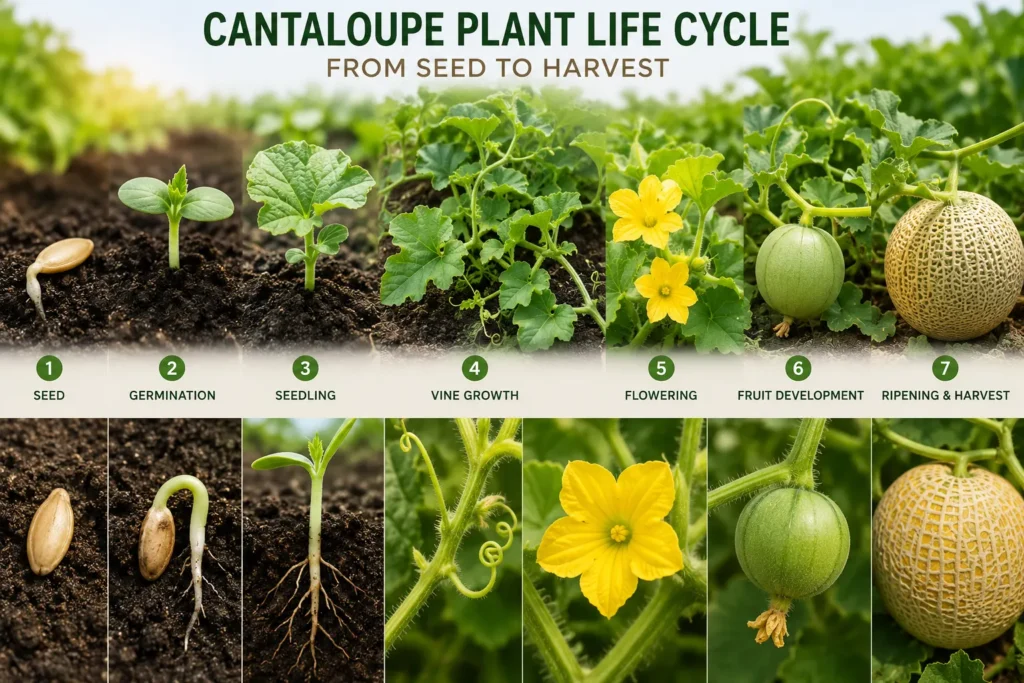
The cantaloupe plant has a clear growth cycle. It starts as a small seed, develops into a seedling, sends out long vines, produces flowers, sets fruit, and finally gives you ripe melons.
I find the easiest way to follow a cantaloupe plant is to watch what changes above the soil. The leaves, vines, flowers, young fruit, and mature melon each give you clues about the stage the plant has reached.
The full cantaloupe plant life cycle does not follow one exact calendar. Variety, temperature, sunlight, water, soil, and other growing conditions can change the timing. In general, many cantaloupes take around 70 to 100 days from planting to harvest, while the fruit itself often needs about 35 to 45 days after flowering to mature.
Here is the complete cantaloupe growth cycle, from seed to harvest.
How Long Does the Cantaloupe Plant Life Cycle Take?
A cantaloupe plant usually goes through seven main stages:
- Seed and germination
- Seedling and first leaves
- Vine and leaf growth
- Flowering
- Pollination and fruit set
- Fruit development and ripening
- Harvest and the end of the growing season
The exact timing can vary.
Warm soil helps seeds germinate. Strong sunlight supports vine growth. Good pollination helps fruit set, while steady growing conditions help the melon mature.
For this reason, I would use the plant’s appearance as a guide instead of relying only on a day-by-day calendar.
Cantaloupe Growth Stages at a Glance

| Growth stage | What you see | What is happening |
| Germination | Small shoot emerges | Seed begins growing |
| Seedling | First true leaves appear | Roots and leaves develop |
| Vine growth | Long stems and large leaves | Plant builds its main structure |
| Flowering | Yellow flowers appear | Reproductive growth begins |
| Fruit set | Tiny melon forms | Pollinated flower starts producing fruit |
| Fruit development | Melon grows and develops netting | Fruit fills out and ripens |
| Harvest | Mature melon separates from vine | Growing cycle reaches its final stage |
The dates in this table are only general guides. I would never expect every cantaloupe plant to follow exactly the same schedule.
Stage 1: Cantaloupe Seed and Germination

The cantaloupe life cycle begins with a seed.
Once the seed gets enough moisture and the soil is warm enough, it starts the germination process. The seed absorbs water, the root begins to grow, and a small shoot pushes upward through the soil.
Temperature has a major effect on melon seed germination. Research from Virginia Tech shows that temperature strongly affects germination, with warm conditions supporting better germination in melon crops. Oregon State University also recommends warm soil for successful melon production.
What Does a Germinating Cantaloupe Seed Look Like?
At first, you may see nothing above the soil.
Below the surface, however, the seed is already changing.
The first root grows downward. Then the young shoot moves upward toward the surface.
Once it breaks through the soil, the seedling begins its next stage.
How Long Does Cantaloupe Take to Germinate?
The exact time depends on soil temperature, moisture, seed quality, and variety.
Warm conditions generally speed up germination, while cold soil can slow it down.
This is why I would pay more attention to soil temperature than simply counting days on the calendar.
Cold, wet soil can leave seeds sitting in the ground for longer than expected.
Stage 2: Cantaloupe Seedling and First Leaves

After germination, the young cantaloupe plant enters the seedling stage.
The first leaves you see are the seed leaves, also called cotyledons. Soon after that, the plant produces its first true leaves.
These leaves look more like the leaves of a mature cantaloupe plant.
At this point, the plant is still small, but a lot is happening below the soil. The root system is developing while the leaves begin capturing sunlight and supporting new growth.
What Does a Young Cantaloupe Plant Look Like?
A young cantaloupe seedling usually has:
- A short green stem
- Two early seed leaves
- Small true leaves
- A developing root system
- Slow growth at first
As more true leaves appear, growth usually becomes more noticeable.
I use the number and size of true leaves as a better visual sign of development than the plant’s height alone.
What Happens During the Seedling Stage?
The plant is building the basic structure it will need later.
Roots spread through the soil.
Leaves become larger.
The stem becomes stronger.
New leaves appear.
Once the plant has enough leaf growth, it can begin producing longer stems and vines.
That takes the plant into the vegetative stage.
Stage 3: Cantaloupe Vine and Leaf Growth

This is the stage when a cantaloupe plant starts to look like a melon plant rather than a small seedling.
The main stems become longer, leaves become larger, and side growth can develop. Tendrils also appear as the plant grows.
Cantaloupes are trailing vines, although some varieties have more compact growth than others.
What Does a Cantaloupe Vine Look Like?
A growing cantaloupe vine has:
- Long green stems
- Large leaves
- Curled tendrils
- New leaves at growing points
- Side shoots on some plants
The vines can spread several feet across the garden when grown along the ground.
This is the main vegetative growth stage.
The plant is still focused heavily on producing leaves, stems, roots, and other structures rather than developing mature fruit.
Why Is Vine Growth Important?
The leaves are essential to the plant’s development.
They capture sunlight and help the plant produce the energy needed for continued growth and fruit production.
I would not worry if a healthy young plant seems to spend a lot of time producing leaves before you see melons. Strong vegetative growth is part of the normal cantaloupe plant life cycle.
The timing of flowering varies with variety and growing conditions, so there is no single day when every cantaloupe plant should begin producing flowers.
Stage 4: Cantaloupe Flowering

Flowering marks a major change in the cantaloupe growth cycle.
The plant begins producing yellow flowers as it moves into reproductive growth.
At first, you may see many flowers without any visible melons. That does not automatically mean something is wrong.
Cantaloupe plants produce flowers that play different roles in reproduction. Early flowers are often male, while female flowers have a small swelling at the base that can develop into fruit.
How Can You Tell Male and Female Cantaloupe Flowers Apart?
The easiest way is to look behind the flower.
A male flower usually has a thin stem behind it.
A female flower has a small swollen structure behind the flower. This is the ovary, which can develop into a melon after successful pollination.
The flowers can look similar from above, so checking the area directly behind the flower makes identification easier.
Why Does My Cantaloupe Plant Have Flowers but No Melons?
Flowering does not automatically mean fruit will develop.
The female flower needs successful pollination.
If pollination does not occur, the small ovary may stop developing.
Pollinator activity, weather, plant stress, and other conditions can affect fruit set. Poor bee pollination, high temperatures, and water stress among factors that can contribute to poor fruit set.
So if I saw several flowers but no small melons, I would first check whether the flowers are male or female and then look at pollination conditions.
Stage 5: Pollination and Fruit Set

Pollination is the bridge between flowering and fruit development.
This stage is easy to overlook, but it is one of the most important parts of the cantaloupe plant life cycle.
Bees and other pollinating insects can carry pollen from flowers to the female flowers. Once a female flower receives suitable pollen, the small ovary at its base can begin developing into a melon.
What Does a Cantaloupe Plant Look Like After Successful Pollination?
Look at the base of a female flower.
You may see a tiny green melon-shaped swelling.
If that small fruit continues getting larger over the next several days, the flower has likely moved into fruit development.
If it stops growing, turns yellow, or falls away, fruit set may not have been successful.
How Long Does the Pollination Stage Last?
The pollination window is short.
University of Minnesota notes that cantaloupe flowers have a short period in which successful pollination can occur.
This is one reason healthy pollinator activity matters during flowering.
I would avoid thinking of pollination as a long stage. It is more like a short transition between flowering and fruit development.
Stage 6: Cantaloupe Fruit Development and Ripening

Once fruit set is successful, the tiny melon begins to grow.
This is when the plant’s growth becomes easy to see.
A small green fruit slowly becomes a full-sized cantaloupe.
The fruit passes through several visible changes:
Tiny fruit → rapid growth → mature size → netting develops → color changes → ripening
The fruit development stage is one of the longest and most noticeable parts of the cantaloupe growth cycle.
How Fast Does a Cantaloupe Grow After Flowering?
Many cantaloupe varieties need around 35 to 45 days from flowering to maturity, although the exact period changes with variety and growing conditions.
Other extension guidance gives a slightly wider range, which shows why a fixed number of days should not be treated as a rule.
I prefer to use both time and visual signs.
If the calendar says the fruit should be close to maturity but the melon still looks green and immature, I would give the plant more time.
What Does a Developing Cantaloupe Look Like?
Early in fruit development, the melon is small and green.
As it grows, the fruit becomes larger and begins developing the characteristic netted surface found on many cantaloupe varieties.
The fruit eventually reaches its mature size.
Near the end of the cycle, the background color changes and other maturity signs become easier to see.
When Does Cantaloupe Start Developing Netting?
The netted surface becomes more obvious as the fruit develops.
The amount and appearance of netting vary by variety, so I would not use netting alone to decide whether a melon is ready.
Instead, look at several signs together.
Stage 7: Cantaloupe Ripening, Harvest, and the End of the Cycle

The final stage is ripening.
At this point, the melon has reached most of its size and begins showing signs that it is ready to harvest.
Common maturity signs include:
- Coarse, well-developed netting
- A change in background color
- A stronger mature appearance
- A drying tendril near the fruit on some plants
- The stem beginning to separate from the melon
- The fruit becoming easier to remove from the vine
USU and University of Minnesota both recommend looking at changes in color, netting, and stem separation when deciding when to harvest.
What Is Full Slip?
Full slip is a common term used for cantaloupe maturity.
It means the fruit separates easily from the vine when it reaches the proper maturity stage.
I would not pull hard on the melon. If it is mature and ready for full slip, it should come away with little effort.
Not every variety behaves in exactly the same way, so the expected maturity signs for the variety still matter.
What Happens to the Plant After Harvest?
Cantaloupe is an annual crop.
That means the individual plant completes its life cycle during one growing season rather than growing back year after year like a perennial.
The basic cycle is:
Seed → seedling → vine → flowers → pollination → fruit → ripe melon → seeds → end of plant
If mature seeds are saved, they can start the next generation of plants.
Cantaloupe Plant Life Cycle Timeline
The following timeline gives a simple way to picture the complete growth cycle.
| Stage | Approximate period | Main changes |
| Seed and germination | Early days | Seed absorbs water and sprouts |
| Seedling | Early growth | Cotyledons and true leaves develop |
| Vine growth | Following weeks | Stems, leaves, roots, and tendrils expand |
| Flowering | Later growth | Male and female flowers appear |
| Pollination and fruit set | Short transition | Pollinated flowers begin forming fruit |
| Fruit development | About 35–45 days after flowering for many varieties | Melon enlarges and ripens |
| Harvest | End of cycle | Mature fruit separates from the vine |
These periods are approximate.
I would use them to understand the order of events rather than to predict the exact harvest date.
What Can Slow Down the Cantaloupe Growth Cycle?
A cantaloupe plant may move through its stages more slowly when growing conditions are poor.
Common factors include:
Cold Soil
Cantaloupe is a warm-season crop. Cold soil can slow seed germination and early growth.
Cool Weather
Warm conditions support melon growth. Extended cool weather can delay development.
Poor Sunlight
Cantaloupes need plenty of direct sunlight. Too much shade can limit plant growth and fruit development.
Water Stress
Too little water can stress the plant, while uneven moisture can also create problems during fruit development.
Poor Nutrition
Cantaloupe plants need adequate nutrients for healthy growth. Poor soil fertility can reduce plant growth.
Pest Damage
Insects can damage leaves, stems, flowers, and developing fruit. Heavy damage can slow the plant’s progress through the growth cycle.
Disease
Diseases can affect roots, leaves, stems, flowers, and fruit. A diseased plant may stop growing normally or show symptoms such as wilting, leaf spots, or poor fruit development.
Poor Pollination
A plant can produce plenty of flowers but very few melons if female flowers do not receive enough pollen.
For me, the useful point is this: a delayed cantaloupe plant does not always have one single problem. I would look at temperature, sunlight, water, plant health, and pollination before deciding what has gone wrong.
How Can You Tell Which Cantaloupe Growth Stage Your Plant Is In?
If you are not sure where your plant is in its life cycle, look at the plant itself.
No plant above the soil
The seed is still germinating.
Small plant with first leaves
It is in the seedling stage.
Long vines and large leaves
The plant is in the vegetative growth stage.
Yellow flowers
The plant has reached flowering.
Tiny melon behind a flower
The plant has reached fruit set and early fruit development.
Large melon with developing netting
The fruit is in the development stage.
Mature color and easy stem separation
The fruit is approaching or has reached harvest maturity.
This simple visual check is often more useful than trying to count the exact number of days since planting.
Cantaloupe Seed to Harvest: The Complete Cycle
The cantaloupe plant life cycle follows a simple pattern, even though the timing can change.
First, the seed absorbs water and germinates.
Next, the seedling develops roots and true leaves.
The plant then enters a period of strong vegetative growth. Vines become longer, leaves become larger, and tendrils appear.
After that, the plant begins flowering. Male and female flowers play their parts in reproduction.
Pollinators move pollen to female flowers. When pollination succeeds, a tiny fruit begins growing at the base of the flower.
The melon then enlarges and develops its mature appearance. Netting becomes more noticeable, the background color changes, and the fruit eventually reaches harvest maturity.
Finally, the ripe melon is harvested and the annual plant reaches the end of its growing season.
That is the complete cantaloupe growth cycle:
Seed → germination → seedling → vine growth → flowering → pollination → fruit set → fruit development → ripening → harvest
Final Thoughts
The cantaloupe plant life cycle is easier to follow when you watch the plant instead of relying on a fixed calendar.
I would think of it as seven connected stages: germination, seedling growth, vine growth, flowering, pollination and fruit set, fruit development, and harvest.
Each stage gives you visible clues. A new shoot tells you the seed has germinated. Long vines show strong vegetative growth. Yellow flowers mark the reproductive stage. A tiny melon behind a female flower shows successful fruit development has started. Mature netting, color changes, and stem separation tell you the final stage is near.
The exact timing will vary, but the order stays much the same.
Once you know these stages, it becomes much easier to look at a cantaloupe plant and tell where it is in its growth cycle.
Cantaloupe Plant Life Cycle FAQs
How long does the complete cantaloupe life cycle take?
Many cantaloupes take roughly 70 to 100 days from planting to harvest, but the timing depends on variety and growing conditions. The period from flowering to mature fruit is often around 35 to 45 days.
How long does a cantaloupe seed take to germinate?
Warm, moist soil helps cantaloupe seeds germinate. The exact time varies with soil temperature, moisture, seed quality, and variety.
What happens after a cantaloupe seed germinates?
The seed develops into a small seedling. It first produces its early seed leaves and then true leaves. The root system also continues developing.
When does a cantaloupe plant start flowering?
Flowering begins after the plant has developed enough vegetative growth, but there is no single flowering day for every plant. Variety, temperature, sunlight, and general plant health all affect timing.
How long after flowering does a cantaloupe ripen?
Many cantaloupes need about 35 to 45 days after flowering to reach maturity, although some varieties and growing conditions can extend that period.
Why does my cantaloupe plant have flowers but no fruit?
The flowers may be male, or female flowers may not have received enough pollen. Heat, water stress, and low pollinator activity can also affect fruit set.
Does a cantaloupe plant grow back every year?
No. Cantaloupe is an annual plant, so it normally completes its growth cycle during one growing season.
How do I know when the cantaloupe plant has reached the final stage?
Look at the fruit. Mature netting, a change in background color, and easy separation from the vine are useful signs of harvest maturity.