Skip to content
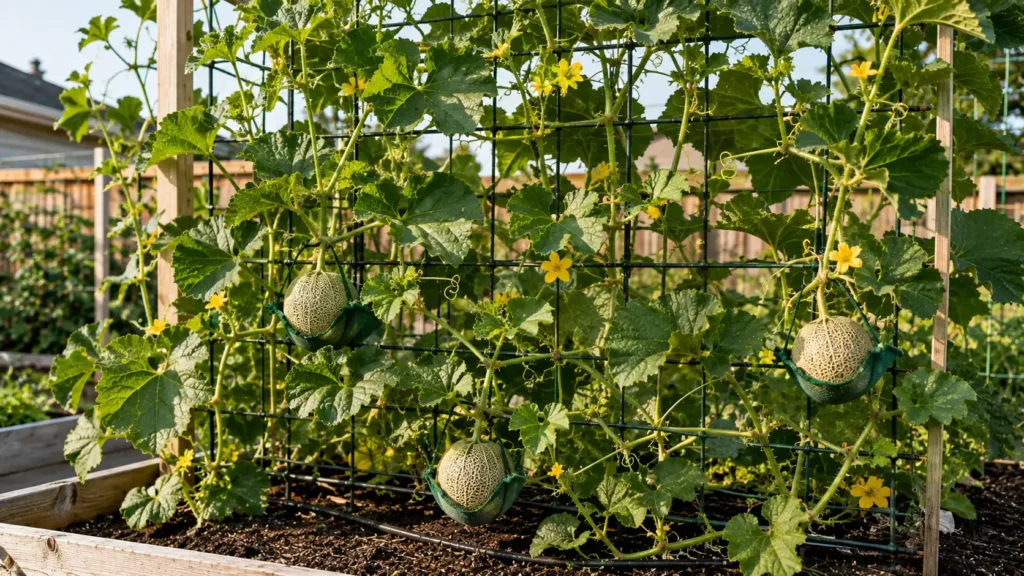
Cantaloupe vines can spread much farther than many gardeners expect. When I first plan a cantaloupe bed, I always think about where the vines will go, not just where I will plant the seedling.
A healthy cantaloupe plant produces long runners that can quickly move across a garden bed. If I have plenty of room, I let the vines trail along the ground. If space is limited, I prefer to guide them onto a strong support.
The main thing I have learned is that cantaloupe vines are easier to manage when I guide them early instead of trying to control a large, tangled plant later.
In this guide, I’ll explain how cantaloupe vines grow, how much space they can take, how I train them, when I prune them, and how I support the fruit.
How Does a Cantaloupe Vine Grow?
Cantaloupe is a warm-season annual plant in the Cucumis melo group. It grows as a spreading vine rather than a compact bush.
The main vine develops as the plant grows. From it, you can see additional lateral growth and long runners spreading into nearby space.
A healthy cantaloupe vine can produce:
- Large leaves
- Long runners
- Lateral vines
- Tendrils
- Male flowers
- Female flowers
- Developing fruit
When there is nothing to support the plant, the vines naturally move across the ground.
I don’t try to stop this natural habit. Instead, I decide where I want the growth to go and guide it in that direction.
That simple approach makes vine management much easier.
What Are the Main Parts of a Cantaloupe Vine?

Before training a cantaloupe plant, it helps to know what you are looking at.
Main vine
The main vine is the primary stem that grows from the young plant.
It forms much of the plant’s basic structure and produces leaves, flowers, and additional vine growth.
When I train a plant vertically, I pay close attention to the main vine because it forms the main path I want the plant to follow.
Lateral vines
Lateral vines grow from the main vine and can move sideways.
These are often responsible for making a cantaloupe plant look much larger than expected.
If space is limited, I guide these vines as they develop instead of allowing them to grow in every direction.
Runners
The long stems that spread across the garden are commonly called runners.
These runners are a normal part of cantaloupe growth.
If I leave a plant alone, the runners can quickly move across open soil and into nearby garden areas.
Tendrils
Cantaloupe plants also produce small tendrils.
These can help the plant grip nearby structures, but I would not rely on tendrils alone to hold a mature melon.
If I grow cantaloupe vertically, I make sure the trellis and fruit support are doing most of the work.
Flowers and fruit
Cantaloupe plants produce male and female flowers.
The female flowers are the ones that can develop into melons after successful pollination.
So the vine is more than just a long stem. It carries the leaves, flowers, and developing fruit that the plant needs throughout the season.
How Big Does a Cantaloupe Vine Get?
Cantaloupe vine size can vary quite a bit.
The variety, growing conditions, available space, temperature, sunlight, and overall plant health can all affect how far the vines spread.
Some plants remain fairly manageable, while others can cover a surprisingly large part of a garden bed.
For that reason, I don’t plan a cantaloupe bed based on the size of the young plant.
A small seedling can eventually produce several long runners.
If I am growing several plants, I leave enough room for that growth or prepare a trellis before the vines start spreading.
The main thing to remember is simple:
A cantaloupe is a spreading vine, not a compact bush.
Give it open ground and it will usually use it.
When Does a Cantaloupe Plant Start Producing Vines?
A young cantaloupe plant starts as a small seedling, but vine growth becomes much more noticeable once it has developed several true leaves.
The general pattern is:
Seedling → true leaves → main vine → lateral growth and runners → flowers → fruit
I don’t worry if a young plant seems slow to produce long vines at first.
Once the plant becomes established and growing conditions are suitable, the vine can begin extending much faster.
The exact timing can vary with the variety and growing conditions.
If you want the full progression from seed to mature plant, I would keep that information in your separate cantaloupe plant life cycle article rather than repeating it here.
Should Cantaloupe Vines Grow on the Ground?

Yes. Growing cantaloupe vines along the ground is perfectly reasonable.
This is the simplest method if you have enough garden space.
When I have an open garden area, I often prefer letting the vines trail naturally because there is less setup involved.
Benefits of growing vines on the ground
- No trellis is required.
- The plant can follow its natural growth habit.
- There is no need to build a support system.
- The vines can spread freely.
- Setup is simple.
Drawbacks
- Vines can take up a lot of garden space.
- Runners may reach pathways.
- Vines can become tangled.
- Fruit can rest directly on the soil.
- A dense canopy can make the plant harder to inspect.
- Harvesting can be less convenient.
If I have a large garden, ground-growing is often the easiest choice.
If I am working with a small raised bed, I would seriously consider vertical training.
Can Cantaloupe Vines Grow on a Trellis?

Yes, you can train cantaloupe vines onto a trellis.
I like this method when garden space is limited because it gives the vines a clear direction instead of allowing them to spread across the soil.
But there is one thing I always keep in mind:
Supporting the vine is different from supporting the fruit.
A trellis can hold the vine, but a growing melon becomes heavy. The fruit may need its own sling, net, or cradle.
Why grow cantaloupe vertically?
Vertical growing can help me make better use of a small garden.
Instead of allowing runners to spread several feet across the ground, I can guide them upward.
This can:
- Reduce the ground space used by the plant
- Keep pathways clear
- Make the vines easier to inspect
- Make developing fruit easier to see
- Help organize a crowded garden
I don’t think vertical growing is necessary for everyone.
If I have plenty of open ground, letting the vines spread can be easier.
What Is the Best Trellis for Cantaloupe?
I look for three things when choosing a trellis for cantaloupe:
Strength, stability, and enough room for the vines.
Some useful choices include:
| Trellis type | Best use |
| Cattle panel | Large plants and strong support |
| A-frame trellis | Raised beds and home gardens |
| Strong garden fence | Using an existing structure |
| Heavy wire mesh | Smaller vertical setups |
| Garden arch | Larger garden spaces |
I would avoid flimsy supports that can bend once the plant becomes large.
I also prefer installing the trellis early.
It is much easier to train a young vine onto a support than to untangle a mature vine that has already spread across the garden.
How to Train a Cantaloupe Vine

Training a cantaloupe vine is mostly about guiding it.
I don’t try to force the stem into a sharp turn. I work with the direction the vine is already growing.
Step 1: Install the trellis early
I like to have the trellis ready before the vines become long.
This gives the plant somewhere to go as it starts producing runners.
Step 2: Guide the young vine toward the support
When the vine reaches a useful length, I gently direct it toward the trellis.
Young growth is easier to guide, so I avoid waiting until the stem becomes stiff and difficult to move.
Step 3: Use soft plant ties if needed
If the vine will not stay where I want it, I use a soft plant tie.
I don’t pull the stem tightly against the support.
The tie is there to guide the vine, not squeeze it.
Step 4: Keep redirecting new growth
Training is not something I do once and forget.
Cantaloupe vines keep growing, so I check them regularly.
If a runner starts moving toward a walkway or another plant, I gently redirect it.
Step 5: Add fruit support
Once the melons start getting larger, I add support underneath them.
A fabric sling or suitable mesh can help carry the weight.
This is especially useful when the plant is growing vertically.
How to Tie Cantaloupe Vines Without Damaging Them
A growing vine needs room.
I prefer soft and flexible materials such as:
- Soft garden tape
- Flexible plant ties
- Soft cloth strips
- Garden clips made for plant support
I avoid anything that can cut into the stem.
I also leave some room around the vine instead of tying it tightly.
One thing I recommend checking often is the tie itself.
A tie that looks loose today may become tight as the stem grows.
Do You Need to Prune Cantaloupe Vines?
No, I don’t think a gardener should automatically prune a cantaloupe vine just because it has become long.
Long vines are normal.
Cantaloupe naturally produces runners and lateral growth, so I first ask whether the growth is actually causing a problem.
If the plant is healthy and has enough space, I may simply let it grow.
I focus more on training and redirecting than heavy pruning.
Training and pruning are different
This is an important distinction.
Training means guiding the vine where you want it to grow.
Pruning means removing part of the plant.
For most home gardens, I would start with training.
If a vine is healthy but simply long, I don’t see length alone as a good reason to cut it.
How to Prune Cantaloupe Vines

When pruning is actually needed, I keep it limited.
I may remove:
- Damaged vines
- Diseased growth
- Dead plant material
- Severely tangled growth
- Unwanted lateral growth that is creating a genuine space problem
I avoid removing large amounts of healthy foliage without a clear reason.
The leaves are important to the plant, so I don’t want to strip the vine simply to make it look tidier.
Should you cut the main cantaloupe vine?
I would not cut the main vine just because it has become long.
If the problem is lack of space, I first try redirecting the vine.
If I am growing vertically, I guide the main vine along the support instead of cutting it back just to control its length.
How to Manage Cantaloupe Vines in a Small Garden
Small gardens need more planning because cantaloupe vines can quickly move into other growing areas.
I prefer deciding the direction of growth before the plant becomes large.
Option 1: Use an A-frame trellis
An A-frame gives the vines a clear vertical structure.
This can work well in raised beds where ground space is limited.
Option 2: Train vines along a fence
If I already have a strong garden fence, I can use it as a support.
I guide the young vine toward the fence and use soft ties where necessary.
Option 3: Use a cattle panel
A cattle panel gives vigorous vines plenty of support.
It can be useful when I want to train several vines vertically.
Option 4: Redirect runners
If a runner starts moving into a path, I gently redirect it while it is still young.
I find this much easier than waiting until several vines have become tangled.
How to Support Cantaloupes Growing on a Trellis

This is one area I would never overlook when growing cantaloupe vertically.
The vine may be strong enough to climb, but the fruit becomes heavier as it develops.
That weight can pull on the vine.
Use a melon sling
A melon sling works like a small hammock under the fruit.
I can use:
- Strong fabric
- Mesh bags
- Commercial melon slings
- Soft netting
The support needs to hold the fruit without cutting into it.
Support the fruit before it gets too heavy
I prefer adding the sling while the melon is still manageable.
Waiting until a large melon is hanging from the vine makes the job harder.
Check the support as the fruit grows
I would check the sling and trellis regularly.
Look for:
- Loose ties
- Stretched material
- Pressure on the fruit
- Rubbing against the trellis
- Stress on the vine
The goal is to keep the fruit supported throughout its growth.
How to Keep Cantaloupe Vines From Spreading
I don’t try to stop cantaloupe from producing runners.
Instead, I control where those runners go.
My preferred methods are:
- Choose the growing direction early.
- Redirect young runners.
- Train vines vertically when space is tight.
- Remove only growth that is genuinely causing a problem.
If I have enough garden space, I let the vines spread.
If I don’t, I use a trellis.
That is much easier than constantly cutting the plant back.
Why Are My Cantaloupe Vines So Long?
Long vines are usually part of normal cantaloupe growth.
A healthy plant is supposed to produce spreading stems.
So I would not immediately assume that something is wrong just because the vines are long.
I look at the entire plant.
Are the leaves healthy?
Is the plant growing actively?
Are flowers appearing?
Is fruit developing?
If everything else looks healthy, long vines may simply mean the plant is doing what it naturally does.
Why Are My Cantaloupe Vines Growing but Not Producing Fruit?
A plant can produce plenty of vine growth before it produces useful fruit.
Several things can affect fruit production, including:
- Flowering stage
- Pollination
- Growing stress
- Excessive vegetative growth
- Pests
- Disease
- Nutrient imbalance
If I see many vines and flowers but little fruit, I don’t immediately start cutting the plant.
I first look at the flowers and overall plant condition.
If the issue appears related to nutrition, I would refer to the separate fertilizing cantaloupe guide rather than treating pruning as the answer to every fruiting problem.
Why Is My Cantaloupe Vine Wilting?
A wilted cantaloupe vine can have several possible causes.
I would check:
- Soil moisture
- Roots
- Stem condition
- Leaves
- Insect damage
- Recent weather
- Signs of disease
I don’t assume that every wilted vine simply needs more water.
Overwatering, root problems, pests, and disease can also cause problems.
For detailed irrigation advice, I would keep that information in the separate watering cantaloupe article.
What Should I Do if a Cantaloupe Vine Breaks?
If a vine breaks, I first check how much of the stem is still connected.
A slightly bent or damaged stem may need gentle support and less handling.
A completely severed vine is a different situation.
I would avoid repeatedly moving the plant around while trying to repair it.
This is also why I prefer gentle training.
When I guide a young vine gradually, there is less reason to force a stiff stem into a position it does not want to take.
Cantaloupe Vine Problems at a Glance
| Problem | What it may mean | What I would check |
| Very long vines | Normal spreading growth | Overall plant health |
| Vines crossing paths | Growth needs redirecting | Vine direction |
| Tangled vines | Too many runners or poor training | Plant layout |
| Broken vine | Wind, handling, or fruit weight | Support |
| Lots of leaves, few fruits | Pollination or growing conditions | Flowers and plant health |
| Wilting vine | Water, roots, pests, disease, or heat | Whole plant |
| Fruit pulling on vine | Fruit needs support | Sling or cradle |
| Vine stays small | Growing conditions or plant health issue | Soil, temperature, roots, pests |
I would never diagnose a plant from one symptom alone.
Looking at the whole plant usually gives a better answer.
Cantaloupe Vine vs. Cantaloupe Plant
These terms are closely related, but they refer to different parts of the plant.
A cantaloupe plant includes the whole plant:
- Roots
- Stems
- Leaves
- Flowers
- Vines
- Fruit
A cantaloupe vine usually refers to the long stems and runners that spread from the plant.
So when someone asks how long a cantaloupe vine gets, they are mainly asking about the spreading stems and runners.
Ground-Grown vs. Trellised Cantaloupe Vines
Both methods can work well.
| Feature | Ground growing | Trellis growing |
| Ground space | More needed | Less needed |
| Setup | Simple | Requires support |
| Training | Minimal | Regular guidance |
| Fruit support | Usually less of a concern | Often needed |
| Harvest visibility | Can be harder | Often easier |
| Best for | Larger gardens | Small gardens |
| Main challenge | Spreading vines | Strong support |
I would choose based on the space available.
If I have plenty of open ground, I don’t see a reason to build a complicated support system.
If I am working in a small raised bed, vertical growing can make the available space much easier to use.
Final Thoughts
I don’t see long cantaloupe vines as a problem by themselves.
This plant naturally wants to spread, and trying to make it behave like a compact bush usually creates more work.
What I recommend instead is planning the growth direction early.
If I have plenty of garden space, I let the vines trail along the ground. If space is limited, I give them a strong trellis and guide the young vines as they grow.
I also avoid heavy pruning unless there is a clear reason for it. A healthy long vine is still a productive part of the plant, so I would rather redirect it than cut it unnecessarily.
For vertical growing, I pay special attention to the fruit. The vine may climb without much trouble, but a developing melon can become heavy. A simple sling or fruit cradle can help keep that weight from pulling on the vine.
The approach I recommend is simple:
Give the cantaloupe vine a clear direction, guide it while the growth is young, support the fruit when needed, and prune only when there is a real reason.
That keeps the plant easier to manage while still allowing it to grow in its natural way.
Frequently Asked Questions About Cantaloupe Vines
How long do cantaloupe vines get?
Cantaloupe vines can spread several feet, but their final size depends on the variety and growing conditions. Some plants can cover a large part of a garden when allowed to grow freely.
Do cantaloupes climb?
Cantaloupe vines can be trained onto a suitable support. If I want them to grow vertically, I guide the young vines toward the trellis and secure them gently when needed.
Do cantaloupes need a trellis?
No. A trellis is optional. I use one mainly when I want to save ground space or keep the vines contained.
Can I grow cantaloupe vertically?
Yes. I can train cantaloupe vines onto a strong trellis. I also support the developing fruit so its weight does not pull heavily on the vine.
Should I prune cantaloupe vines?
I don’t recommend heavy pruning simply because the vines are long. I focus on training and redirecting healthy vines and only remove growth when there is a good reason.
How do I keep cantaloupe vines from spreading?
I guide young runners, redirect unwanted growth, and use a trellis when space is limited. I find this much better than repeatedly cutting healthy vines.
How do I support cantaloupe fruit on a trellis?
I use a strong sling, mesh bag, or fruit cradle beneath the developing melon. The support should be secure but should not squeeze the fruit.
Why are my cantaloupe vines growing but not producing fruit?
There can be several reasons, including flowering stage, pollination, growing stress, excessive vegetative growth, pests, disease, or nutrient problems. I would inspect the flowers and overall plant before pruning the vines.
Why is my cantaloupe vine wilting?
Wilting can result from water stress, root problems, pests, disease, heat, or stem damage. I would check the soil and entire plant before deciding what treatment it needs.
Can I move a cantaloupe vine after it starts spreading?
I try not to move a mature vine unless necessary. Young vines are much easier to redirect because they are more flexible.