Skip to content
Cantaloupe plants grow quickly and need enough nutrients to produce healthy vines, flowers, and fruit. But more fertilizer does not always mean more melons.
Too much nitrogen can make a cantaloupe plant produce lots of leaves and vines while delaying fruit production. The best approach is to first look at the soil, then give the plant the nutrients it actually needs.
I prefer to start with a soil test rather than choosing a fertilizer by habit. A test can show whether your soil has enough nitrogen, phosphorus, potassium, and other nutrients. This makes it easier to choose the right fertilizer and avoid adding nutrients the plant does not need.
In this guide, I’ll explain what fertilizer cantaloupes need, when to apply it, how to side-dress plants, and how to avoid common fertilizer problems.
Do Cantaloupes Need Fertilizer?
Yes, cantaloupes can benefit from fertilizer when the soil does not provide enough nutrients.
These plants produce long vines and large leaves before developing their fruit. They also need enough nutrition to support flowering and fruit development during the growing season.
However, I would not automatically fertilize a cantaloupe plant every week.
Garden soil can already contain nutrients from compost, manure, previous fertilizer applications, or natural soil fertility. Adding more fertilizer without knowing what is already available can create an imbalance.
A better approach is:
Test the soil, check the plant, and fertilize based on its actual needs.
If your soil is already fertile, you may need much less fertilizer than you expect.
Test Your Soil Before Fertilizing Cantaloupe

A soil test is one of the best ways to decide what fertilizer your cantaloupe needs.
A basic soil test can provide information about:
- Soil pH
- Nitrogen availability
- Phosphorus
- Potassium
- Organic matter
- Soil condition
- Recommended nutrient applications
University programs commonly recommend soil testing because it gives you a better picture of nutrient availability than simply looking at the plant.
Cantaloupes generally grow well in slightly acidic soil. A soil pH around 6.0 to 6.5 is suitable for good nutrient availability and plant growth.
If your soil test shows a pH problem, correct that issue based on the test recommendation instead of trying to solve it with extra fertilizer.
Why soil testing matters
Suppose your soil already contains plenty of phosphorus and potassium but has low nitrogen.
A fertilizer containing large amounts of all three nutrients may add more phosphorus and potassium than your garden needs.
Another garden may have a completely different nutrient profile.
That is why I would not recommend one fertilizer ratio for every cantaloupe grower.
What Do the N-P-K Numbers Mean?

Most fertilizer packages show three numbers, such as 10-10-10 or 5-10-10.
These numbers represent the fertilizer’s N-P-K analysis:
- N = nitrogen
- P = phosphorus
- K = potassium
These are three major nutrients plants need in fairly large amounts.
Each one has a different role in plant growth.
Nitrogen
Nitrogen helps cantaloupe plants produce leaves and vines.
A healthy supply supports strong vegetative growth, especially early in the season.
But too much nitrogen can become a problem.
Excess nitrogen can encourage large amounts of leafy growth and delay fruit production. This is one reason I would avoid repeatedly applying a high-nitrogen fertilizer without checking the soil first.
Phosphorus
Phosphorus supports root development and several processes involved in plant growth and reproduction.
Cantaloupes need phosphorus, but adding extra phosphorus does not automatically mean more melons.
If your soil already contains enough phosphorus, additional applications may provide little benefit.
Potassium
Potassium supports many plant processes and helps plants maintain normal growth.
It is also involved in water regulation and other functions that help plants cope with environmental stress.
Again, I would add potassium based on the needs shown by a soil test rather than assuming more is better.
What Is the Best Fertilizer for Cantaloupe?
There is no single fertilizer that is best for every cantaloupe garden.
The right fertilizer depends on:
- Soil-test results
- Soil fertility
- Existing organic matter
- Previous fertilizer applications
- Plant growth
- Fertilizer N-P-K ratio
- Whether you prefer organic or synthetic fertilizer
If your soil needs nitrogen, phosphorus, and potassium, a complete fertilizer may be useful.
If the soil already contains enough phosphorus and potassium but lacks nitrogen, a nitrogen fertilizer may make more sense.
This is why I would not choose fertilizer based only on a product being marketed for vegetables or melons.
Look at the nutrient analysis and compare it with what your soil actually needs.
Is 10-10-10 Fertilizer Good for Cantaloupe?
10-10-10 can work for cantaloupe when the soil needs all three major nutrients.
The three numbers mean the product contains equal percentages of nitrogen, phosphorus, and potassium by weight.
That can make it useful for some gardens.
But 10-10-10 is not automatically the best fertilizer for every cantaloupe plant.
If your soil already has enough phosphorus and potassium, repeatedly using 10-10-10 may add nutrients that are not needed.
I would use it only when the nutrient balance makes sense for your soil.
When Should You Fertilize Cantaloupe?

Fertilizer timing should follow the plant’s growth and the condition of the soil.
I think of cantaloupe feeding in a few stages rather than following a rigid weekly schedule.
Before planting
Start by preparing the soil before planting your seeds or transplants.
If your soil test recommends fertilizer, apply it according to the test and product instructions.
Some fertilizer can be incorporated into the planting area before the cantaloupe goes into the ground. Utah State University recommends working required fertilizer into the upper soil before planting.
Compost can also be added if the soil needs more organic matter.
When seedlings are established
Young cantaloupe seedlings do not need a heavy fertilizer application.
At this stage, the plant is still building its root system.
If additional nitrogen is needed, one recommended approach is to side-dress established plants once they reach about 3 to 4 inches tall.
I would avoid giving a small seedling a large dose of fertilizer simply because I want it to grow faster.
When vines begin running
This is another useful point to check the plant’s nutrient needs.
Once cantaloupe vines begin producing runners, the plant is entering a period of strong growth.
If the soil test or previous fertilizer plan shows that more nitrogen is needed, a side-dressing can supply it at this stage.
Utah State University recommends a nitrogen side-dressing after the vines develop runners.
The key point is that this should be based on actual nutrient needs rather than treated as a reason to add a large amount of fertilizer.
During flowering
Flowering does not automatically mean you should fertilize again.
If the plant has healthy green leaves, good growth, and adequate soil nutrients, another heavy application may be unnecessary.
I would be especially careful with high-nitrogen fertilizer at this point.
The goal is to support healthy growth without pushing the plant into excessive vine production.
During fruit development
Once small cantaloupes begin developing, avoid unnecessary heavy nitrogen applications.
Too much nitrogen can keep the plant focused on leaves and vines instead of fruit production.
At this stage, steady growing conditions are more useful than trying to force the plant with extra fertilizer.
Near harvest
I would generally avoid routine heavy feeding close to harvest.
If the plant has already received the nutrients it needs, another large fertilizer application is unlikely to improve the fruit.
Instead, focus on keeping the plant healthy and maintaining good growing conditions.
How to Side-Dress Cantaloupe

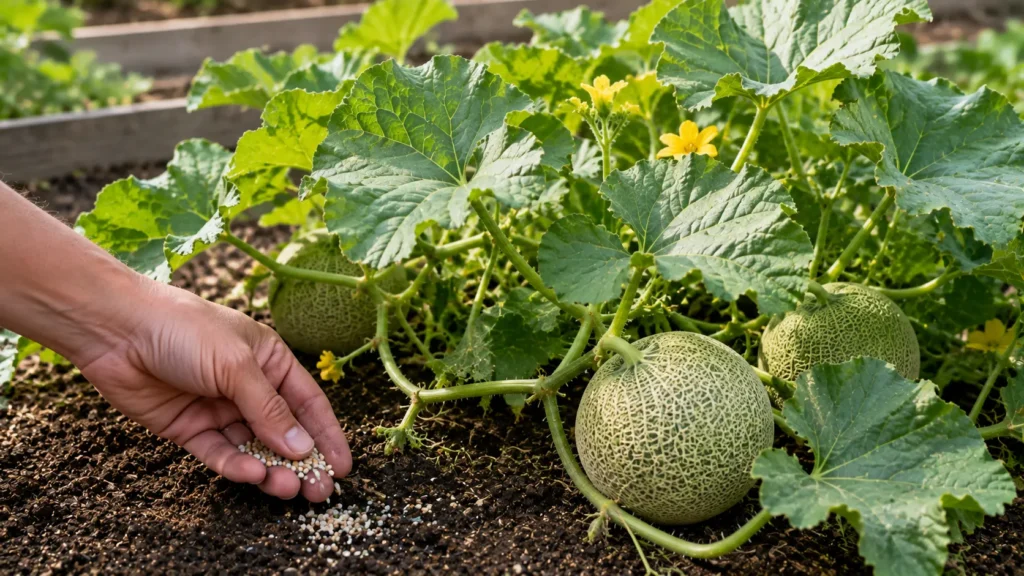
Side-dressing means applying fertilizer beside an established plant rather than placing it directly on the stem.
This method can supply nutrients during the growing season without disturbing the main root system.
For granular fertilizer, I would:
- Measure the fertilizer according to the product label.
- Keep it away from the main stem.
- Place it beside the plant or along the row.
- Apply it evenly.
- Water as directed by the fertilizer label.
Do not create a pile of fertilizer next to the stem.
Some fertilizer products can injure roots or plant tissue if they are applied too heavily or placed too close to the plant.
The exact distance depends on the fertilizer and application method, so the product label should take priority.
How Much Fertilizer Does Cantaloupe Need?
There is no universal amount that works for every cantaloupe plant.
The correct amount depends on:
- Soil fertility
- Fertilizer type
- N-P-K ratio
- Garden size
- Plant growth
- Previous fertilizer applications
- Soil-test recommendations
For example, a fertilizer with a high nitrogen percentage needs a different application rate from one with a lower nitrogen percentage.
That is why I would avoid advice based only on measurements such as one tablespoon per plant.
Instead, check the fertilizer label and calculate the amount based on your garden and the product’s nutrient analysis.
More fertilizer is not better.
Using too much can damage the plant and create nutrient problems in the soil.
Organic Fertilizer for Cantaloupe
Cantaloupes can be grown with organic sources of nutrients.
Common choices include:
- Compost
- Well-rotted manure
- Fish emulsion
- Blood meal
- Organic granular fertilizers
- Other approved organic nutrient sources
Organic fertilizer is not automatically safer to use in unlimited amounts.
The plant still receives nutrients, and excessive applications can still create problems.
Many organic fertilizers also release nutrients more slowly than readily available synthetic fertilizers. Soil organisms help break down many organic materials before their nutrients become available to plants.
Compost for cantaloupe
Compost is useful for improving soil structure and adding organic matter.
It can also provide nutrients, although the amount varies from one compost source to another.
I like to think of compost mainly as a soil-building material rather than a precise replacement for a fertilizer program.
If a soil test shows a specific nutrient deficiency, use a suitable fertilizer or amendment to address that need.
Manure for cantaloupe
Well-rotted or properly composted manure can add organic matter and nutrients.
Avoid using fresh manure directly in a food garden.
Fresh manure can contain harmful pathogens and may also introduce weed seeds.
Properly composted manure is a better choice.
Fish emulsion
Fish emulsion can provide nutrients and is commonly used as an organic fertilizer.
It can be useful when the plant needs additional nutrients, but it should still be applied according to the product label.
Organic products can cause problems if they are applied at excessive rates.
Blood meal
Blood meal is mainly a nitrogen source.
It can be useful when a soil test indicates that more nitrogen is needed.
I would not add it simply because the plant looks small. If the soil already has enough nitrogen, extra blood meal may encourage excessive vine growth.
Can You Overfertilize Cantaloupe?
Yes, you can overfertilize cantaloupe.
Too much fertilizer can cause:
- Excessive vine growth
- Delayed fruit production
- Leaf or root damage
- Nutrient imbalance
- Salt buildup in soil
- Poor nutrient uptake
Excess fertilizer can also move into waterways through runoff.
One of the biggest mistakes is assuming that a weak-looking plant always needs more fertilizer.
The actual problem could be:
- Too much water
- Too little water
- Poor drainage
- Root damage
- Pest damage
- Disease
- Poor soil pH
- Temperature stress
- Nutrient deficiency
I would check these factors before adding another dose of fertilizer.
What Is Fertilizer Burn on Cantaloupe?

Fertilizer burn occurs when a concentrated fertilizer damages plant tissue or roots.
It can happen when fertilizer is:
- Applied at too high a rate
- Placed directly against the stem
- Applied too close to roots
- Left on leaves
- Not used according to label directions
Granular fertilizer should never be piled against the base of a cantaloupe plant.
If you are using a liquid fertilizer, follow the dilution rate on the label.
A little care during application can prevent many fertilizer problems.
Does Cantaloupe Need More Nitrogen?
Cantaloupe plants need nitrogen, but that does not mean they always need more nitrogen.
Nitrogen deficiency can cause poor growth and yellowing of older leaves.
However, yellow leaves do not prove that nitrogen is the problem.
Other issues can create similar symptoms.
Before adding nitrogen, I would check:
- Soil-test results
- Recent fertilizer applications
- Soil moisture
- Drainage
- Root health
- Pest activity
- Disease symptoms
If the soil already contains adequate nitrogen, adding more may make the situation worse.
Can Too Much Nitrogen Stop Cantaloupes From Fruiting?

Too much nitrogen can delay fruit production.
Nitrogen encourages vegetative growth, so a plant receiving excessive amounts may keep producing leaves and vines.
This can be especially frustrating when the plant looks very healthy but produces few fruits.
If your cantaloupe has huge vines and lots of leaves but little fruit, I would not immediately add more nitrogen.
Check other factors too, especially:
- Pollination
- Temperature
- Water stress
- Sunlight
- Variety
- Pest damage
- Disease
- Overall plant health
Fertilizer is only one part of fruit production.
How to Tell if Cantaloupe Has a Nutrient Deficiency
Nutrient deficiency symptoms can give you clues, but they should not be treated as a final diagnosis.
Here are some signs that may point to nutrient problems:
| Possible issue | Possible symptoms |
| Nitrogen deficiency | Yellowing older leaves and weak growth |
| Phosphorus deficiency | Slow or stunted growth and possible reddish-purple coloring |
| Potassium deficiency | Browning or yellowing around older leaf edges |
| Nutrient imbalance | Uneven growth or poor plant development |
| Excess nitrogen | Very leafy growth and delayed fruit production |
Several problems can produce similar symptoms.
For example, yellow leaves can result from nutrient issues, water problems, root damage, or disease.
That is why a soil test is much more useful than trying to diagnose a deficiency from one leaf.
Does Fertilizer Make Cantaloupes Sweeter?
Fertilizer alone does not determine how sweet a cantaloupe becomes.
Fruit quality depends on several factors, including:
- Variety
- Sunlight
- Temperature
- Water
- Plant health
- Nutrient availability
- Growing conditions
- Harvest timing
Good nutrition supports healthy growth, but adding extra fertilizer does not guarantee sweeter fruit.
In fact, too much nitrogen can create more leafy growth without improving the fruit.
If I want good-quality cantaloupes, I focus on balanced nutrition and consistent growing conditions rather than looking for a special fertilizer that promises sweeter melons.
Does Fertilizer Help Cantaloupe Produce More Fruit?
Proper nutrition supports healthy growth and fruit production, but fertilizer is not the only factor involved.
Cantaloupe fruit production also depends on:
- Pollination
- Adequate sunlight
- Suitable temperatures
- Consistent moisture
- Healthy roots
- Pest control
- Disease prevention
- Variety
If a plant has flowers but very little fruit, fertilizer may not be the problem.
Poor pollination is one possibility.
Water stress or unsuitable temperatures can also affect fruit production.
Before adding fertilizer, I would first look at the complete growing conditions.
Common Cantaloupe Fertilizing Mistakes
1. Fertilizing without testing the soil
You may add nutrients that are already present in sufficient amounts.
2. Using too much nitrogen
This can create excessive vine growth and delay fruit production.
3. Putting fertilizer against the stem
Concentrated fertilizer can damage the plant.
4. Assuming 10-10-10 is always the best choice
A balanced fertilizer is useful only when its nutrient ratio fits the needs of your soil.
5. Fertilizing every week
Cantaloupes do not automatically need fertilizer every week.
Use the soil test, plant condition, fertilizer label, and growing stage as your guide.
6. Treating every yellow leaf as nitrogen deficiency
Yellowing has many possible causes.
Check the plant and soil before adding nutrients.
7. Using fresh manure
Fresh manure can create food-safety and weed problems.
Use properly composted material instead.
8. Adding fertilizer to solve poor fruit production
Poor fruiting can result from pollination, water, temperature, pests, disease, or other factors.
9. Ignoring the fertilizer label
Different products contain different amounts of nutrients.
Always follow the application instructions for the product you are using.
Cantaloupe Fertilizing Schedule
I would not use one fixed fertilizer schedule for every garden.
A better framework looks like this:
| Growth stage | Fertilizer approach |
| Before planting | Test soil and apply recommended nutrients |
| Early seedling stage | Avoid heavy feeding |
| Plants reach 3–4 inches | Consider nitrogen side-dressing if needed |
| Vines begin running | Apply additional nitrogen only when needed |
| Flowering | Avoid unnecessary heavy feeding |
| Fruit development | Maintain balanced nutrition and avoid excess nitrogen |
| Near harvest | Avoid routine heavy fertilizer applications |
This schedule is a guide rather than a rule.
Your soil test and fertilizer label should always take priority.
Cantaloupe Fertilizing Checklist
Before I fertilize a cantaloupe plant, I would check:
- Has the soil been tested?
- What is the soil pH?
- Does the soil already contain enough phosphorus?
- Does it have enough potassium?
- Has compost or manure already been added?
- Does the plant actually show signs of a nutrient problem?
- What is the fertilizer’s N-P-K ratio?
- What application rate does the label recommend?
- Is the plant at the right growth stage?
- Am I keeping fertilizer away from the stem?
- Am I adding nitrogen when the plant already has plenty?
- Could another problem be causing poor growth?
This short check can prevent many common fertilizer mistakes.
Final Thoughts
Fertilizing cantaloupe is not about feeding the plant as much as possible. It is about giving it the nutrients it actually needs at the right time.
I would start with a soil test, especially if you grow cantaloupes in the same garden each year. This gives you a much better starting point than guessing which fertilizer to use.
Nitrogen supports healthy vines and leaves, while phosphorus and potassium perform other important jobs in plant growth. But excess nitrogen can encourage too much vegetative growth and delay fruit production.
For established plants, side-dressing can provide extra nutrients during periods of active growth. The exact amount should come from your soil needs and the fertilizer label rather than a fixed amount that applies to every garden.
The main rule I would follow is simple:
Fertilize because the soil and plant need nutrients, not simply because the plant is growing.
That approach gives you a better chance of maintaining healthy cantaloupe plants without creating unnecessary fertilizer problems.
Frequently Asked Questions About Fertilizing Cantaloupe
What is the best fertilizer for cantaloupe?
There is no single best fertilizer for every garden. Choose one based on your soil-test results, nutrient needs, and the fertilizer’s N-P-K analysis.
How often should I fertilize cantaloupe?
It depends on soil fertility and the fertilizer being used. Some plants may need a few applications during the season, while fertile soil may need very little additional fertilizer.
Is 10-10-10 good for cantaloupe?
Yes, it can be useful when the soil needs nitrogen, phosphorus, and potassium. It is not automatically the right fertilizer for every garden.
Does cantaloupe need nitrogen?
Yes. Nitrogen supports healthy leaves and vines. But excessive nitrogen can delay fruit production.
Can you overfertilize cantaloupe?
Yes. Too much fertilizer can damage roots, cause excessive growth, create nutrient imbalances, and delay fruiting.
Can I use compost on cantaloupe?
Yes. Finished compost can improve soil structure and add organic matter and nutrients. Its nutrient content varies, so it should not automatically replace a fertilizer program.
Is manure good for cantaloupe?
Properly composted or well-rotted manure can be useful. Avoid fresh manure in a food garden.
Should I fertilize cantaloupe when it flowers?
Not automatically. Flowering alone does not mean the plant needs more fertilizer. Check the soil, plant growth, and previous applications first.
Why does my cantaloupe have lots of leaves but no fruit?
Excess nitrogen can cause heavy leaf and vine growth and delay fruiting. Poor pollination, water stress, temperature, pests, and disease can also reduce fruit production.
How do I fertilize cantaloupe plants?
Use a fertilizer that matches the soil’s nutrient needs. Apply it according to the label and keep granular fertilizer away from the plant stem.