Skip to content

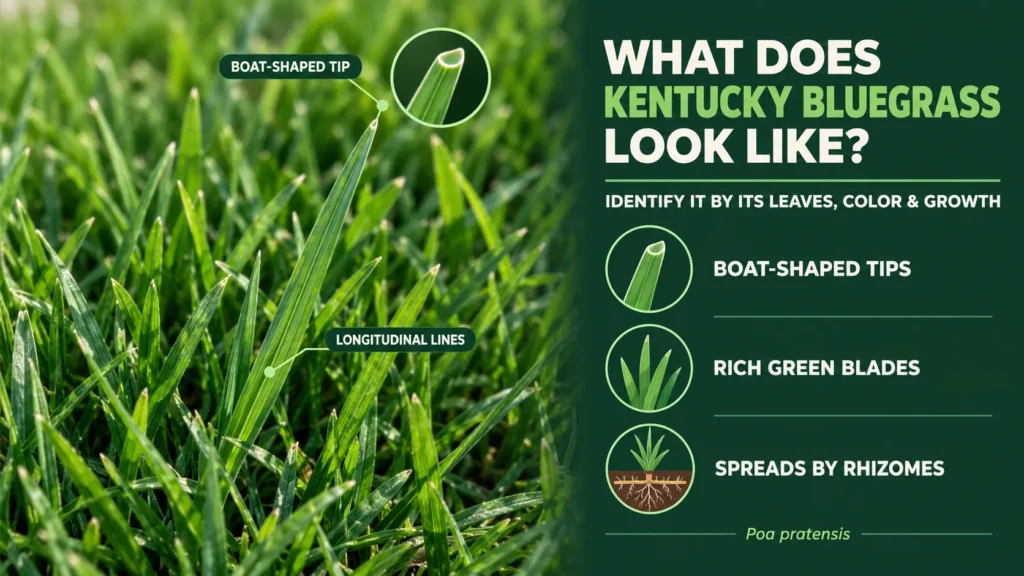
Kentucky bluegrass has a dense, green appearance, narrow leaf blades, and distinctive boat-shaped tips. It spreads through underground stems called rhizomes, which help it fill bare spots and form a thick lawn over time. However, color alone cannot confirm its identity because other grasses can look similar.
If you want to identify Kentucky bluegrass in your yard, start by examining the leaf tips, blade surface, and growth pattern. These features can help you distinguish it from tall fescue, perennial ryegrass, and annual bluegrass.
Quick Answer: What Does Kentucky Bluegrass Look Like?
Kentucky bluegrass (Poa pratensis) is a cool-season grass with medium- to dark-green blades, boat-shaped tips, and a dense growth habit. Its leaves often have two prominent lengthwise lines running beside the central vein. Underground rhizomes help it spread and form a thick lawn.
Here are the main signs to look for:
- Leaf tips: Rounded, boat-shaped ends that look slightly like the front of a small boat.
- Blades: Narrow to moderately narrow leaves with visible lengthwise lines.
- Color: Usually medium to dark green, sometimes with a blue-green appearance.
- Growth: Dense turf that spreads through underground rhizomes.
- Texture: A relatively fine, soft appearance compared with many tall fescue lawns.
- Seed heads: Branched clusters that rise above the leaves when the grass grows long enough.
No single feature confirms the species in every case. Check several characteristics together, especially if your lawn contains more than one type of grass.
How to Recognize Kentucky Bluegrass at a Glance
The easiest way to identify Kentucky bluegrass is to look at the grass closely instead of judging the entire lawn from a distance. Its color and density provide useful clues, but the leaf shape and growth habit are more helpful when you compare it with similar grasses.
| Feature | What Kentucky bluegrass looks like |
| Leaf tip | Boat-shaped, with a rounded point |
| Blade width | Narrow to moderately narrow |
| Leaf surface | Lengthwise lines or ridges may be visible |
| Color | Medium to dark green |
| Growth habit | Dense turf with underground rhizomes |
| Texture | Relatively fine and soft |
| Seed head | Branched flower cluster |
| Seasonal behavior | Grows best in cool weather and may struggle during summer heat |
Use this table as a starting point, not a final diagnosis. Mowing height, sunlight, water, soil conditions, and grass variety can change how a lawn looks.
What Do Kentucky Bluegrass Blades Look Like?

The leaf blade is one of the most useful places to start when identifying Kentucky bluegrass. A close look can reveal details that are difficult to see when you stand over the lawn.
The Boat-Shaped Leaf Tip
Kentucky bluegrass has a distinctive boat-shaped leaf tip. The end of the blade is rounded and slightly pointed, resembling the front of a small boat.
This feature is often easier to see when you examine a single leaf rather than a clump of grass. Gently separate a few blades and look at their tips in good natural light.
However, do not rely on this clue alone. Annual bluegrass can also have boat-shaped tips, so you need to compare other features before deciding which grass you have.
Leaf Veins and Surface Texture
Kentucky bluegrass leaves often have two prominent lengthwise lines running beside the midrib. These lines may look like narrow tracks along the surface of the blade.
The leaves can also have a slightly ridged texture. Run your fingers gently along a blade to feel its surface, but remember that touch alone cannot confirm the grass species.
Look at several mature leaves because individual blades may vary. Dirt, moisture, leaf damage, and lighting can make these details harder to see.
Color and Blade Width
Kentucky bluegrass is usually medium to dark green. Some varieties have a noticeable blue-green tone, which helps explain the name.
Its blades are generally narrow, but their width can vary with the variety and growing conditions. A well-maintained lawn may look fine and even, while stressed or poorly maintained turf may appear thinner or less uniform.
Avoid identifying Kentucky bluegrass by color alone. Tall fescue, perennial ryegrass, and other lawn grasses can also have dark-green leaves.
What Does Kentucky Bluegrass Look Like in a Lawn?
From a distance, Kentucky bluegrass often forms a thick, fairly uniform lawn with a smooth appearance. When it grows well, individual grass plants spread and fill open spaces, helping the turf look dense.
Established Kentucky bluegrass lawns may show these characteristics:
- A relatively even green surface.
- Many narrow blades growing close together.
- A soft, dense appearance.
- Few open spaces where the grass has spread successfully.
- New growth filling some small gaps through underground rhizomes.
The lawn’s appearance depends on more than its grass species. Mowing height, sunlight, soil moisture, nutrition, and seasonal weather all affect how thick and green the turf looks.
A patchy lawn is not automatically a different grass. Kentucky bluegrass can become thin under stress, while a mixed lawn may contain several species with different blade shapes and growth patterns.
What Do Kentucky Bluegrass Rhizomes Look Like?
Kentucky bluegrass spreads through underground stems called rhizomes. These stems grow horizontally beneath the soil and can produce new shoots and roots at different points.
Rhizomes help Kentucky bluegrass fill gaps and recover from some types of damage. This spreading habit is one of the main differences between Kentucky bluegrass and bunch-type grasses, such as tall fescue.
To look for rhizomes, inspect a small section near the edge of a healthy grass patch. You may see pale, stem-like growth beneath the soil surface, with roots extending downward and shoots growing upward.
Do not confuse rhizomes with roots. Roots mainly absorb water and nutrients and anchor the plant, while rhizomes are horizontal stems that can produce new grass plants. Kentucky bluegrass does not rely on above-ground runners in the same way that some spreading grasses do.
What Does Kentucky Bluegrass Look Like Through the Seasons?

Kentucky bluegrass is a cool-season grass. It generally grows best during mild spring and fall weather, while extreme summer heat can slow its growth and affect its color.
Spring
In spring, Kentucky bluegrass often becomes greener as temperatures favor new growth. The lawn may look thicker as new leaves develop and rhizomes produce shoots.
The timing of green-up depends on local weather, soil conditions, and how the lawn handled winter. Some lawns recover quickly, while others take longer to develop a uniform appearance.
Summer
During mild summer weather, Kentucky bluegrass can maintain a dense green lawn if growing conditions are suitable. In hot weather, however, growth may slow and the grass can become pale, thin, or brown.
Heat and water stress can make identification more difficult because the lawn may no longer show its healthiest appearance. Examine surviving green leaves and the growth habit rather than relying on color.
Fall
Fall often brings another period of active growth as temperatures cool. Kentucky bluegrass may regain its green color and fill some thin areas when moisture and other conditions are suitable.
This is also a useful time to examine the leaf tips and growth pattern. The lawn may look healthier than it did during summer stress.
Winter
In winter, Kentucky bluegrass may remain green during mild weather or lose some color during cold conditions. Its appearance varies with the local climate and the severity of winter.
Do not assume that brown grass is dead or that every green lawn contains Kentucky bluegrass. Use leaf shape and other identification clues whenever possible.
What Does Kentucky Bluegrass Look Like When It Goes to Seed?
When Kentucky bluegrass grows long enough to produce flowers, it develops branched seed heads above the leaf canopy. These structures are usually more open and branching than the compact appearance of the lawn itself.
The seed head rises on a stem and carries small spikelets along its branches. It may appear pale green at first and become straw-colored as it matures.
Seed heads are useful for identification when they are present, but many lawns are mowed before they develop. Their absence does not mean you have a different grass species.
If you see seed heads, examine them alongside the leaf tips and growth habit. A single flower structure should not be your only basis for identifying the lawn.
Kentucky Bluegrass vs. Similar Grasses

Several lawn grasses can look like Kentucky bluegrass from a distance. Comparing leaf shape, texture, growth habit, and other details can help you narrow down the possibilities.
Kentucky Bluegrass vs. Annual Bluegrass
Annual bluegrass (Poa annua) is one of the most important look-alikes because it can share the boat-shaped leaf tip found in Kentucky bluegrass.
Annual bluegrass often appears lighter green and may produce seed heads at a relatively low mowing height. It commonly appears as small patches within lawns, although its growth habit varies with the environment.
Kentucky bluegrass usually forms a more persistent, spreading turf through underground rhizomes. Because their leaf tips can look alike, compare color, overall growth, seed heads, and the wider lawn pattern rather than using one feature.
Kentucky Bluegrass vs. Tall Fescue
Tall fescue usually has wider, coarser-looking blades than Kentucky bluegrass. Its leaves often show more prominent veins and a stronger ribbed texture.
Tall fescue typically grows in bunches rather than spreading through an extensive network of rhizomes. This means it may not fill open spaces in the same way Kentucky bluegrass can.
Look at the blade width and growth habit together. A single leaf can be misleading, especially when the lawn contains a mixture of grass species.
Kentucky Bluegrass vs. Perennial Ryegrass
Perennial ryegrass often has a glossy surface and narrow blades with a more pointed tip. Its leaves commonly show strong lengthwise ridges, and the lower leaf surfaces may look shiny.
Kentucky bluegrass generally has a boat-shaped tip and spreads through underground rhizomes. Perennial ryegrass is more bunch-forming, although the two can grow together in the same lawn.
Surface shine can help with comparison, but it is not a definitive test. Moisture, light, and the condition of the leaf can change how reflective it appears.
Quick Comparison Chart
| Feature | Kentucky bluegrass | Annual bluegrass | Tall fescue | Perennial ryegrass |
| Leaf tip | Boat-shaped | Often boat-shaped | Usually pointed | Usually pointed |
| Blade appearance | Narrow to moderately narrow | Often soft and light green | Generally wider and coarser | Narrow, often glossy |
| Typical color | Medium to dark green | Often lighter green | Medium to dark green | Medium to dark green |
| Growth habit | Spreads through rhizomes | Varies; often forms patches | Mainly bunch-forming | Mainly bunch-forming |
| Useful clue | Boat-shaped tip plus rhizomes | Boat-shaped tip plus other traits | Wider blade and strong veins | Glossy surface and pointed tip |
These are general tendencies rather than strict rules. Grass varieties and growing conditions can affect their appearance, and mixed lawns may show traits from more than one species.
Why Does Kentucky Bluegrass Look Thin, Pale, or Brown?
Kentucky bluegrass does not always look like the thick, dark-green lawn shown in photographs. Weather, growing conditions, and the presence of other grass species can change its appearance.
Heat and Drought Stress
Kentucky bluegrass is adapted to cool-season growth and may struggle during prolonged summer heat. When the soil becomes too dry or temperatures remain high, the grass can lose color and stop growing actively.
Look for surviving leaves and examine their shape before deciding whether the grass is Kentucky bluegrass. Brown color by itself does not identify a species or explain the cause of the problem.
Shade and Poor Growing Conditions
Limited sunlight can reduce the density of Kentucky bluegrass. Compacted soil, poor drainage, and other growing problems may also affect its appearance.
A thin lawn may expose more soil and make individual plants easier to inspect. However, these conditions can also allow other grass species or weeds to become more noticeable.
Mixed Grass or Uncertain Identification
Some lawns contain Kentucky bluegrass mixed with tall fescue, perennial ryegrass, or annual bluegrass. These grasses may grow at different rates and show different colors, textures, and blade shapes.
If one patch looks noticeably different from the rest, inspect several leaves from that patch and compare them with healthy areas. You may find that the lawn contains more than one species rather than one grass changing its appearance.
How to Identify Kentucky Bluegrass Step by Step

If you are unsure what type of grass grows in your lawn, follow these steps. The aim is to compare several clues instead of relying on a single feature.
Step 1: Examine the Leaf Tip
Choose a healthy, mature blade and look closely at its end. A rounded, boat-shaped tip supports Kentucky bluegrass identification, but remember that annual bluegrass can have a similar feature.
Step 2: Check the Blade Surface
Look for lengthwise lines beside the midrib. Compare several leaves because dirt, damage, and light can make the surface details difficult to see.
Step 3: Assess the Growth Habit
Step back and look at the whole patch. Kentucky bluegrass often forms dense turf and spreads into open areas through underground rhizomes.
Step 4: Inspect the Growth Beneath the Soil
If you need more evidence, carefully lift a small section of turf near the edge of the patch. Look for horizontal underground stems that can produce new shoots.
Avoid damaging a large area just to identify the grass. A small sample is usually enough to inspect the growth pattern.
Step 5: Compare Similar Grasses
Compare the sample with annual bluegrass, tall fescue, and perennial ryegrass. Consider blade width, tip shape, surface texture, and growth habit together.
Step 6: Consider the Season and Lawn Condition
Think about whether the grass is growing during cool weather or struggling in summer heat. Seasonal stress can affect color and density, so do not treat these features as proof of the species.
Step 7: Confirm the Overall Pattern
If the blade features and growth habit agree, you have stronger evidence that the grass is Kentucky bluegrass. If the clues conflict, consider the possibility of a mixed lawn or seek a closer identification using a clear sample.
Final Takeaway
Kentucky bluegrass is best recognized by its boat-shaped leaf tips, lengthwise blade lines, dense growth, and underground rhizomes. Its green color and soft, even appearance can support identification, but these features can change with weather and lawn care.
If you want to identify Kentucky bluegrass accurately, compare several clues and check for similar grasses before making a decision. Looking at both an individual blade and the way the grass grows will give you a more reliable answer than judging the lawn by color alone.
Frequently Asked Questions
What color is Kentucky bluegrass?
Kentucky bluegrass is usually medium to dark green. Some varieties can show a blue-green tone, but color changes with light, moisture, nutrition, and seasonal stress.
Does Kentucky bluegrass spread?
Yes. Kentucky bluegrass spreads through underground rhizomes that can produce new shoots and roots. This growth habit helps it fill open areas and form dense turf when conditions are suitable.
What does Kentucky bluegrass look like in winter?
Its appearance depends on the climate. It may stay green during mild winter weather or lose some color during colder conditions. Examine the leaf shape and growth habit if color alone is not helpful.
How can I tell Kentucky bluegrass from tall fescue?
Kentucky bluegrass usually has boat-shaped leaf tips and spreads through underground rhizomes. Tall fescue generally has wider, coarser blades with more prominent veins and a bunch-forming growth habit.
Is Kentucky bluegrass the same as annual bluegrass?
No. Kentucky bluegrass is Poa pratensis, while annual bluegrass is Poa annua. They can look similar, particularly at the leaf tip, but they differ in growth behavior and other identifying features.
Does Kentucky bluegrass have runners?
Kentucky bluegrass spreads through underground rhizomes rather than relying on above-ground runners. If you see stems spreading across the soil surface, compare the plant with other spreading grasses before identifying it.
Why does Kentucky bluegrass turn brown in summer?
Hot weather, drought, and other growing stresses can cause Kentucky bluegrass to lose color. Browning alone cannot confirm whether the grass is dormant, damaged, or dead, so examine the plant and its growing conditions.