Skip to content
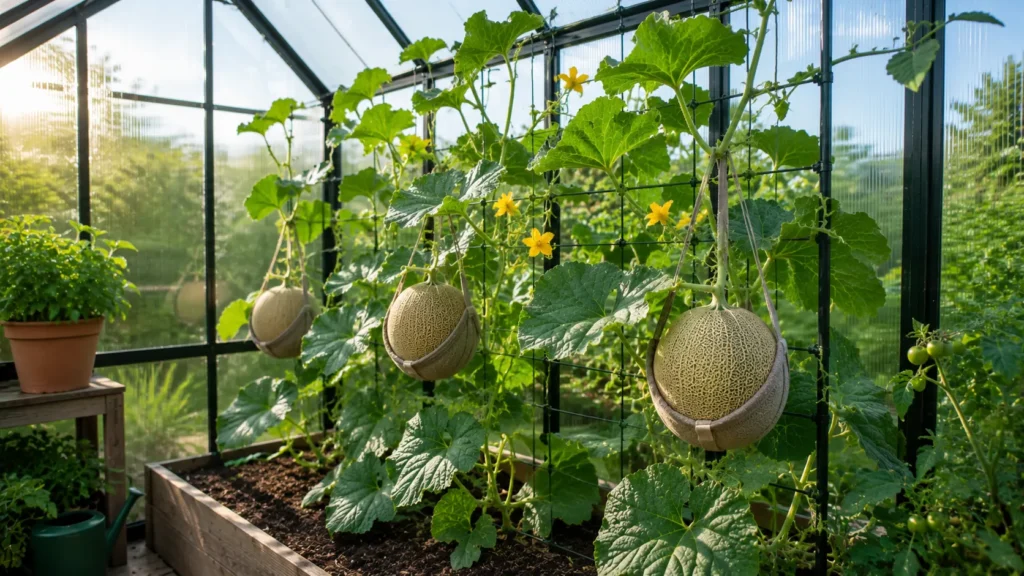
Growing cantaloupe in a greenhouse gives me much more control over the growing conditions. I can protect young plants from cold weather, give them a longer growing season, and keep rain away from the leaves and fruit.
But there is one thing I have learned to keep in mind: a greenhouse is not just a warmer garden.
It can become too hot, too humid, and too crowded if I don’t manage it properly.
Cantaloupe is a warm-season vine that needs plenty of sunlight, fertile soil, steady moisture, good airflow, and successful pollination. In a greenhouse, I also need to think about ventilation, temperature, humidity, vine training, and how the flowers will be pollinated.
This guide focuses on those greenhouse-specific issues rather than repeating the basic steps from my general cantaloupe growing guide.
Can You Grow Cantaloupe in a Greenhouse?
Yes, cantaloupe can grow very well in a greenhouse.
I find a greenhouse especially useful when the outdoor growing season is too short or spring temperatures stay low. Cantaloupes need warm conditions, and starting them under cover can give the plants a better start.
Cantaloupes can also be trained vertically, which makes them a useful crop for a greenhouse where floor space is limited. They naturally grow as trailing vines, but they can be trained onto a suitable support.
The main difference is that I have to manage the greenhouse environment.
Outside, rain, wind, and natural airflow do much of the work. Inside a greenhouse, I control more of these conditions.
That means I need to pay attention to temperature, ventilation, humidity, watering, and pollination.
Why I Like Growing Cantaloupe in a Greenhouse
There are several reasons I would choose a greenhouse for cantaloupe.
A longer growing season
Cantaloupe needs warm conditions, so a greenhouse can help me start the crop earlier and protect it from cool weather.
This is especially useful in areas where summer is short.
Better protection from cold
Young cantaloupe plants can struggle in cold conditions.
A greenhouse gives me more control over the temperature around the plants during the early part of the season.
Protection from heavy rain
Too much rain can make soil management harder and can keep foliage wet.
Inside a greenhouse, I can control how much water reaches the plants.
Easier vertical growing
A greenhouse gives me a natural place to install a trellis or other support.
Instead of letting vines cover the floor, I can train them upward.
Better control of the growing environment
I can manage:
- Ventilation
- Irrigation
- Soil moisture
- Plant spacing
- Temperature
- Humidity
- Vine direction
- Fruit support
That control is useful, but it also means I have to pay closer attention to the plants.
What Temperature Does Cantaloupe Need in a Greenhouse?
Cantaloupe is a warm-season crop.
For starting seeds, I want the growing medium to be warm enough for good germination. Outdoor growing guidance commonly recommends waiting until soil reaches about 65°F before planting cantaloupe.
Once the plants are established, I aim to keep the greenhouse warm without allowing it to become excessively hot.
This is where greenhouse growing can catch beginners off guard.
On a sunny day, the temperature inside a greenhouse can rise quickly.
I don’t assume that a hotter greenhouse will always produce better cantaloupes.
If the temperature becomes excessive, the plants can become stressed. Very hot conditions can also affect flower development and fruit set. Heat stress is one of the factors linked with poor fruit set in cantaloupe.
So I watch the temperature instead of simply closing the greenhouse and letting it heat up.
How I Control Greenhouse Heat

When the weather becomes warm, ventilation becomes one of my main jobs.
I use whatever combination of greenhouse vents, doors, and fans the structure allows.
My goal is to move hot air out and bring fresher air in.
On a warm sunny day, I don’t wait until the greenhouse feels extremely hot before opening the vents.
I also pay attention to the temperature outside.
A greenhouse that was useful for keeping plants warm in spring can become a heat trap once summer arrives.
Shade during extreme heat
If the greenhouse gets excessive direct heat, temporary shade can help reduce the temperature.
I use shade carefully because cantaloupe still needs strong light.
I don’t want to solve a heat problem by creating a light problem.
The best approach is to maintain good light while preventing extreme heat buildup.
Why Ventilation Matters for Greenhouse Cantaloupe
Good airflow is one of the first things I think about when growing cantaloupe under cover.
A greenhouse can trap humid air around the leaves.
If the foliage stays wet and air movement is poor, disease problems can become more likely.
I try to avoid creating a dense wall of leaves.
Training the vines vertically can help me organize the plant and keep the foliage from becoming one tangled mass.
I also avoid watering the leaves when I can.
Instead, I direct water toward the soil around the roots.
My main greenhouse ventilation goals are simple:
- Move hot air out
- Keep air circulating
- Reduce excessive humidity
- Keep foliage from staying wet
- Avoid overcrowding
- Give each plant enough space
I don’t need the greenhouse to feel dry.
I just don’t want it to become stagnant and constantly humid.
How Much Light Does Cantaloupe Need in a Greenhouse?
Cantaloupe needs strong sunlight.
A greenhouse cannot make up for a poor location with little natural light.
I place the greenhouse where the plants can receive as much direct sunlight as possible.
At least six hours of direct sunlight is a useful minimum, while eight to ten hours is better when the site allows it.
Good light supports healthy leaves, flowers, and fruit development.
If the greenhouse gets shaded for much of the day, I would expect weaker growth and less reliable fruit production.
This is why I would rather choose a sunny greenhouse location than try to fix poor light later.
Choosing Cantaloupe Varieties for Greenhouse Growing
I don’t need a special greenhouse variety for every setup, but I do look for varieties that fit the space.
For greenhouse growing, useful traits include:
- Compact growth
- Shorter days to maturity
- Smaller fruit
- Strong disease resistance
- Good performance in protected conditions
- Vines that are easy to train
Smaller melons can also be easier to support when grown vertically.
The University of Florida’s greenhouse melon work includes specialty melons such as Galia and Charentais among types suitable for greenhouse production.
I would not choose a variety only because it is described as a greenhouse melon.
I also check its maturity time, fruit size, disease resistance, and how much space the mature vine needs.
For a full variety comparison, I would use my separate Best Cantaloupe Varieties for Home Gardens article.
Preparing the Greenhouse Growing Area
Before planting, I prepare the growing area first.
I want the root zone to have:
- Good drainage
- Good fertility
- Organic matter
- Loose soil
- Enough room for root growth
A soil test can help show whether the soil needs specific nutrients.
I avoid guessing with large amounts of fertilizer.
If I’m using an existing greenhouse bed, I also think about what grew there before.
Growing cucurbits in the same soil year after year can make pest and disease management harder.
If possible, I rotate crops or refresh the growing medium.
Can I Grow Cantaloupe in Greenhouse Containers?
Yes.
Containers and grow bags can work well in a small greenhouse.
They give me more control over the growing medium and make it possible to grow cantaloupe where there is no permanent garden bed.
The main issue is moisture.
Containers can dry out faster than a large soil bed, especially inside a warm greenhouse.
So I check container moisture more often.
I also make sure the container has proper drainage.
I don’t let the roots sit in water.
Since you already have a separate article on growing cantaloupe in containers, I would keep this section short and use that page for the full container method.
When Should I Plant Cantaloupe in a Greenhouse?
The answer depends on whether the greenhouse is heated or unheated.
In an unheated greenhouse, I still wait until conditions are warm enough for healthy growth.
Starting seeds too early in a cold greenhouse can give me weak, slow-growing plants.
For an early crop, I can start seeds in a warm indoor area and move the young plants into the greenhouse once conditions are suitable.
Cantaloupe seeds can also be started in a greenhouse when enough warmth is available for germination.
The main point is that I use the greenhouse to extend the growing season, not to ignore the plant’s need for warmth.
How to Plant Cantaloupe in a Greenhouse

I can start with seeds or transplants.
If I sow directly into the greenhouse bed, I wait until the soil is warm enough.
For transplants, I handle the roots carefully and avoid unnecessary disturbance.
Once the plant is established, I decide how I want the vine to grow.
This decision should happen early.
I don’t want to wait until the vine has spread across the greenhouse floor before deciding where it should go.
How Much Space Does Greenhouse Cantaloupe Need?
Cantaloupe vines can become surprisingly large.
They may grow several feet long and can spread across a large area when left on the ground. North Carolina Extension notes that cantaloupe can climb 6 to 9 feet and spread 3 to 6 feet wide.
That is a lot of greenhouse floor space.
This is why I prefer to plan the vine direction before planting.
If I have a large greenhouse, I can let the vines trail.
If space is limited, vertical growing makes much more sense.
I also leave enough room between plants to inspect the leaves, water the roots, and reach the fruit.
Overcrowding can turn a greenhouse into a wall of leaves.
How to Trellis Cantaloupe in a Greenhouse

I prefer vertical growing when greenhouse floor space is limited.
I place a strong trellis or support system where the vine can reach it easily.
As the plant grows, I guide the main vine upward.
I don’t wait until the vine is several feet long and tangled with neighboring plants.
Instead, I check the plant often and gently guide new growth toward the support.
Cantaloupe vines naturally have tendrils that help them climb, but I still provide extra support when needed.
The support needs to be strong enough for the mature plant and its fruit.
I don’t assume the greenhouse frame can safely carry the weight unless it was built for that purpose.
How I Train Cantaloupe Vines in a Greenhouse
Once the main vine starts growing, I guide it toward the trellis.
I use soft ties if the plant needs help.
I avoid tight ties because the stem becomes thicker as it grows.
The goal is to keep the vine organized without damaging it.
I also keep the lower part of the plant and walkways clear.
A well-trained vine makes it easier for me to:
- Inspect leaves
- Spot pests
- Find flowers
- Pollinate flowers
- Support fruit
- Water the root zone
- Harvest ripe melons
Should I Prune Cantaloupe in a Greenhouse?
Greenhouse cantaloupes may benefit from more active vine management than plants growing across an open garden.
I don’t prune randomly.
I first decide how I want the plant to grow.
The purpose is to control the vine, improve access, and manage fruit production.
Greenhouse melon production commonly uses pruning and training to keep plants within the available growing area.
I avoid giving one pruning formula for every cantaloupe variety.
Different cultivars can have different growth habits.
Instead, I remove growth only when it serves a clear purpose, such as keeping the plant within its support system or reducing excessive crowding.
How to Pollinate Cantaloupe in a Greenhouse

This is one of the biggest differences between greenhouse and outdoor growing.
Outside, bees can visit the flowers naturally.
Inside a closed greenhouse, there may not be enough pollinators.
Cantaloupe produces separate male and female flowers on the same plant. The female flower has a small swelling behind the flower, which later becomes the melon. Bees transfer pollen from male flowers to female flowers.
If pollinators cannot enter the greenhouse, I can hand-pollinate the flowers.
How I hand-pollinate
I look for a freshly opened male flower and a female flower.
The female flower has the small swollen area behind it.
I transfer pollen from the male flower onto the center of the female flower.
I prefer doing this early in the day because melon flowers have a short receptive period.
After pollination, I watch the small fruit behind the female flower.
If it starts growing instead of shriveling, that is a good sign that fruit set has occurred.
If the tiny fruit turns yellow and drops, I check pollination, temperature, water stress, and general plant health.
For the full process, I would use my dedicated cantaloupe plant pollination article.
Watering Cantaloupe in a Greenhouse

I don’t water greenhouse cantaloupes simply because the greenhouse feels hot.
I check the soil first.
The plant needs steady moisture, but the root zone should not remain waterlogged.
Greenhouse containers may need more frequent checks because they can dry out faster.
I prefer watering at the base of the plant rather than spraying the leaves.
Drip irrigation is useful because it puts water near the roots while keeping foliage drier.
I also adjust watering as the plant changes.
A small seedling doesn’t need the same amount of water as a large plant covered with leaves and developing fruit.
During hot greenhouse weather, I check the soil more often.
For the full watering schedule and fruit-development advice, I would link to my watering cantaloupe article.
How I Fertilize Greenhouse Cantaloupe
I start with good soil rather than trying to fix everything with fertilizer.
If possible, I use a soil test to see what nutrients are already present.
Then I follow the fertilizer label and adjust feeding based on the plant’s growth.
I avoid excessive nitrogen because I don’t want to encourage huge amounts of leafy growth at the expense of fruit production.
If the plant looks weak, I first check the whole growing environment.
I ask:
- Is the soil too wet?
- Is the soil too dry?
- Is the plant getting enough light?
- Is the greenhouse too hot?
- Are pests present?
- Is there a disease?
- Has the plant been overfed?
A fertilizer problem is only one possible cause.
Should I Thin Cantaloupe Fruits in a Greenhouse?
Sometimes.
I don’t automatically remove fruit from every plant.
Instead, I look at the plant’s strength, variety, fruit size, and growing conditions.
A strong plant may support several fruits, while a weaker plant may struggle with a heavy fruit load.
If I am growing a large-fruited type vertically, I am more careful about how many fruits I allow to develop.
The goal is to avoid asking a small plant to support more fruit than it can handle.
How to Support Cantaloupes on a Greenhouse Trellis

This is something I take seriously.
A trellis supports the vine.
It does not automatically support the weight of a mature melon.
As the fruit gets larger, I use a soft sling.
A melon sling can be made from:
- Soft fabric
- Mesh
- Old cloth
- Suitable garden netting
I place the sling underneath the fruit and attach it to the trellis.
I make sure it is wide enough to hold the melon without cutting into the fruit.
This is especially useful for larger melons grown vertically.
Cantaloupes can be trained onto trellises, but developing fruit needs support as it gets heavier.
How I Manage Humidity in the Greenhouse
Humidity is one of the greenhouse conditions I watch closely.
I don’t want water sitting on the leaves for long periods.
My main steps are simple:
- Water the soil rather than the foliage.
- Keep plants from becoming overcrowded.
- Open vents when conditions allow.
- Use fans for air movement if needed.
- Remove badly damaged plant material.
- Keep the greenhouse clean.
I also avoid watering late in the day when the greenhouse is likely to stay humid overnight.
The exact timing depends on my climate and greenhouse, but I want the foliage to have a chance to dry.
Greenhouse Pests That Can Attack Cantaloupe
A greenhouse protects plants from some outdoor conditions, but it does not make them pest-free.
Common pests can include:
- Aphids
- Whiteflies
- Spider mites
- Thrips
- Cucumber beetles
- Fungus gnats in wet growing media
I check the underside of leaves because several small pests hide there.
I also inspect new growth regularly.
A pest problem is much easier to manage when I catch it early.
For detailed pest identification and control, I would use my separate Cantaloupe Plant Pests article rather than repeating every treatment here.
Greenhouse Diseases and Cantaloupe
The main thing I focus on is prevention.
Warm, humid, poorly ventilated greenhouse conditions can create a good environment for disease problems.
I reduce that risk by:
- Giving plants enough space
- Improving airflow
- Avoiding wet foliage
- Controlling irrigation
- Removing diseased plant material
- Cleaning tools
- Keeping weeds under control
If I see spots, powdery growth, wilting, or other unusual symptoms, I don’t assume the cause immediately.
I check the plant and growing conditions first.
For disease identification and treatment, I would direct readers to my Cantaloupe Plant Diseases guide.
Why Is My Greenhouse Cantaloupe Flowering but Not Producing Fruit?
If my greenhouse cantaloupe is covered with flowers but I don’t see developing melons, I first think about pollination.
This is especially important inside a greenhouse.
The first flowers are often male, so seeing flowers without fruit at the beginning is not automatically a problem. Female flowers appear later and have a swollen base.
If female flowers appear but fail to produce fruit, I check:
- Was the flower pollinated?
- Was the greenhouse too hot?
- Was the plant under water stress?
- Are there enough healthy leaves?
- Is the plant overcrowded?
- Are pests affecting the plant?
For a complete explanation, my Cantaloupe Flowering but Not Fruit article covers this problem in more detail.
How to Get Bigger Cantaloupes in a Greenhouse
I don’t try to force fruit size with extra fertilizer.
Instead, I focus on the whole growing environment.
I want:
- Strong sunlight
- Healthy leaves
- Good root growth
- Steady moisture
- Suitable temperature
- Successful pollination
- Good nutrition
- Reasonable fruit load
If the plant is stressed, adding more fertilizer usually isn’t the answer.
I first find the source of the stress.
Healthy foliage is especially important because the leaves produce the energy the plant uses for growth and fruit development.
When to Harvest Greenhouse Cantaloupe

Greenhouse-grown cantaloupes are harvested using the same basic maturity signs as outdoor fruit, but the exact harvest stage depends on the variety.
I look for changes in:
- Fruit color
- Aroma
- Stem attachment
- Rind appearance
- Fruit maturity
Some cantaloupes are ready when the fruit separates easily from the vine, while other melon types are harvested at a different stage.
I don’t pick only because the fruit has reached a certain size.
Size does not always mean the melon is ripe.
For the full process, I would use my When and How to Harvest Cantaloupe guide.
Common Greenhouse Cantaloupe Problems
The greenhouse gets too hot
I improve ventilation and use shade when needed.
I don’t leave the greenhouse sealed on a hot sunny day.
The plants are growing leaves but not fruit
I check pollination, temperature, water, nutrition, and fruit load.
Flowers appear but fruit drops
I check whether the female flowers were properly pollinated and whether the plant is under heat or water stress.
The vines are taking over the greenhouse
I start training them vertically and remove growth only when needed to keep the plant manageable.
The melons are too heavy for the trellis
I add fruit slings.
The leaves are staying wet
I improve ventilation and change the way I water.
Whiteflies or aphids appear
I inspect the plant early and deal with the infestation before it spreads.
The soil stays wet
I check drainage and irrigation rather than simply adding more water.
My Simple Greenhouse Cantaloupe Setup
If I were setting up a greenhouse for cantaloupe, I would keep the system simple.
Location: Full sun
Growing medium: Fertile, well-drained soil or a suitable container mix
Planting: Start once the growing conditions are warm enough
Variety: Choose a variety that fits the greenhouse and available space
Training: Use vertical support when floor space is limited
Pollination: Encourage pollinators where practical or hand-pollinate
Watering: Keep the root zone evenly supplied with moisture
Ventilation: Keep hot, humid air moving
Fruit support: Use soft slings for vertically grown melons
Pest checks: Inspect leaves regularly
Harvest: Follow the maturity signs for the specific variety
This setup gives me control without making the process more complicated than it needs to be.
Greenhouse vs. Outdoor Cantaloupe Growing
Both methods can work, but they have different strengths.
| Greenhouse growing | Outdoor growing |
| Better protection from cold | More exposure to natural weather |
| Longer season in many climates | Limited by outdoor temperatures |
| More control over irrigation | Rain provides some water |
| Easier to manage vine direction | More room for vines to spread |
| Pollination may require extra work | Bees can access flowers naturally |
| Heat can build up quickly | Natural airflow is usually better |
| Humidity needs close attention | Humidity is less enclosed |
| Vertical growing is easy to organize | Ground growing is simple |
I would choose a greenhouse when the growing season is short or when I want more control over the environment.
If I live somewhere with long, hot summers, outdoor growing may be much simpler.
Final Thoughts
I think growing cantaloupe in a greenhouse is most useful when I treat the greenhouse as a controlled growing system rather than simply a glass box that keeps plants warm.
The warmth helps, but I also need to manage ventilation, humidity, water, light, and pollination.
For me, the biggest advantage is being able to control where the plant grows. Instead of letting long vines cover the greenhouse floor, I can train them vertically and support the developing melons.
The biggest challenge is pollination.
If bees cannot reach the flowers, I need to take care of that myself.
Once I have those basics in place, greenhouse cantaloupe becomes much easier to manage. Good light, healthy soil, steady moisture, clean airflow, proper vine training, and successful pollination give the plant what it needs to develop healthy fruit.
Frequently Asked Questions
Can you grow cantaloupe in an unheated greenhouse?
Yes, but timing matters. An unheated greenhouse can protect plants from some cold conditions, but it does not provide the same temperature control as a heated structure. I still wait for suitable growing conditions before moving young plants into it.
How hot is too hot for cantaloupe in a greenhouse?
Cantaloupe likes warmth, but extreme heat can stress the plant and interfere with fruit set. I monitor the greenhouse instead of relying on a fixed outdoor temperature and use ventilation and shade when needed.
Does cantaloupe need a trellis in a greenhouse?
No. I can grow the vines along the ground if I have enough floor space. I prefer a trellis when the greenhouse is small because vertical growing uses the available space more efficiently.
How do you pollinate cantaloupe in a greenhouse?
If bees cannot enter the greenhouse, I hand-pollinate the female flowers by transferring pollen from a freshly opened male flower to the center of the female flower. I prefer doing this in the morning because the flowers have a short receptive period.
Can I grow cantaloupe in a small greenhouse?
Yes. I would choose a suitable compact variety, keep the plant count low, and train the vines vertically. The biggest challenge is usually vine management rather than the root space itself.
How many cantaloupes can one greenhouse plant produce?
There is no single number that works for every plant. Variety, plant health, pollination, fruit size, growing conditions, and fruit load all affect production. I focus on keeping the plant healthy rather than forcing it to carry a specific number of fruits.
Why does my greenhouse cantaloupe have flowers but no fruit?
Poor pollination is one of the first things I check. I also look at heat, water stress, plant health, and the timing of female flower production. Male flowers usually appear before female flowers, so early flowers without fruit are normal.
Can cantaloupe grow vertically in a greenhouse?
Yes. Cantaloupe vines can be trained onto a strong trellis. As the melons become heavy, I support them with soft slings to reduce stress on the vine.
What is the best soil for greenhouse cantaloupe?
I use fertile, well-drained soil with good organic matter. I also avoid keeping the root zone constantly wet. If the greenhouse uses containers or grow bags, I choose a growing medium that drains well while still holding enough moisture for the roots.
Do greenhouse cantaloupes need bees?
They need successful pollination, but the pollination can come from bees or from hand-pollination. If the greenhouse prevents bees from reaching the flowers, hand-pollination can be useful for a small home crop.