Skip to content
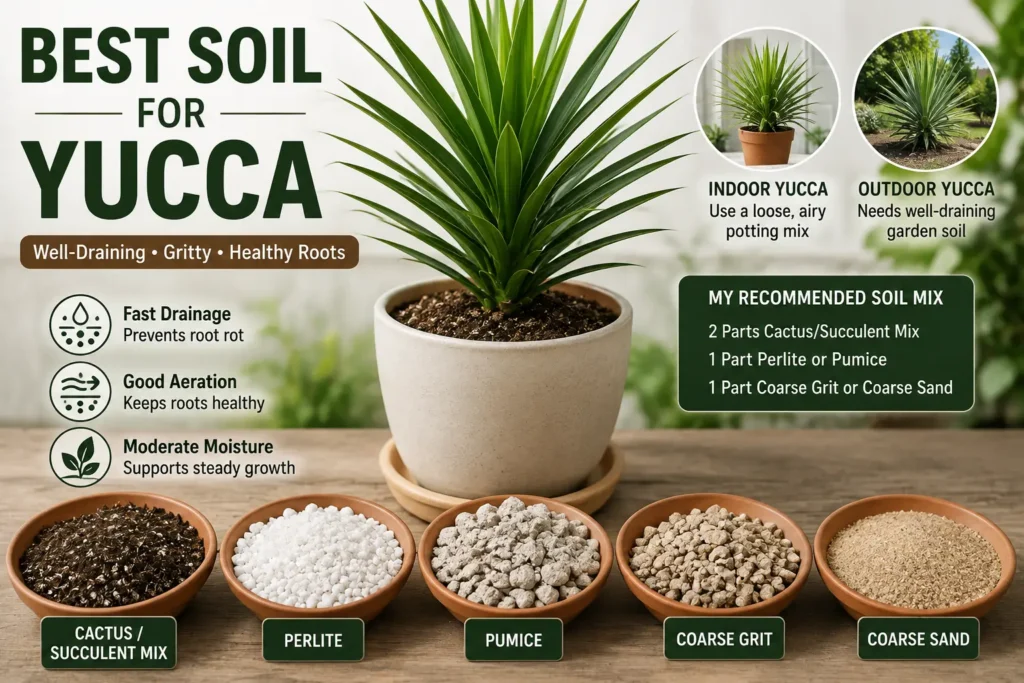
The best soil for yucca is loose, gritty, and fast-draining. I prefer a mix that lets excess water move through the pot instead of keeping moisture around the roots for too long.
For a potted yucca, my starting mix is 2 parts cactus or succulent potting mix, 1 part perlite or pumice, and 1 part coarse horticultural grit. This gives the roots a good balance of drainage, air space, and moderate moisture retention.
The right soil also depends on where you grow the plant. A yucca in a container needs a different approach from one planted directly in a garden bed, especially if your outdoor soil is heavy or stays wet.
What Is the Best Soil for Yucca?
Yucca plants do best in soil that drains freely and does not stay wet for long periods. The root zone needs both moisture and air, so dense soil can create problems even when the plant gets enough light.
I look for four main qualities in yucca plant soil:
- Fast drainage
- Good air space between soil particles
- Moderate moisture retention
- A loose structure that does not compact easily
The exact ingredients can vary. What matters most is the final texture of the growing medium.
What Good Yucca Soil Should Feel Like

Good yucca soil should feel loose and slightly gritty when you handle it.
I look for a mix with some visible mineral particles rather than one that feels smooth, sticky, or muddy. When I add water, it should move through the soil without sitting on the surface for a long time.
The soil should also hold a small amount of moisture after watering. Yucca does not need soil that becomes completely dry immediately.
How to Judge Yucca Soil by Texture
A simple texture check can tell you a lot about a potting mix.
Good yucca soil should be:
- Loose rather than packed
- Gritty rather than fine and muddy
- Easy to break apart
- Free of large wet clumps
- Able to absorb water without becoming sticky
- Able to release excess water through the drainage hole
If the mix feels heavy and stays in a wet lump after watering, I would improve the drainage before planting a yucca.
Best Soil Mix for Yucca Plants

For most indoor container yuccas, I recommend starting with:
2 parts cactus or succulent potting mix
1 part perlite or pumice
1 part coarse horticultural grit
This gives you a simple yucca soil mix without needing a long list of ingredients.
My Recommended Indoor Yucca Soil Mix
| Ingredient | Amount | Main purpose |
| Cactus or succulent mix | 2 parts | Provides the main growing medium |
| Perlite or pumice | 1 part | Adds air space and improves drainage |
| Coarse grit | 1 part | Adds larger mineral particles and helps keep the mix open |
You can measure the parts with a cup, scoop, or small container. The actual size of the measuring tool does not matter as long as you use the same one for every ingredient.
For example, if you use two cups of cactus mix, add one cup of perlite or pumice and one cup of coarse grit.
Why Yucca Soil Recipes Differ
You may find different yucca soil recipes online. That does not mean one recipe is automatically wrong.
Different base mixes hold different amounts of moisture. A very light cactus mix may need less added drainage material than a dense potting mix.
I treat a soil recipe as a starting point rather than a fixed formula. I would check the finished texture and drainage before making further adjustments.
How to Adjust the Mix
If your mix stays wet for too long, increase the mineral portion slightly.
If it dries extremely fast and the plant struggles to get enough moisture, you can add a little more of the organic base.
The goal is a growing medium that lets excess water leave while still giving the roots access to some moisture.
What Ingredients Are Best for Yucca Soil?

Each ingredient has a different job. Once you know what each one does, it becomes easier to make or adjust a yucca potting mix.
Cactus or Succulent Mix
Cactus or succulent soil makes a useful base for yucca because it is generally made with better drainage in mind than many standard houseplant mixes.
I like using it as the starting point rather than trying to build the entire mix from raw materials.
Still, check the texture before using it. Two bags labeled for cactus or succulents can have different textures and moisture-holding properties.
Perlite
Perlite is a lightweight mineral material that creates extra air spaces in potting soil.
It can help prevent the mix from becoming dense and can improve drainage without adding much weight.
For a container yucca, perlite is a practical choice if you want to loosen a regular potting mix.
Pumice
Pumice also adds porous mineral material to the soil.
It is heavier than perlite, which can be useful for larger yuccas that become top-heavy. It also remains in the mix rather than breaking down like some organic materials.
If you have pumice instead of perlite, I would use it in the same general role.
Coarse Sand
Coarse horticultural sand can add mineral material and help create a more open mix.
The word coarse matters here. Very fine sand can fill the spaces between other particles and make the soil denser instead of improving drainage.
I would choose horticultural-grade coarse sand rather than beach sand, play sand, or random construction sand.
Horticultural Grit
Grit provides larger particles that create air spaces in the growing medium.
It can also add weight to a container, which is useful for a tall yucca that could become unstable.
For this reason, grit is one of my preferred additions when making soil for a large indoor yucca.
Peat and Coco Coir
Peat and coco coir can hold moisture and add structure to a potting mix.
They are not automatically bad for yucca. The issue is using too much moisture-holding material in a plant that needs good drainage.
If your base mix already holds a lot of water, adding more moisture-retaining material is unlikely to help.
Compost
Compost adds organic matter and nutrients, but I would keep it as a smaller part of a yucca mix rather than making it the main ingredient.
Too much organic material can make a container mix hold more moisture than you want.
For yucca, I would focus on drainage and soil structure first, then provide nutrients through normal plant care.
Perlite vs Pumice for Yucca

Both perlite and pumice can work well in yucca soil, so you do not need to buy both.
| Feature | Perlite | Pumice |
| Weight | Very light | Heavier |
| Air space | Good | Good |
| Drainage | Good | Good |
| Effect on pot weight | Small | Noticeable |
| Good for large yucca | Useful | Especially useful |
| Easy to mix | Yes | Yes |
If I want a lighter container mix, I would choose perlite.
If I want more weight and a mineral component that stays in the mix, I would choose pumice.
Neither one is automatically the best choice for every yucca.
Sand vs Grit for Yucca

Sand and grit can both be useful, but they are not interchangeable in every situation.
Coarse sand adds smaller mineral particles to the mix. Horticultural grit uses larger particles and can create more noticeable air spaces.
I would avoid using fine sand as the main drainage material. It can settle between larger particles and make the mix more compact.
If you are unsure what to buy, look for a product sold specifically for horticultural use and check its particle size.
Best Soil for Yucca Indoors

Indoor yuccas need a potting mix that drains well because the plant is growing in a restricted container.
A good indoor yucca soil should:
- Drain excess water quickly
- Stay loose rather than compacting
- Contain some organic material
- Include mineral material such as perlite, pumice, or grit
- Work with a pot that has drainage holes
For most indoor plants, I would start with the 2:1:1 cactus mix, perlite or pumice, and coarse grit recipe.
The pot matters too. Even good yucca soil cannot drain properly if the container has nowhere for excess water to escape.
How to Choose Bagged Yucca Soil
You do not have to buy a bag specifically labeled yucca soil.
A cactus or succulent mix can work well if the texture suits the plant. I would check the ingredients and the physical texture before buying.
Look for these signs:
- Mineral particles are present
- The mix feels loose
- It does not feel muddy when wet
- It does not contain an unusually large amount of moisture-retaining material
- The mix is described as free-draining
- The finished soil can dry between waterings
If the commercial mix looks very fine and holds a lot of moisture, I would amend it with perlite, pumice, or coarse grit.
A Simple Bagged Soil Test
If you already have the soil, you can test a small amount before filling the whole pot.
Put some of the mix into a container with drainage holes and add water. Watch how the water moves through the mix.
If water quickly passes through while the soil still retains some moisture, the mix may be a good starting point.
If water sits on top or the soil turns into a dense wet mass, I would add more mineral material.
Best Soil for Outdoor Yucca

Outdoor yucca has more room for its roots, but the soil still needs good drainage.
Many yucca species can grow in sandy, loamy, or other soils as long as excess water can drain away.
The main question I would ask before planting outdoors is:
Does water drain away from this spot, or does it remain wet after rain?
If water regularly collects around the planting area, changing the planting location may be more useful than simply adding a small amount of sand to the planting hole.
Outdoor Soil for Heavy Clay

Heavy clay can create a difficult growing environment because it can hold water and become compact.
If you are planting yucca in heavy soil, focus on improving the overall drainage of the planting area rather than creating a small pocket of different soil around the roots.
A raised planting area or a naturally better-drained location may be a better solution in some gardens.
Can You Use Regular Potting Soil for Yucca?
Yes, but I would not use heavy regular potting soil by itself for a container yucca if it stays wet for a long time.
You can improve regular potting soil by mixing it with materials that increase drainage and air space.
A simple approach is:
- 2 parts regular potting mix
- 1 part perlite or pumice
- 1 part coarse horticultural grit
Check the finished texture before planting.
If the mix still feels dense after you moisten it, add more mineral material rather than adding more water-retaining ingredients.
Can You Use Cactus Soil for Yucca?
Yes. Cactus or succulent soil can be a good starting point for yucca.
The important thing is to look at the actual texture rather than relying only on the label. Some commercial mixes drain faster than others.
If the cactus mix already feels loose and gritty, you may need only a small adjustment. If it feels too fine or moisture-retentive, add perlite, pumice, or coarse grit.
Can You Use Succulent Soil for Yucca?
Yes. Succulent soil is often suitable for yucca because it is made for plants that benefit from good drainage.
Still, I would check the mix rather than assuming every succulent soil behaves the same way.
If it holds too much water, improve the structure with perlite, pumice, or coarse grit.
Can Yucca Grow in Sandy Soil?
Yes, many yucca species tolerate sandy, well-drained soil.
Sandy soil allows water to move through more easily than heavy clay, but extremely loose sand can also drain very quickly and provide less support for roots.
The goal is not simply to make the soil as sandy as possible.
For outdoor yucca, I would aim for soil that drains freely while still holding enough moisture and nutrients for the plant to grow.
What Soil pH Does Yucca Need?
I would not make pH the main focus when choosing yucca soil.
Different yucca species can tolerate a fairly broad range of soil conditions. For a typical home-grown yucca, I would focus first on drainage, soil texture, and aeration.
If you have a serious soil issue outdoors, a soil test can help you decide whether pH needs correction.
What Soil Should You Avoid for Yucca?
The biggest problem is soil that stays wet and compacted for too long.
I would avoid:
- Heavy moisture-retaining potting mixes
- Dense garden soil in containers
- Fine sand used as the main drainage material
- Moisture-control mixes that hold water for extended periods
- Compacted soil
- Soil with poor drainage
- Containers without drainage holes
- Heavy clay in areas that remain wet
This does not mean every ingredient on the list is always harmful. The final soil structure matters more than any single ingredient.
Signs Your Yucca Has the Wrong Soil
Sometimes the plant gives you clues that the growing medium is not working well.
Watch for:
- Soil that stays wet for many days
- Water pooling on the surface
- Water taking a long time to move through the pot
- Soil becoming hard and compacted
- Yellowing leaves combined with consistently wet soil
- A soft or unhealthy stem base
- Very slow growth despite suitable growing conditions
- An unpleasant smell coming from persistently wet soil
These signs can have several causes, so I would not blame the soil immediately.
Start by checking the soil itself. If it stays saturated long after watering, the mix or drainage setup deserves closer attention.
How to Test Yucca Soil for Good Drainage

You do not need special equipment to get a basic idea of how your potting mix behaves.
Simple Drainage Test
- Fill the pot with your dry yucca soil mix.
- Place the pot somewhere water can drain freely.
- Pour water evenly over the surface.
- Watch how quickly water moves through the mix.
- Check whether water pools on top.
- Look underneath the pot to see whether excess water can escape.
- Feel the mix later to see how quickly it moves from wet to moderately dry.
The goal is not for the soil to become completely dry immediately.
You want a mix that allows excess water to leave while keeping enough moisture for the roots.
How to Read the Drainage Test

Your results can help you decide whether the mix needs adjustment.
If water pools on the surface: The mix may be too dense or compacted.
If water moves through easily and the mix remains lightly moist: That is a good starting point.
If water runs straight through and the mix becomes extremely dry very quickly: The mix may contain too much drainage material or too little moisture-holding material.
If the soil remains wet for a long time: Increase the amount of mineral material or check whether the container itself has a drainage problem.
This test is more useful than following a soil ratio without checking how the finished mix behaves.
Soil and Drainage Holes Work Together
I would never judge a yucca soil mix without also looking at the container.
A pot with a drainage hole gives excess water somewhere to go. A decorative outer pot or saucer can still trap water if you leave the inner pot sitting in standing water.
Check these three things together:
Soil: Is the mix loose and free-draining?
Pot: Does the container have a usable drainage hole?
Saucer: Can excess water be emptied after watering?
A problem with any one of these can affect how the soil behaves.
Common Yucca Soil Mistakes

Using Regular Potting Soil Without Checking Its Texture
Some regular potting mixes hold a lot of moisture. If yours stays wet for too long, amend it rather than assuming every bag of potting soil will work the same way.
Using Fine Sand
Fine sand is not the same as coarse horticultural sand. It can make the mix heavier and more compact.
Adding Too Much Organic Material
Compost, peat, and coco coir all have useful roles, but too much moisture-holding material can work against the drainage yucca needs.
Ignoring the Container
Good soil needs a good drainage setup. A pot without a drainage hole can turn even a well-made mix into a moisture problem.
Following a Soil Recipe Without Checking the Result
A recipe is only a starting point.
Your local climate, indoor temperature, pot size, and existing ingredients can change how quickly the mix dries. I prefer checking the finished texture and drainage instead of following a ratio blindly.
Best Yucca Soil Mix at a Glance

| Soil mix | Drainage | Best use | My take |
| Cactus/succulent mix | Good | Indoor yucca | Good starting point |
| Regular potting mix | Moderate | Indoor plants | Better when amended |
| Cactus mix + perlite + grit | Very good | Container yucca | My preferred starting mix |
| Cactus mix + pumice + grit | Very good | Large container yucca | Good when extra weight helps |
| Sandy garden soil | Good | Outdoor yucca | Suitable if it drains well |
| Heavy clay | Poor | Outdoor planting | Improve drainage first |
| Fine sand-heavy mix | Variable | Containers | I would avoid it |
| Moisture-control mix | Low for this use | Water-retentive setups | Not my first choice |
What I Recommend for Different Yucca Situations
If you want a quick answer, I would use this guide:
For an indoor yucca: Start with cactus or succulent mix, then add perlite or pumice and coarse grit.
For a large indoor yucca: Pumice and grit can be useful because they add mineral structure and some weight.
For an outdoor yucca: Use the existing garden soil if it drains well. If the area stays wet, fix the drainage problem rather than relying on a small amount of amended soil.
For regular potting soil: Amend it with drainage material instead of using it heavily on its own.
For heavy clay: Look for a better-drained planting location or improve the larger planting area.
For a commercial cactus mix: Check the texture before deciding whether it needs extra perlite, pumice, or grit.
How to Choose Soil Based on Your Yucca’s Situation
| Your situation | Best starting point |
| Indoor yucca | Cactus or succulent mix + perlite/pumice + grit |
| Large indoor yucca | Cactus mix + pumice + grit |
| Regular potting soil | Amend with perlite, pumice, or grit |
| Outdoor sandy soil | Usually suitable if drainage is good |
| Heavy clay soil | Improve the larger planting area |
| Soil stays wet | Increase drainage and check the pot |
| Soil dries too quickly | Add a little more moisture-holding base |
This approach is more useful than trying to find one soil recipe that works in every situation.
Final Take
For me, the best yucca soil is less about finding one perfect brand or recipe and more about getting the soil structure right.
For a container yucca, I would start with 2 parts cactus or succulent mix, 1 part perlite or pumice, and 1 part coarse grit. For outdoor yuccas, I would pay more attention to the natural drainage of the planting site before changing the soil.
The main rule is simple: give yucca a loose growing medium that drains excess water instead of keeping the roots wet for long periods. Once the soil, pot, and drainage setup work together, the plant has a much better base for healthy growth.
Frequently Asked Questions
What is the best soil for yucca?
The best soil for yucca is loose, well-draining soil with good air space and moderate moisture retention. For container plants, a cactus or succulent mix combined with perlite or pumice and coarse grit makes a good starting point.
Is cactus soil good for yucca?
Yes. Cactus soil can work well for yucca because it is generally made for plants that prefer good drainage. Check the texture and add mineral material if the mix stays too wet.
Can I use regular potting soil for yucca?
Yes, but I would amend it if it holds too much moisture. Adding perlite, pumice, or coarse grit can create a looser, faster-draining yucca plant potting mix.
Does yucca need sandy soil?
Yucca can grow well in sandy soil, especially outdoors, as long as the soil provides enough support and does not drain so quickly that the plant struggles. The key feature is good drainage rather than a specific percentage of sand.
Is perlite good for yucca?
Yes. Perlite can improve air space and drainage in yucca potting soil. It is especially useful when a regular potting mix feels too dense.
Is pumice good for yucca?
Yes. Pumice provides porous mineral material and can help keep the soil structure open. It is also heavier than perlite, which can help stabilize large container-grown yuccas.
What kind of sand is best for yucca?
Use coarse horticultural sand or another gardening-grade coarse sand. I would avoid relying on fine sand because it can make the growing medium dense.
What is the best soil mix for indoor yucca?
A practical starting mix is 2 parts cactus or succulent mix, 1 part perlite or pumice, and 1 part coarse grit. Adjust the mineral portion if the finished mix stays wet for too long.
Can yucca grow in clay soil?
Some yuccas can tolerate different garden soils, but heavy clay becomes a problem when it stays wet and compacted. If your planting area drains poorly, improve the larger soil area or choose a better-drained location.
Does yucca need well-draining soil?
Yes. Good drainage is one of the most important features of yucca soil. The roots need access to air, and excess water needs a way to leave the root zone.
Why does my yucca soil stay wet?
The cause may be a moisture-retentive mix, poor drainage holes, a large container, compacted soil, or low evaporation. Check the soil texture and the container before changing your watering routine.
Can I use succulent soil for yucca?
Yes. Succulent soil is often suitable for yucca because it is made for plants that benefit from good drainage. Check the texture and adjust the mix if it stays wet for too long.