Skip to content
Repotting a yucca plant is fairly simple, but I would not move a yucca into a new pot just because it has been in the same container for a certain amount of time. I prefer to check the roots, soil, drainage, and plant size first.
A yucca usually needs repotting when its roots have filled the container, the soil has broken down, drainage has become poor, or the plant has become unstable. When I repot one, I use a pot that is only slightly larger, fresh well-draining soil, and keep the plant at about the same soil depth.
In this guide, I will show you how to repot a yucca plant step by step. I will also cover root-bound yuccas, pot size, soil, root trimming, watering, post-repot care, common mistakes, and problems that can appear after repotting.
Quick Answer: How Do You Repot a Yucca Plant?
To repot a yucca, choose a container with drainage holes that is about 1 to 2 inches wider than the current pot. Remove the plant carefully, inspect and gently loosen crowded roots, place it at the same depth in fresh well-draining soil, and water only as needed after repotting. Avoid oversized pots and excessive watering while the plant settles.

Does Your Yucca Plant Need Repotting?
A yucca does not need a new pot simply because a certain amount of time has passed. I prefer to look at the plant and root system first.
Some yuccas can stay slightly root-bound without immediate problems. Indoor yuccas are often repotted every two to three years, but the actual timing depends on the plant’s growth, root condition, soil, and container.
Signs Your Yucca Is Ready for a New Pot

Look for these signs:
- Roots growing through the drainage holes
- Roots forming a tight circle around the inside of the pot
- Roots appearing on top of the soil
- Water running through the pot very quickly
- Soil that has become hard or badly compacted
- The plant becoming unstable in its current container
- The root ball taking up almost all of the pot
- The current pot becoming damaged or too small for the plant
Roots coming out of the drainage hole are one of the easiest signs to spot. A tightly packed root system or soil that drains unusually fast can also tell me that it is time to inspect the root ball.
When I Would Not Repot
If the yucca looks healthy, the soil drains well, and the roots still have usable space, I would leave it alone.
Repotting disturbs the root system. There is little benefit in moving a healthy yucca into a larger container simply to give it more soil.
A Simple Yucca Repotting Decision Guide
| What you see | What I would do |
| Roots have plenty of room | Keep the current pot |
| A few roots are crowded | Monitor the plant |
| Roots fill most of the pot | Plan to repot |
| Roots grow from drainage holes | Inspect the root ball |
| Soil stays wet for a long time | Check the soil mix and drainage |
| Plant is unstable | Consider a heavier container |
| Large plant is difficult to move | Consider top-dressing |
When Is the Best Time to Repot a Yucca?
Spring is usually my preferred time for repotting a healthy yucca because the plant has the growing season ahead of it.
You do not have to wait for spring if there is a serious problem. A broken container, badly compacted soil, poor drainage, or damaged roots can make repotting necessary at another time.
For a routine repot, I would choose a mild period when the plant is actively growing rather than repotting simply because the calendar says it is time.
What You Need to Repot a Yucca
Before starting, I like to have everything ready. This keeps the plant out of its container for as little time as possible.
Repotting Checklist
- A new pot with drainage holes
- Fresh well-draining potting mix
- Gardening gloves
- A small hand trowel
- Clean pruning shears
- Newspaper, cardboard, or a clean work surface
- A watering can
- A clean cloth for removing loose soil
If your yucca is tall or very large, I would also have another person available to help.
Yucca leaves can have sharp tips, so gloves and long sleeves are useful while handling the plant.
How to Choose the Right Pot for a Yucca
Choosing the right container is just as important as choosing the soil.
I would avoid moving a small yucca into a huge pot. A much larger container holds more soil, and that soil can stay wet for longer after watering.
How Much Bigger Should the New Pot Be?

In most cases, choose a container about one or two sizes larger than the current one.
A pot that is roughly 1 to 2 inches wider than the current container is a useful general guide when the plant needs more room. The exact size depends on the root ball, but there is no need to give a yucca a huge jump in container size.
Should You Use a Heavy Pot?
I prefer a stable, heavy container for a tall yucca.
Yuccas can become top-heavy as they grow. A lightweight plastic pot may tip more easily, especially when the plant has a tall trunk.
Terracotta and ceramic containers can provide more stability, but good drainage remains the main requirement.
Does the Pot Need Drainage Holes?
Yes.
I would not put a yucca directly into a container with no drainage hole.
Excess water needs a way to leave the pot. A drainage hole also makes it easier to tell whether water is moving through the soil properly.
What Soil Should You Use When Repotting Yucca?
Yucca needs a loose, well-draining growing mix.
For a simple option, I would use a cactus or succulent mix. You can also improve drainage with materials such as perlite or pumice.
The main thing I look for is a soil mix that does not remain wet for long periods.
Avoid heavy garden soil for an indoor potted yucca. Container soil needs enough air space around the roots while allowing excess water to drain.
For a detailed look at soil recipes and materials, see my guide to the best soil for yucca.
Can You Use Regular Potting Soil for Yucca?
You can use regular indoor potting soil, but I would not use a heavy moisture-retaining mix by itself for most container-grown yuccas.
A cactus or succulent mix is an easier starting point because it is usually made to drain more freely. If you already have regular potting soil, you can combine it with a suitable drainage material such as perlite or pumice.
The goal is simple: give the root system a growing medium that drains well and does not stay saturated after watering.
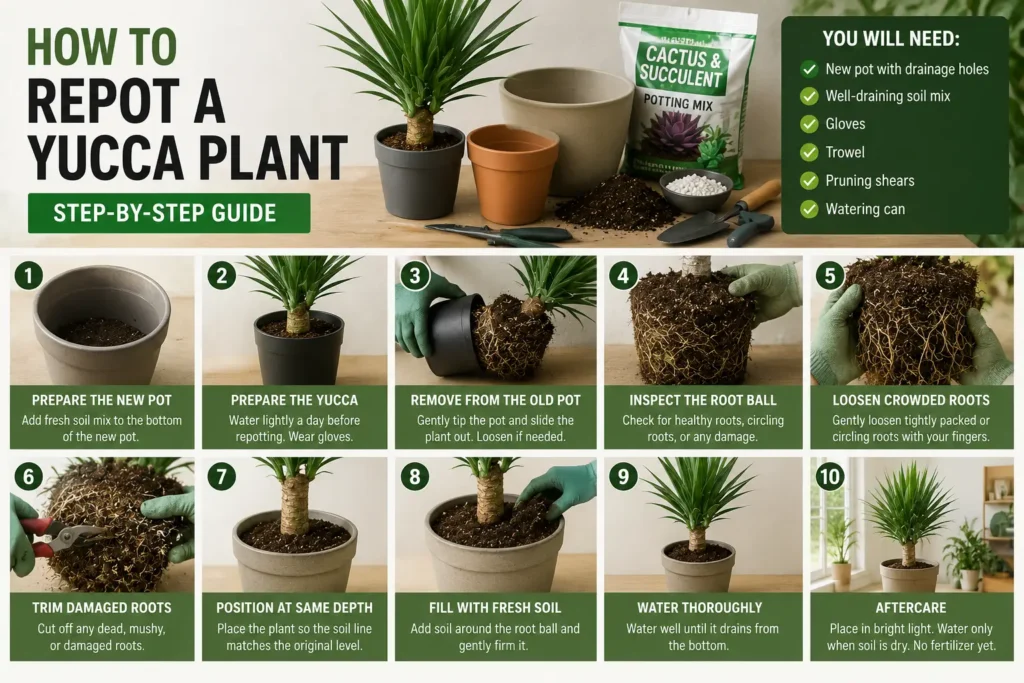
How to Repot a Yucca Plant Step by Step
Once the pot, soil, and tools are ready, the process is straightforward.
1. Prepare the New Pot
Start by cleaning the new container if it has been used before.
Check the drainage holes and make sure they are open. Add enough fresh potting mix to the bottom of the container so that the top of the yucca’s root ball will sit at the correct height.
I do not fill the entire pot before placing the plant inside. I add enough soil to create a base, then adjust the level after checking the root ball.
2. Prepare the Yucca
Move the plant to a clear workspace.
Put on gloves and wear long sleeves if the leaves are sharp. If the yucca is tall, have someone help hold the plant while you work.
I prefer to handle the plant by the root ball or lower trunk rather than pulling on the leaves.
3. Remove the Yucca From Its Old Pot
Tip the container carefully and support the plant as you remove it.
If the root ball is stuck, do not yank the trunk upward.
Instead, gently squeeze a flexible plastic pot or run a dull tool around the inside edge of the container to loosen the root ball.
Once the plant comes free, place it on your work surface.
4. Inspect the Root Ball

This is where I decide how much work the roots actually need.
Look for:
- Healthy firm roots
- Tightly circling roots
- A dense mass of roots around the container edge
- Dark, mushy, or damaged roots
- Very little soil remaining between the roots
Healthy roots do not need aggressive cutting.
If the roots are simply crowded, gently loosen the outer layer with your fingers. I would avoid tearing apart the entire root ball just because some roots are circling.
5. Loosen Crowded Roots Carefully
If your yucca is root-bound, work around the outer portion of the root ball.
Use your fingers to gently separate roots that have become tightly packed.
The goal is to help the roots move into the fresh soil. You do not need to turn the root ball into a loose pile of individual roots.
If the roots are heavily tangled, take your time rather than forcing them apart.
6. Trim Only Damaged Roots

Healthy roots should generally stay in place.
If you find roots that are clearly dead, mushy, or damaged, remove those sections with clean pruning shears.
I would not cut healthy roots simply to make the root ball smaller unless there is a specific reason to do so.
If the plant has severe root damage, repotting becomes more than a simple container upgrade. At that point, the condition of the remaining root system matters more than giving the plant a larger pot.
7. Position the Yucca at the Same Depth

This is one step I pay close attention to.
Place the yucca in the center of the new pot and check the old soil line on the root ball.
The new soil should come up to about the same level as the old soil.
Do not bury more of the trunk simply because the new container is deeper.
The root ball should sit securely without the plant being planted too deeply.
8. Add Fresh Soil Around the Root Ball

Once the yucca is sitting at the correct height, fill the open spaces around the root ball with fresh potting mix.
Add the soil gradually.
Gently tap the sides of the pot to help the mix settle into open spaces.
I would not press the soil down hard. A loose mix gives the roots better air space and allows excess water to move through the container.
9. Check the Plant Before Watering
Step back and look at the plant.
Make sure:
- The yucca is centered
- The trunk is upright
- The soil line is correct
- The root ball is fully covered
- The soil is not packed tightly
- The drainage holes remain clear
If the plant is leaning, correct it before you finish.
10. Water the Repotted Yucca

Water according to the condition of the new soil and root system.
If you water after repotting, allow excess water to drain completely from the bottom of the pot.
Do not leave the container sitting in a saucer full of water.
After this first watering, I would check the soil before watering again rather than following a fixed schedule. Light, temperature, pot size, and soil mix all affect how quickly the container dries.
How to Repot a Root-Bound Yucca

A root-bound yucca has roots that have filled much of the container and may form a dense circle around the outside of the root ball.
What Root-Bound Yucca Roots Look Like
You may see:
- Roots growing through drainage holes
- A solid mass of roots
- Roots circling the container
- Very little loose soil
- Roots growing across the surface
- Water passing through unusually quickly
A little crowding is not automatically a serious problem with yucca. I would look at the whole plant before deciding what to do.
Should You Loosen Root-Bound Yucca Roots?
Yes, but gently.
Start at the outside of the root ball and loosen the tightest roots with your fingers.
If the roots are severely crowded, you can remove clearly dead or damaged sections with clean shears.
I would avoid cutting healthy roots simply because they are growing in circles.
The goal is to help the roots move into the new soil without causing unnecessary damage.
How to Repot a Large Yucca Plant

Large yuccas require more care because the plant can be tall, heavy, and difficult to control.
I would not try to wrestle a large yucca out of its container alone.
Use Two People for Large Plants
One person can support the trunk and foliage while the other works on the pot.
Lay the plant down carefully if needed, but protect the leaves and trunk from sharp edges.
If the plant is extremely large, moving it into a new container may be more work than the plant actually needs.
When Top-Dressing Is Better Than Repotting
Top-dressing means removing some of the old surface soil and replacing it with fresh potting mix.
I would consider this option when:
- The roots are not severely crowded
- The pot is still a suitable size
- The plant is healthy
- The main issue is old surface soil
- The plant is too large to handle safely
This can be a useful option for mature yuccas that are difficult to move.
What to Do After Repotting a Yucca

The work does not end when the plant goes into the new pot.
For the first few weeks, I pay closer attention to moisture, light, and signs of stress.
Keep the Plant in Suitable Light
A newly repotted yucca does not need a completely different location.
I would avoid making several major changes at once. Keep the plant in a suitable bright location and give it time to settle.
If the plant shows some temporary stress after the root system has been disturbed, give it time before making another major change.
Be Careful With Watering
Fresh soil can behave differently from the old mix.
The new container may also be larger, which can change how quickly the soil dries.
I would check the soil before watering again instead of assuming that the plant needs water because it has just been repotted.
This is especially important if you used a mix that holds moisture for a long time.
For more detail, see my guide on how often to water a yucca plant.
Do Not Rush to Fertilize
Fresh potting mix may already contain nutrients.
I would give the plant time to settle before adding fertilizer unless there is a specific reason to feed it.
There is no benefit in making several major changes immediately after repotting.
How Long Does a Yucca Take to Recover After Repotting?
A yucca may need some time to settle after its root system has been disturbed.
I would not judge the plant by one slightly drooping leaf. Instead, I would watch its overall condition over time.
Look for:
- Leaves staying firm and healthy
- The trunk remaining stable
- Soil drying at a reasonable rate
- No soft or damaged roots
- No worsening signs of stress
- New growth appearing when conditions are suitable
Avoid making another major change immediately if the plant is simply showing mild transplant stress.
If the plant keeps getting worse, check the soil moisture, drainage, root condition, and planting depth.
Why Is My Yucca Drooping After Repotting?
Some temporary drooping can happen after repotting because the root system has been disturbed.
Before watering again, check the soil.
If the soil is already wet, adding more water can create a bigger problem. If the soil is dry, the plant may need water depending on the soil mix and current conditions.
I would also check whether the yucca is sitting in a suitable bright location and whether the roots were heavily disturbed during the repotting process.
A single drooping leaf is less concerning than a plant that continues to decline.
Common Yucca Repotting Mistakes

Here are the mistakes I would avoid:
- Using a pot that is much too large
More soil can mean more moisture around the root system. - Choosing a pot without drainage holes
Excess water has nowhere to go. - Burying the trunk too deeply
Keep the yucca close to its original soil depth. - Packing the new soil too tightly
Loose soil gives the roots better air space and drainage. - Cutting healthy roots unnecessarily
Remove only roots that genuinely need removal. - Watering repeatedly after repotting
Check the soil before watering again. - Repotting just because the calendar says it is time
Look at the plant and root system first. - Using a very light pot for a tall yucca
A top-heavy plant can tip over. - Trying to move a huge yucca alone
Get help rather than risking damage to yourself or the plant. - Changing the soil, light, watering, and location all at once
Give the plant a stable place while it settles.
Yucca Repotting Problems and What to Do

| Problem | Possible reason | What I would check |
| Leaves droop after repotting | Root disturbance or moisture issue | Soil moisture and root condition |
| Soil stays wet for a long time | Heavy mix or oversized pot | Drainage and pot size |
| Plant keeps leaning | Unstable container | Pot weight and plant position |
| Water runs straight through | Very dry or tightly packed root ball | Root condition and soil structure |
| Roots are tightly packed | Root-bound plant | Root ball and container size |
| Lower leaves turn yellow | Natural aging or moisture issue | Overall plant and soil |
| Trunk becomes soft | Serious moisture or root issue | Roots and soil immediately |
| Pot tips over | Container is too light | Use a heavier, stable pot |
Not every yellow leaf means the repotting failed. I would look at the whole plant and soil before reacting to one leaf.
Should You Repot a Yucca Into a Much Bigger Pot?
I would not.
The goal is to give the roots enough new space, not to surround them with a huge amount of fresh soil.
A modest increase in pot size is easier to manage because there is less excess soil around the root system. A heavier container can also help keep tall yuccas stable.
Can You Repot a Yucca Without Changing the Pot Size?
Yes.
If the existing pot is still a good size but the soil has broken down or drainage has become poor, you can sometimes refresh the soil without moving to a larger container.
This can be a good option for a mature yucca that already fills its container well.
Can You Repot a Yucca With Root Rot?
If you suspect root rot, the job becomes more urgent.
Remove the plant from the container and inspect the roots. Clearly damaged, soft, or rotten sections should be removed with clean tools.
Then place the plant into fresh, well-draining soil and a clean container with proper drainage.
Do not put a damaged root system back into the same wet, compacted soil and expect the problem to solve itself.
Can Yucca Stay Root-Bound?
A yucca can tolerate some root crowding, so I would not treat every root-bound plant as an emergency.
Once the roots become severely crowded or drainage and plant stability suffer, repotting becomes more useful.
The important thing is to look at the whole plant rather than reacting to one root growing through a drainage hole.
Can You Repot a Large Yucca Plant?
Yes, but large plants can be difficult to handle.
I would get another person to help with a tall yucca. If the plant is healthy and the main issue is old surface soil, top-dressing can be a more practical option than a full repot.
How Often Should I Repot a Yucca Plant?
There is no fixed schedule that works for every plant.
Indoor yuccas can often stay in the same container for several years. I would use root growth, soil condition, drainage, and plant stability as the main signs that repotting is needed.
What Size Pot Should I Use for a Yucca?
Choose a pot only moderately larger than the current one.
A container around 1 to 2 inches wider is a useful general guide when the plant needs more room. The root ball should have enough space to grow without being surrounded by a large amount of unused soil.
What Is the Best Pot for a Yucca Plant?
I prefer a stable pot with drainage holes.
A heavy terracotta or ceramic container can work well for a tall, top-heavy yucca. Plastic can also work if the container is stable enough for the plant.
Should I Loosen the Roots When Repotting Yucca?
If the roots are tightly circling the root ball, gently loosen the outer roots.
Avoid aggressively tearing apart healthy roots. The goal is to help the root system move into the fresh soil while keeping unnecessary damage low.
Should I Cut Yucca Roots When Repotting?
Only cut roots that are clearly damaged, dead, or causing a specific problem.
Healthy roots do not need to be cut simply because they are crowded.
Final Take
I find the best approach to yucca repotting is to keep the process simple. First, check whether the plant actually needs a new container. Then choose a pot with drainage holes that is only moderately larger, use loose and well-draining soil, and handle the root ball gently.
The details that matter most are easy to keep in mind: do not use an oversized pot, do not bury the yucca deeper than before, do not cut healthy roots without a reason, and do not keep the fresh soil constantly wet.
If the plant is large and difficult to move, do not force a full repot. Sometimes refreshing the surface soil is the better option.
With the right pot, suitable soil, careful root handling, and sensible watering, repotting can give a yucca a better growing setup without putting unnecessary stress on the plant.
Frequently Asked Questions
How often should I repot a yucca plant?
There is no fixed schedule. I would repot a yucca when the roots fill the container, the soil becomes compacted, drainage gets worse, or the plant becomes unstable.
What size pot should I use for a yucca?
Choose a pot about 1 to 2 inches wider than the current container. I would avoid a much larger pot because excess soil can hold moisture for too long.
What is the best soil for repotting a yucca?
I prefer a loose, well-draining mix. A cactus or succulent mix works well, and you can add perlite or pumice if the mix needs better drainage.
Should I loosen yucca roots when repotting?
If the roots are tightly packed or circling the root ball, gently loosen the outer roots with your fingers. Avoid aggressively pulling apart healthy roots.
Should I cut the roots when repotting a yucca?
Only remove roots that are clearly dead, soft, or damaged. Healthy roots generally do not need to be cut just because they are crowded.
Should I water a yucca after repotting?
You can water after repotting when the soil and root condition call for it. Let excess water drain completely, then check the soil before watering again.
Why is my yucca drooping after repotting?
Some temporary drooping can happen after the roots have been disturbed. Check the soil moisture, drainage, planting depth, and light before making another change.
Can a yucca stay root-bound?
Yes, yuccas can tolerate some root crowding. I would consider repotting when the roots become severely crowded or the plant starts having drainage, growth, or stability problems.
Can I repot a large yucca plant?
Yes, but large yuccas can be difficult to handle. I recommend getting help with a tall plant. If it is healthy and only needs fresh surface soil, top-dressing may be a better option.
Can I repot a yucca in winter?
You can repot a yucca in winter if there is a serious problem with the roots, soil, drainage, or container. For routine repotting, I prefer spring.
Can I use regular potting soil for a yucca?
You can, but I would avoid a heavy mix that stays wet for long periods. A well-draining cactus or succulent mix is usually a better starting point.
How long does a yucca take to recover after repotting?
Recovery varies depending on the plant, roots, soil, light, and watering. I would give the plant time to settle rather than making several additional changes immediately after repotting.