Skip to content
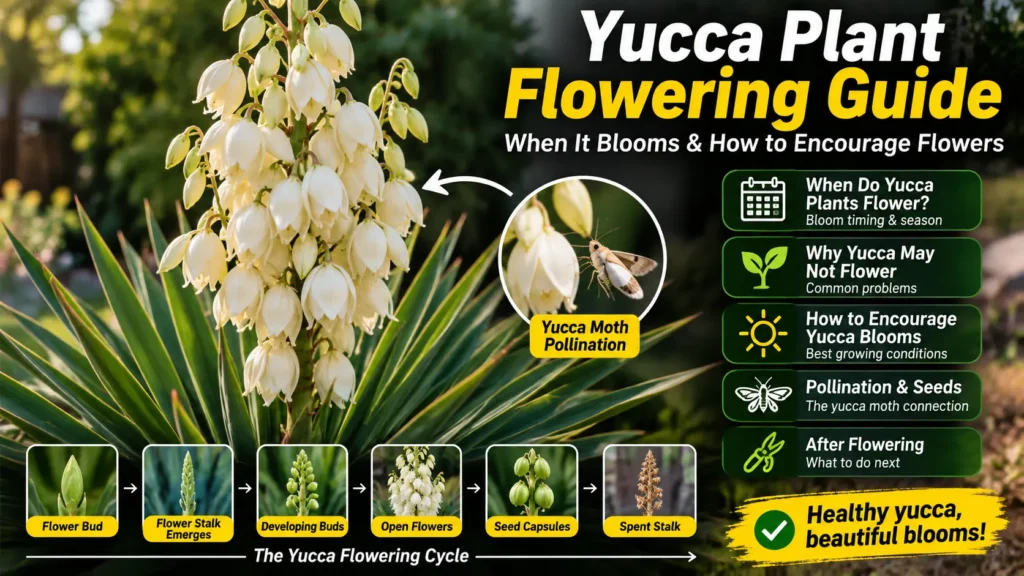
Yucca plants are best known for their stiff, sword-shaped leaves, but their flowers can be the most striking part of the plant. A mature yucca can send a tall flower stalk from the center of its leaves, followed by clusters of creamy white, bell-shaped flowers.
I look at yucca flowering as the result of several factors working together. The plant needs to be mature enough to bloom, and species, light, growing conditions, and seasonal weather can all affect the result. A healthy yucca may flower well one year and produce few or no flowers the next, and that does not always mean something is wrong.
Quick Answer: When Do Yucca Plants Flower?
Most mature yucca plants flower during the warmer part of the growing season, usually from late spring through summer, although the exact timing varies by species and climate. Some varieties can flower later in summer or early fall. A flowering yucca produces a tall central stalk covered with clusters of creamy white, bell-shaped flowers. Some mature plants may also skip a flowering season.
Do Yucca Plants Flower?
Yes, mature yucca plants can produce flowers.
The process usually starts with a flower bud or thick growth appearing from the center of the leaf rosette. This growth develops into a tall flower stalk that rises above the leaves. As it grows, the stalk produces branches or clusters of flower buds.
Once the buds open, you can see the typical white or creamy yucca flowers.
The exact appearance depends on the species. Some yuccas produce very tall flower stalks, while others have shorter or more compact flower clusters.
What Do Yucca Flowers Look Like?
Yucca flowers are usually:
- White to creamy white
- Bell-shaped or cup-shaped
- Produced in clusters
- Carried on tall flower stalks
- Positioned above the main leaf rosette
- Sometimes slightly drooping when fully open
The flowers stand out against the stiff green foliage. On a mature plant, a large flower stalk can rise several feet above the leaves.
How Does a Yucca Flower Develop?

The flowering process is easier to follow when you know what to look for.
| Flowering stage | What you may see | What I would do |
| Flower bud | Small growth starts emerging from the center | Continue normal care |
| Flower stalk | A thick stalk begins rising above the leaves | Avoid unnecessary disturbance |
| Developing buds | Small buds appear along the stalk | Keep light and moisture conditions steady |
| Open flowers | White or creamy bell-shaped flowers appear | Enjoy the bloom and continue normal care |
| Fading flowers | Flowers lose color and begin drying | Decide whether you want to keep the stalk |
| Seed development | Seed capsules may form after successful pollination | Leave the stalk if you want to collect seed |
| Spent stalk | The flower stalk becomes dry and brown | Remove it if you prefer |
This cycle can take time, so I would not worry if the stalk develops slowly at first.
When Do Yucca Plants Flower?
There is no single flowering month for every yucca.
The species, local climate, temperature, rainfall, plant maturity, and growing conditions can all affect the timing. Some yuccas flower in spring, while many common garden varieties bloom during late spring or summer.
Yucca Flowering Season

As a general guide, yucca flowering can occur during these periods:
| Period | What you may see |
| Spring | Flower stalks or early blooms on some species |
| Late spring | More mature plants beginning to flower |
| Summer | Peak flowering for many garden yuccas |
| Late summer | Some varieties begin or continue blooming |
| Early fall | Later-flowering varieties may still have flowers |
Use these periods as a general guide rather than a strict calendar. Your yucca’s species and local climate matter more than a specific month.
What Month Does Yucca Bloom?
Many garden yuccas bloom around late spring or summer, but there is no single month that applies to every plant.
If you know the species, check its usual flowering period first. If you do not know the species, watch the plant’s growth rather than waiting for one particular month.
How Long Do Yucca Flowers Last?
Yucca flowers provide a seasonal display rather than staying open indefinitely.
Individual flowers open along the stalk over time. This means the overall flowering display can continue even after the first flowers begin to fade.
The exact length varies with species and growing conditions.
Once flowering finishes, the flowers dry and the stalk may eventually turn brown.
How Often Do Yucca Plants Flower?
There is no universal flowering schedule for every yucca.
Some mature yuccas can flower every year when growing conditions are suitable. Others may skip a season or flower less often.
I would not assume that a healthy yucca must produce flowers every year.
Flowering uses a lot of the plant’s resources, and seasonal weather can also affect flower production. A plant that produced a large flower display one year may simply have a quieter year afterward.
Do Yuccas Flower Every Year?
Some mature yuccas can flower every year, but annual flowering is not guaranteed.
Species, plant maturity, light, seasonal weather, and general growing conditions can all affect whether a yucca produces flowers in a particular year.
If your plant flowered last year but has no flower stalk this year, check its health and growing conditions first. If the leaves look healthy and the plant is growing normally, a missed flowering season does not automatically mean there is a problem.
How Old Does a Yucca Have to Be to Flower?
A yucca needs to reach reproductive maturity before it can produce flowers.
There is no single age that applies to every species. Growth rate, climate, light, soil conditions, and the type of yucca all affect how quickly it reaches flowering size.
A young plant may spend several growing seasons producing leaves and developing its root system before producing its first flower stalk.
If your yucca is still small, I would give it time instead of trying to force it into flowering.
Yucca Flowering Times by Species

Different yucca species can have different flowering periods.
| Yucca species | General flowering period | Flower color | Useful note |
| Yucca filamentosa | Late spring to summer | White to creamy white | Common garden yucca |
| Yucca gloriosa | Late summer to autumn | Creamy white | Often flowers later in the season |
| Yucca rostrata | Spring to summer | White | Known for its tall, trunk-forming shape |
| Yucca rigida | Spring to summer | White | Blue-green foliage is a common feature |
| Yucca elata | Spring | White | Often associated with desert habitats |
| Yucca brevifolia | Spring | Creamy white | Commonly known as the Joshua tree |
These periods are general. Weather and local growing conditions can shift flowering from one year to another.
For a broader look at the different types, see my guide to yucca plant varieties.
Why Is My Yucca Not Flowering?

If your yucca has healthy leaves but no flowers, several factors could be responsible.
The Yucca Is Too Young
A young plant may simply not be mature enough to flower.
I would not compare a small nursery plant with a large established yucca and expect the same flowering behavior. The plant needs time to reach the right stage of growth.
It Does Not Get Enough Light
Light is an important part of healthy yucca growth.
Outdoor yuccas generally prefer plenty of sunlight, while indoor plants can struggle if they spend most of the day in a dim location.
If your indoor yucca is healthy but has never flowered, I would check its light before changing its fertilizer routine.
The Soil Holds Too Much Water
Yuccas generally prefer well-drained soil.
If water remains around the roots for too long, the plant can become stressed and develop root problems. This can affect its overall growth and may reduce its ability to flower.
If the soil stays wet for a long time after watering, check the container, drainage holes, and growing medium.
Too Much Nitrogen
Nitrogen encourages leafy growth, but adding large amounts of fertilizer is not a reliable way to make a yucca flower.
If your plant produces plenty of leaves but never develops a flower stalk, I would review the feeding routine instead of simply adding more fertilizer.
The Plant Is Under Stress
A stressed yucca may focus its resources on maintaining healthy growth instead of producing flowers.
Possible sources of stress include:
- Poor drainage
- Root damage
- Major transplant stress
- Insufficient light
- Extreme temperatures
- Major changes in growing conditions
- Long periods of unsuitable moisture
Fix the basic growing conditions before trying to encourage flowering.
The Yucca Flowered Recently
A previous flowering season can also be part of the picture.
If the plant produced a large flower stalk and many flowers last year, it may not produce the same display the following year.
I would look at the whole plant rather than judging it only by the presence or absence of flowers.
The Species Naturally Flowers Less Often
Not every yucca follows the same bloom cycle.
Some species can flower regularly under suitable conditions, while others may have less predictable flowering. This is another reason to identify your plant before deciding that something is wrong.
Why Does My Yucca Flower Some Years but Not Others?
If your yucca blooms one year and skips the next, I would not immediately assume that you made a mistake.
Flower production depends on several factors. The plant needs enough stored resources to produce the flower stalk, while temperature, rainfall, sunlight, and other seasonal conditions can also affect flowering.
This is particularly noticeable in yuccas growing in areas with changing weather from year to year.
A simple way to look at it is:
Healthy plant + mature age + suitable conditions does not always equal flowers every year.
The plant still follows its natural flowering cycle.
How to Encourage a Yucca Plant to Flower

You cannot make a yucca flower on a fixed schedule, but you can give a mature plant conditions that support healthy flowering.
I recommend focusing on these areas:
- Provide suitable light. Give outdoor yuccas plenty of sun where appropriate for the species. Indoor plants should have the brightest suitable location available.
- Use well-draining soil. Avoid growing conditions where water remains around the roots for long periods.
- Water sensibly. Do not keep the soil constantly wet.
- Avoid excessive fertilizer. More fertilizer does not automatically mean more flowers.
- Let the plant mature. Young yuccas may simply need more time.
- Protect root health. Good drainage and suitable soil help reduce root stress.
- Avoid unnecessary disturbance. Repeated major changes can add stress to an otherwise healthy plant.
- Give it time. Flowering naturally varies between species and growing seasons.
For more detail on general plant health, see my guide to yucca plant care.
Can an Indoor Yucca Plant Flower?

Yes, an indoor yucca can flower, but indoor flowering is much less common than the leafy growth most people see from houseplant yuccas.
The main challenge is often light. Indoor rooms can be much dimmer than the bright conditions yuccas receive outdoors.
An indoor yucca also needs to reach sufficient maturity before it can flower.
If you want to give an indoor plant the best chance of producing flowers, focus on:
- Bright light
- Good drainage
- Sensible watering
- A mature plant
- Stable growing conditions
- Healthy roots
- Suitable container conditions
For the complete indoor routine, see my guide on how to grow and care for yucca plants indoors.
How to Encourage an Indoor Yucca to Flower
I would start with light rather than fertilizer.
If the plant sits in a dim corner all day, adding fertilizer is unlikely to solve the main issue. Move it to a brighter suitable location, keep the soil well drained, and give the plant time to mature.
What Does a Yucca Flower Stalk Look Like?
A yucca flower stalk usually emerges from the center of the leaf rosette.
At first, the new growth can look like a thick shoot coming from the middle of the plant. It gradually becomes taller and more obvious.
As the stalk develops, flower buds form along its upper branches. The buds eventually open into the familiar white or creamy bell-shaped flowers.
A mature flower stalk can rise well above the leaves, making it easy to spot.
Do Yucca Flowers Need Pollination?
Pollination is important if the plant is going to produce viable seeds.
Yuccas have a special relationship with yucca moths. Female yucca moths collect pollen from yucca flowers and transfer it to the stigma of another flower.
The moth also lays eggs in or near developing flowers. Some of its larvae later feed on a portion of the developing seeds.
This relationship benefits both the moth and the plant.
The moth gets a place to reproduce and food for its larvae, while the yucca receives pollination that can lead to seed production.
What Is the Yucca Moth?
The yucca moth is a small moth closely associated with yucca plants.
Its behavior is different from that of an ordinary flower visitor. The female collects yucca pollen and actively transfers it to the flower’s reproductive surface.
This makes the moth an important part of natural yucca reproduction.
Can Yucca Flowers Be Hand-Pollinated?
Yes, yucca flowers can be hand-pollinated when seed production is the goal.
The basic idea is to transfer pollen to the appropriate part of a receptive flower using a clean tool.
This can be useful for gardeners growing yuccas outside the range of their natural pollinators.
For normal ornamental growing, though, I would not worry about hand pollination unless you specifically want to produce seeds.
Can Yucca Flowers Produce Seeds?

Yes, successful pollination can lead to seed development in suitable yucca species.
After the flowers fade, you may notice developing fruit or seed capsules. These can mature over time and contain seeds.
If you want to collect seeds, leave the developing structures attached to the plant until they mature.
If seed production is not important to you, you can simply allow the flower stalk to finish and remove it later.
I would keep this separate from propagation because how to propagate yucca is a different topic with its own growing steps.
Do Yuccas Die After Flowering?
Many ornamental yuccas can flower more than once during their lives.
However, some yuccas grow as clumps with multiple rosettes. In these plants, one flowering rosette may decline after flowering while other rosettes continue growing.
So, seeing one rosette change after flowering does not automatically mean the entire plant is dying.
This is one reason I would look at the whole plant before removing healthy growth.
What to Do After a Yucca Flowers

Once the flowers fade, there is no need to make major changes to the plant’s care.
I recommend these simple steps:
- Let the flowers finish. Enjoy the display before removing anything.
- Watch for seed development. Leave the flower stalk in place if you want to collect seeds.
- Wait for the stalk to dry. A spent stalk is easier to remove once it has finished its flowering cycle.
- Use clean pruning tools. A sharp, clean tool makes removal easier.
- Continue normal care. Do not suddenly increase watering or fertilizer after flowering.
- Check the plant’s overall health. Look at the leaves, roots, and growing conditions rather than focusing only on the old flower stalk.
Should You Cut Off the Yucca Flower Stalk?
You can remove the flower stalk after flowering, but there is no need to rush.
I prefer to wait until the flowers have finished and the stalk begins to dry. This also gives you time to see whether seed capsules develop.
You may want to keep the stalk if:
- You like its appearance
- You want to watch seed development
- You want to collect seeds
You may want to remove it if:
- The flowers have completely faded
- The stalk has dried
- It looks untidy
- It has become damaged
Use clean pruning shears and wear gloves when working around yucca foliage because the leaf tips can be sharp.
Can You Get a Yucca to Flower Again?
You can improve the plant’s growing conditions, but you cannot force a yucca to flower on demand.
If your plant is mature, healthy, well lit, and growing in suitable soil, you are already giving it a good chance to bloom.
The next flowering event still depends on the species and seasonal conditions.
I would avoid products that promise guaranteed flowers. A mature yucca needs the right combination of age, health, light, and seasonal conditions, and some plants naturally skip flowering years.
Yucca Flowering Problems at a Glance

| Problem | Possible reason | What I would check |
| Young yucca has no flowers | Plant is not mature | Age and size |
| Healthy yucca skips a year | Natural flowering variation | Previous flowering and seasonal conditions |
| Indoor yucca never flowers | Low light or insufficient maturity | Light and plant age |
| Lots of leaves but no flowers | Growing conditions or feeding | Light, soil, and fertilizer |
| Yellow leaves with wet soil | Poor drainage | Pot and soil |
| Flower stalk develops poorly | Plant stress or environmental conditions | Light, moisture, and temperature |
| Flowers fade without seeds | Pollination may not occur | Pollination conditions |
| One rosette declines after flowering | Normal behavior in some yuccas | Other rosettes and overall plant health |
Final Take

Yucca plant flowering depends on maturity, species, light, growing conditions, and seasonal weather. A mature yucca can produce an impressive flower stalk covered with creamy white blooms, but a healthy plant may also skip a season.
If your yucca is not flowering, I would start with the basics. Check the light, drainage, soil, watering routine, and plant maturity before changing anything else.
Once your yucca does flower, let the blooms finish naturally. You can leave the stalk in place for seed development or remove it after it dries. The main thing is to avoid trying to force the plant into flowering on a fixed schedule.
A healthy mature yucca with suitable conditions has a good chance of producing flowers when its natural bloom cycle calls for it.
Frequently Asked Questions
Do yucca plants flower?
Yes. Mature yucca plants can produce tall flower stalks covered with clusters of white or creamy, bell-shaped flowers.
When do yucca plants flower?
Many yuccas flower from late spring through summer, although some species can bloom earlier or later. The exact timing depends on the species and climate.
Do yuccas flower every year?
Some mature yuccas can flower every year, but annual flowering is not guaranteed. A healthy plant may skip a season.
What month does yucca bloom?
There is no single bloom month for all yuccas. Many garden varieties flower in late spring or summer, while some species have different flowering periods.
How often do yucca plants flower?
Flowering frequency varies by species, maturity, weather, and growing conditions. Some mature plants flower regularly, while others may skip one or more seasons.
How old does a yucca have to be to flower?
A yucca must reach flowering maturity, but there is no universal age. Young plants may need several growing seasons before they produce a flower stalk.
Why is my yucca plant not flowering?
Common reasons include young age, insufficient light, poor drainage, plant stress, excessive fertilizer, and natural variation in flowering.
How can I encourage my yucca to flower?
Give the plant suitable light, well-draining soil, sensible watering, and good general care. Let it mature naturally rather than trying to force flowers with extra fertilizer.
Do indoor yucca plants flower?
They can, but indoor yuccas flower less often than mature outdoor plants under suitable conditions. Bright light and plant maturity are especially important.
What does a yucca flower stalk look like?
It is a tall, thick growth that emerges from the center of the leaf rosette. It develops flower buds and eventually produces clusters of white or creamy flowers.
How long do yucca flowers last?
The exact duration varies by species and conditions. Flowers open progressively along the stalk, allowing the overall display to continue as individual flowers fade.
Should I cut off the yucca flower stalk?
You can remove it after the flowers have faded and the stalk begins to dry. Leave it in place longer if you want to watch seed development.
Do yucca flowers need pollination?
Pollination is needed for seed production. In natural settings, many yuccas have a close relationship with specialized yucca moths that transfer pollen between flowers.
Can I hand-pollinate a yucca flower?
Yes, hand pollination can be used when you want to produce seeds, especially when the natural pollinator is not present.
Do yuccas die after flowering?
Many ornamental yuccas can flower more than once during their lives. In some clumping types, an individual rosette may decline after flowering while other rosettes continue growing.