Skip to content
I like yuccas as ornamental plants, but I know they can become difficult to manage once they spread into an area where I no longer want them. Cutting the leaves down may make the plant disappear for a while, but that does not always mean the yucca is gone.
The main challenge is below the soil. Yuccas can regrow from roots or crowns left behind after removal, so I focus on getting as much of the underground plant material out as I can. Even after a careful removal, I keep checking the area for new shoots and deal with them early.
In this guide, I will show you how I approach yucca plant removal, including cutting down the top growth, digging out the roots, removing a large yucca, dealing with regrowth, and deciding whether physical removal is enough.
Quick Answer: How Do You Completely Remove a Yucca Plant?
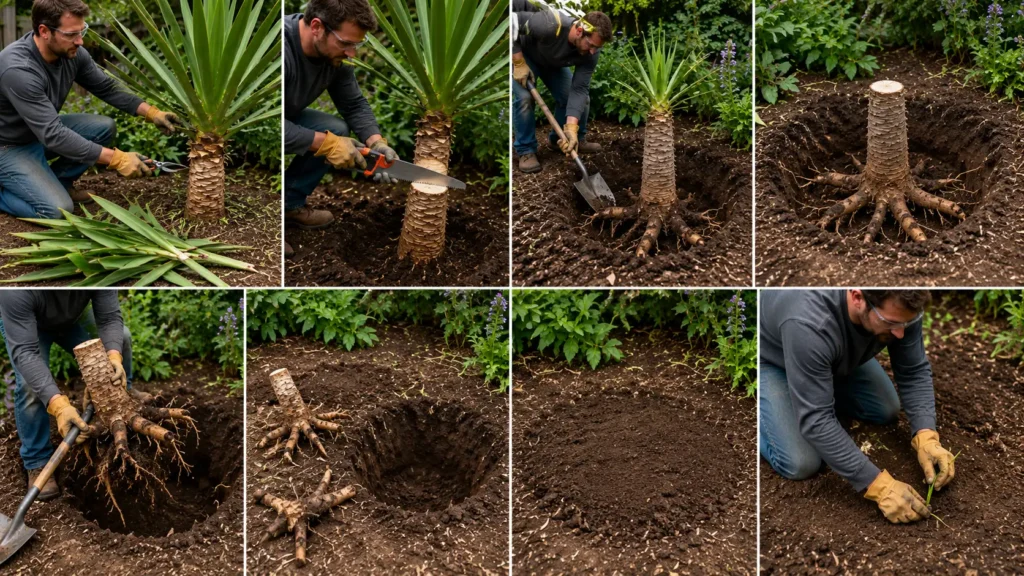
To remove a yucca plant, I first cut back the leaves and trunk to make the plant easier to handle. Then I dig around the base, expose the root crown and larger roots, and remove as much of the root system as possible. I also search the surrounding soil for remaining root pieces before filling the hole. After removal, I monitor the area for new yucca shoots and remove them as soon as they appear. Cutting the plant at ground level without dealing with the roots can allow it to grow again.
Why Is Yucca So Difficult to Remove?
The part of the yucca that I see above the soil is only one part of the plant.
Below the surface, yuccas can have substantial roots and a central crown. If parts of that underground system remain, new shoots can appear later.
This is why I do not consider the job finished just because the leaves and trunk are gone.
A successful removal has two parts:
- Remove the visible plant.
- Remove as much of the underground growth as practical.
The second part usually takes more work.
When Is the Best Time to Remove a Yucca?
I choose a time when the soil is workable and I can safely dig around the plant.
For a large outdoor yucca, I avoid working when the ground is frozen, extremely dry, or so wet that digging turns the area into a muddy mess.
The exact season is less important to me than having suitable soil conditions and enough time to remove the roots properly.
If I am dealing with a small yucca or a young offshoot, the job is usually much easier because I can expose and separate the roots with less digging.
What You Need to Remove a Yucca

The tools I use depend on the size of the plant.
Protective Gloves
I always wear thick gardening gloves when handling yucca.
The leaves can be stiff and sharply pointed, so I also use eye protection when working with a large plant.
Pruning Shears
I use pruning shears for small leaves and thinner growth.
Loppers
Loppers are more useful when the stems are too thick for ordinary pruning shears.
Pruning Saw
For a thick yucca trunk, I use a pruning saw rather than trying to force a smaller tool through it.
Shovel or Spade
A strong shovel is one of the most useful tools for exposing the roots.
Garden Fork
A garden fork helps loosen soil around the root system without immediately slicing through everything underneath.
Digging Bar
For large, established plants growing in hard soil, a digging bar can help break up compacted ground.
Container or Yard Waste Bag
I keep somewhere nearby to collect the cut leaves and other plant material as I work.
How to Remove a Yucca Plant Step by Step
Step 1: Prepare the Area
Before I start cutting, I look around the plant.
I check for nearby plants, irrigation lines, edging, structures, cables, and anything else that could make digging difficult.
I also give myself enough room to move around the yucca safely.
If the plant is large or growing close to a building, wall, utility line, or other structure, I would consider getting professional help rather than forcing the job.
Step 2: Cut Back the Yucca Leaves
I start by removing the long leaves around the outside of the plant.
I cut them into manageable pieces rather than trying to handle a huge bundle of sharp foliage at once.
This makes the base easier to see and gives me better access for digging.
I also avoid throwing viable plant pieces into an area where they could take root again.
Step 3: Cut the Main Stem or Trunk

If the yucca has a thick trunk, I cut it down to a manageable height.
For a large plant, I may make several controlled cuts rather than trying to move the entire plant at once.
I leave enough of the lower trunk visible to help me locate the central base when I begin digging.
Step 4: Dig Around the Base

This is where the real removal starts.
I place the shovel several inches away from the base and begin loosening the soil around the plant.
I work around the entire circumference instead of digging deeply on just one side.
As I expose more of the root system, I widen the area when needed.
Step 5: Expose the Root System

Once I can see the roots, I stop digging blindly.
I follow the larger roots so I know where they are going.
This helps me remove more of the root system instead of cutting through roots and leaving pieces buried.
Some yucca roots can extend well beyond the visible base, so I keep checking the surrounding soil rather than assuming everything is contained directly under the trunk.
Step 6: Remove the Root Crown and Larger Roots

The central root crown is one of the parts I want to remove.
I loosen the soil around it and work underneath it with the shovel or garden fork.
If the root crown is loose enough, I lift it out.
For larger roots, I follow them as far as practical and remove them in sections when necessary.
My goal is not to leave a large piece of the crown or thick root system sitting underground.
Step 7: Search the Soil for Remaining Root Pieces
After the main plant comes out, I inspect the hole and surrounding soil.
I use my hands, shovel, or garden fork to check for obvious pieces of the root system.
I do not assume that every tiny root fragment can be found. Instead, I focus on removing the larger underground pieces and the main crown, then monitor the area afterward.
This matters because yucca can produce new shoots from underground material left behind.
Step 8: Fill the Hole
Once I have removed as much of the plant as practical, I fill the hole with suitable soil.
I remove any obvious roots or woody pieces that I find while filling it.
Then I level the area so I can easily spot new growth later.
Step 9: Monitor the Area for Regrowth
I consider this part of the removal process, not an optional extra.
I check the area regularly for new yucca shoots.
If I see one, I remove it while it is still small.
Yuccas can resprout from underground material, so repeated removal may be necessary after the original plant is gone.
How to Remove a Large Yucca Plant

A large yucca requires more planning than a small garden plant.
I would not try to pull a tall, heavy yucca out of the ground by hand.
Cut the Foliage First
I remove the leaves and reduce the upper growth so the plant becomes easier to work around.
Reduce the Trunk
I cut the trunk into manageable sections if necessary.
This makes lifting and moving the plant much safer.
Dig a Wide Area
I expose the root crown and follow the larger roots outward.
With a mature plant, I expect the root system to extend beyond the immediate base.
Work Around the Root Crown
Once I have loosened enough soil, I work underneath the main crown.
If it is too heavy to lift safely, I stop and get help or use suitable equipment.
Know When to Call a Professional
I would consider professional help if the yucca is:
- Very large
- Growing close to a building
- Close to underground utilities
- Growing beside a wall or paved surface
- Too heavy to lift safely
- Part of a large established planting
- In soil that is too hard to excavate by hand
Large yuccas may require heavy equipment when hand tools are not practical.
How to Remove Yucca Roots
Root removal is the part I take most seriously.
Cutting the visible plant down does not guarantee that the underground system is gone.
Start at the Root Crown
I first expose the central base of the plant.
This gives me a starting point for following the larger roots.
Follow the Larger Roots
I work outward from the crown.
When I find a thick root, I follow it through the soil and remove as much of it as I reasonably can.
Loosen the Soil Before Pulling
I avoid using force on a root that is still firmly attached.
Instead, I loosen more soil around it.
This gives me a better chance of pulling out a longer section instead of snapping it close to the crown.
Remove Large Root Pieces
I focus on the larger roots and crown rather than spending hours searching for every tiny root fiber.
The important point is to remove as much of the substantial underground plant material as practical.
Check the Hole Again
After the main root system is out, I look through the soil one more time.
I remove obvious pieces before replacing the soil.
Why Does My Yucca Keep Coming Back?

This is one of the most frustrating parts of yucca removal.
I can remove what looks like the entire plant and still see new shoots later.
The reason is usually that some living underground material remains.
Yuccas can resprout from roots or crowns left in the ground.
This is why I do not judge the success of removal after one afternoon.
I judge it by what happens over the following months.
How to Stop Yucca From Growing Back
There are two things I focus on:
Remove as much underground growth as practical.
Deal with new shoots as soon as they appear.
If I see a new yucca shoot, I dig it out while it is small whenever practical.
I do not let it grow into another mature plant.
Repeated physical removal can take time, especially where an old root network remains underground. Extension guidance also recommends continued monitoring because yuccas can resprout after the original plant has been removed.
How to Remove Yucca Without Chemicals
If I want to avoid herbicides, I focus on physical removal and follow-up.
My basic method is:
- Cut down the plant.
- Dig out the root crown.
- Remove larger roots.
- Search the surrounding soil.
- Fill the hole.
- Watch for new shoots.
- Dig out new shoots when they appear.
- Repeat as needed.
This method takes patience, but it avoids applying a chemical treatment to the soil or nearby plants.
For a small yucca, physical removal is often the first approach I would try.
Can You Kill Yucca Naturally?
If by naturally you mean without herbicide, physical removal is the approach I would choose.
The goal is to remove the plant and as much of its underground system as possible, then keep removing new shoots.
I would not pour salt, bleach, gasoline, or other household chemicals into the soil.
Those products can create problems for the surrounding soil and plants, and they are not a method I would recommend for a garden.
Should You Use Herbicide to Remove Yucca?
I would treat herbicide as an optional control method rather than my first choice.
If a yucca keeps returning despite repeated physical removal, a properly labeled herbicide may be considered for the specific site and plant.
If I use one, I follow the product label exactly.
That means checking:
- The active ingredient
- Where the product can legally be used
- Application instructions
- Required protective equipment
- Restrictions around desirable plants
- Re-entry instructions
- Environmental precautions
Some extension guidance describes targeted herbicide treatment for persistent yucca, but also stresses that follow-up is needed because underground roots can continue producing shoots.
I would never recommend randomly applying a strong chemical to the soil or using a homemade mixture.
How to Remove Yucca From a Garden Bed
A garden bed requires more care because other plants may be growing close to the yucca.
Protect Nearby Plants
Before digging, I identify the roots of desirable plants near the yucca.
I work slowly so I do not destroy plants that I want to keep.
Cut the Yucca Down
I reduce the foliage first so I have room to work.
Dig Carefully
I expose the yucca roots while trying to avoid unnecessary disturbance to nearby plants.
Remove the Main Crown
I focus on getting the central root crown out.
Follow the Larger Roots
If a root extends into an area occupied by another plant, I work carefully rather than simply pulling hard.
Keep Watching
This is especially important in a garden bed because new yucca shoots can appear among desirable plants later.
A previously cleared garden bed can still produce yucca sprouts when underground roots remain.
How to Remove Yucca From Near a House
If a yucca is growing close to a house, I become much more cautious.
I first check whether there are utilities, drainage lines, irrigation pipes, foundations, or other structures nearby.
I also avoid aggressive digging directly against a building.
For a large established yucca in a tight location, professional removal is often a better choice than risking damage to the property.
What Should You Do With the Removed Yucca?
I collect the leaves, trunk sections, and roots rather than leaving pieces scattered around the garden.
Large green sections may still be useful for propagation depending on the type and condition of the material.
If I want to save a healthy top or stem, I keep it separate and follow the proper propagation process.
For the full process, I would use my separate guide on how to propagate yucca.
For material that I do not want to keep, I follow my local green-waste or yard-waste rules.
I also avoid placing potentially viable root pieces somewhere they could establish again.
Can You Remove Yucca Pups Instead?
Sometimes I am not trying to remove the entire plant.
I may simply have a young yucca pup growing beside the parent plant.
In that situation, the process is different.
I expose the connection between the pup and the parent plant, separate it carefully, and make sure the young plant has enough viable roots if I plan to replant it. Yucca pups can be separated from a mature plant and grown independently when handled correctly.
So I first decide whether I want to:
- Remove the entire yucca
- Remove only unwanted pups
- Relocate the plant
- Keep a cutting for propagation
That decision changes the method I use.
How Long Does It Take to Completely Remove a Yucca?
There is no fixed timeline.
A small yucca with a compact root system may come out during one digging session.
A large established yucca can take much longer, especially if the roots extend through a large planting bed.
Even after the main plant is removed, I keep monitoring the area for new shoots.
Some established yuccas can require repeated control over multiple growing seasons because underground roots may continue producing new growth.
Common Yucca Removal Mistakes
Only Cutting the Leaves
This removes the visible part but leaves the underground system.
If the goal is complete removal, I continue below the soil.
Leaving the Root Crown
The root crown is an important part of the plant’s underground structure.
I make a serious effort to expose and remove it.
Digging Only Directly Under the Trunk
Large roots can extend outward.
I check the surrounding soil rather than assuming everything is directly below the trunk.
Pulling Too Hard
A hard pull can break a root and leave part of it underground.
I loosen the soil first.
Ignoring Small New Shoots
A small shoot is much easier to deal with than an established new plant.
I remove new growth as soon as I notice it.
Using Household Chemicals
I would not use salt, bleach, gasoline, or similar products to kill a yucca.
They can create problems for the soil and nearby plants.
Ignoring Safety
I do not reach blindly into a large yucca.
The leaves can cause painful cuts, so I use gloves and eye protection.
Trying to Remove a Huge Plant Alone
A large root ball can be heavy.
If I cannot lift it safely, I get help instead of risking an injury.
Yucca Removal vs. Yucca Pruning
These two jobs can look similar at first, but the goal is different.
| Task | Main goal | What I focus on |
| Pruning | Maintain the plant | Leaves, flower stalks, height, shape |
| Removal | Get rid of the plant | Trunk, crown, roots, regrowth |
| Propagation | Create a new plant | Healthy cuttings or pups |
| Relocation | Move the plant | Root system and replanting |
If I only want to make an overgrown yucca shorter, I use my how to prune yucca guide.
If I want the plant gone, I focus on removing the underground growth.
Final Take
Removing a yucca is different from pruning one.
When I prune a yucca, I am trying to keep the plant healthy and manageable. When I remove one, my goal is to get the plant and as much of its underground system out of the ground as I reasonably can.
I start by cutting the foliage and trunk into manageable sections. Then I dig around the base, expose the root crown, follow the larger roots, and remove as much of the root system as practical.
The job does not end when the hole is filled.
I keep checking the area for new shoots and remove them early. That follow-up is what makes yucca removal much more effective, especially when an established root system has been left behind.
Frequently Asked Questions
How do you completely remove a yucca plant?
I cut down the above-ground growth, expose the base, remove the main root crown and as much of the larger root system as practical, then monitor the area for new shoots.
How do you get rid of a yucca permanently?
There is no guaranteed one-day method for every established yucca. I remove as much of the underground plant as possible and keep removing new shoots that appear afterward. Persistent plants may require repeated control.
Can you kill a yucca by cutting it down?
Cutting it down alone may not be enough. Yuccas can produce new shoots from roots or crowns left in the soil.
How do you remove yucca roots?
I dig around the base, expose the root crown, loosen the surrounding soil, and follow the larger roots outward. I remove as much of the substantial root system as practical.
Will yucca grow back from the roots?
Yes. Yuccas can produce new shoots from underground roots or crowns that remain after removal.
How do I stop my yucca from growing back?
I remove as much of the root system as possible during the first removal and then check the area for new shoots. I dig out new growth while it is small.
Can I remove yucca without chemicals?
Yes. Physical removal is the main method I would try first. It involves cutting down the plant, digging out the root crown and larger roots, and repeatedly removing new shoots.
What is the easiest way to remove a small yucca?
For a small plant, I cut back the foliage, loosen the soil around the base, expose the roots, and lift the plant out with as much of its root system as possible.
How do you remove a large yucca?
I reduce the foliage and trunk into manageable sections, expose the root crown, dig around the main root system, and remove the plant in sections if necessary. For very large plants or difficult locations, I would get professional help.
Should I remove every tiny yucca root?
I remove as much of the larger underground growth as practical. I do not spend excessive time trying to find every fine root fiber, but I do monitor the area afterward for new shoots.
Why does my yucca keep coming back after I dug it up?
The most likely reason is that some living underground growth remained. Yuccas can resprout from roots or crowns left in the ground.
Can I remove yucca pups without killing the main plant?
Yes. If the goal is to separate a pup rather than remove the parent plant, I carefully expose the connection and separate the young plant with viable roots.
Can I use the removed yucca for propagation?
Healthy top or stem sections may be suitable for propagation. If I want to save a cutting, I keep it separate from the waste and follow a proper propagation method.
Should I use salt to kill yucca?
I would not. Salt can create problems in the soil and affect nearby plants. I prefer physical removal and repeated control of new shoots.
Is herbicide necessary to remove yucca?
Not always. I would try physical removal first. If the plant keeps returning, a properly labeled herbicide may be an option for some situations, but I would follow the product label and local requirements carefully.
How long should I monitor the area after removing yucca?
I would keep checking throughout the growing season and continue checking in later seasons if the plant was large and established. Persistent yucca can produce new shoots after the original plant has been removed.