Skip to content
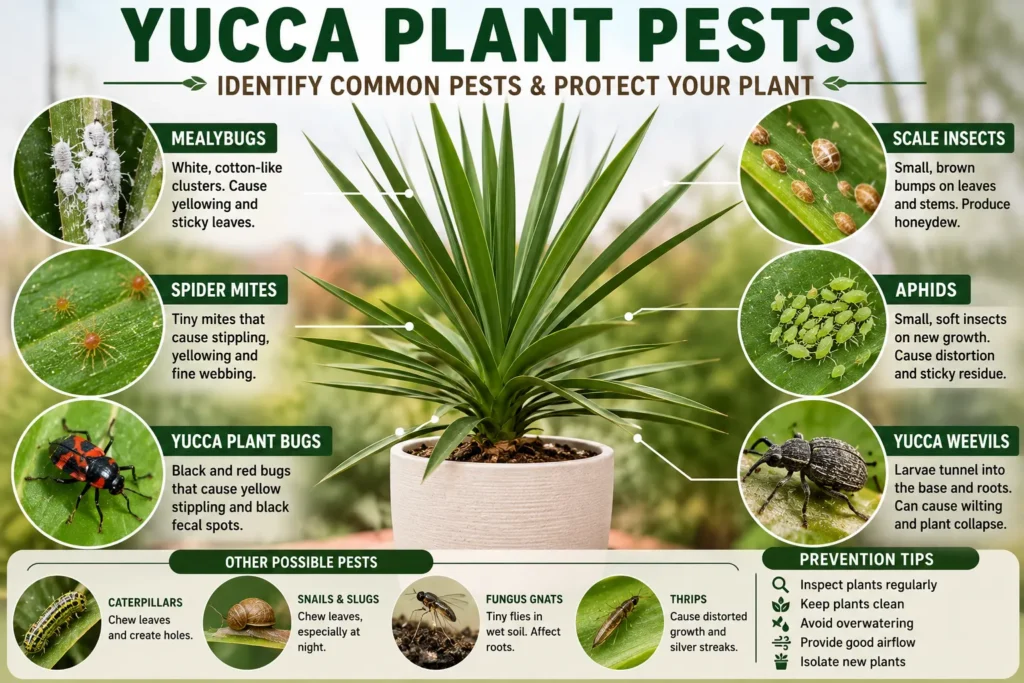
Yucca plants are generally tough, but pests can still show up on both indoor and outdoor plants. The first sign may be yellow stippling, brown spots, sticky leaves, white cottony patches, fine webbing, or small bumps on the leaves and stems.
I would not treat a yucca just because I see a damaged leaf. Many yucca problems can look like pest damage even when the real cause is watering, poor drainage, low light, or natural aging. I first look at the damage pattern, inspect the plant closely, and then decide which pest is most likely.
This guide covers the most common yucca plant pests, what they look like, the damage they cause, how I would treat them, and how to keep them from returning.
Quick Answer: What Are the Most Common Yucca Plant Pests?
The most common yucca plant pests include yucca plant bugs, mealybugs, scale insects, spider mites, aphids, and yucca or agave weevils. Some are easy to spot. Mealybugs look like small white cottony patches, scale looks like tiny bumps attached to leaves or stems, and spider mites can leave fine webbing and pale speckles. Yucca plant bugs are more specific to yuccas. They suck sap from the leaves and can cause pale stippling, yellowing, and small black fecal spots. The best way to deal with yucca pests is to identify the pest first, remove as many as possible, use a treatment suited to that pest, and keep checking the plant for new activity.
What Do Yucca Plant Pests Look Like?
Yucca pests can look very different from one another, so I find the damage pattern just as useful as the insect itself.
| What you see on your yucca | Pest to check |
| White cotton-like patches | Mealybugs |
| Small brown or tan bumps | Scale insects |
| Fine webbing | Spider mites |
| Pale stippling with black specks | Yucca plant bugs |
| Sticky leaves | Aphids, scale, or mealybugs |
| Black sooty coating | Honeydew-producing pests |
| Distorted new growth | Aphids or thrips |
| Small holes or punctures | Chewing insects or weevils |
| Lower leaves wilting and plant declining | Possible weevil damage |
| Tiny insects around flowers | Aphids, thrips, or other flower pests |
I would inspect the undersides of leaves, leaf bases, stem joints, new growth, flower stalks, and the center of the plant. Many pests hide in these areas rather than sitting openly on the top of the leaves.
Common Yucca Plant Pests
Yucca Plant Bugs

The yucca plant bug is one of the most useful pests to know if you grow yuccas outdoors.
Adult bugs are small, with dark blue-black bodies and reddish-orange coloring around the head and thorax. Younger nymphs are smaller and have a different appearance from adults. They feed by piercing plant tissue and sucking sap from the leaves.
What Does Yucca Plant Bug Damage Look Like?
I would look for:
- Pale yellow stippling
- Small chlorotic spots
- Yellowing leaves
- Black fecal specks
- A generally faded or speckled appearance
- Damage concentrated on newer foliage
The damage can become quite noticeable even when the insects themselves are difficult to see.
One reason these bugs can be frustrating is that they may quickly move into the center of the yucca when the plant is disturbed.
When Are Yucca Plant Bugs Most Active?
Their activity depends on the local climate and growing conditions, so I would not rely on one fixed month range for every location.
In warmer areas, yucca plant bugs can have more than one generation during the growing season. This is why I would continue checking the plant after treatment instead of assuming that one inspection is enough.
How I Would Control Yucca Plant Bugs
For a light infestation, I would start by checking the whole plant carefully and removing or washing away visible insects.
A firm spray of plain water can knock some insects from the foliage, although this is usually a temporary measure rather than a complete solution. Repeated monitoring is useful because eggs can remain protected inside leaf tissue.
For a larger infestation, a product labeled for the pest can be used according to its current instructions. Coverage matters because the insects often hide deep inside the plant.
I would also avoid spraying a flowering yucca without checking whether the product is appropriate for that situation.
Mealybugs

Mealybugs are among the easiest yucca pests to recognize once you know what to look for.
They appear as small white, cotton-like clusters. I would check around leaf bases, leaf joints, stems, and other protected areas.
Signs of Mealybugs on Yucca
Look for:
- White cottony material
- Small soft-bodied insects
- Sticky leaves
- Slow growth
- Yellowing foliage
- Weak new growth
- Black sooty material on leaves
Mealybugs feed on plant sap. Heavy infestations can weaken the plant, especially if they remain untreated for a long time.
How I Would Treat Mealybugs
If I find only a few, I would start with physical removal.
A cotton swab can help remove individual insects from tight spaces. A strong but controlled stream of water can also dislodge some insects from the foliage.
For a larger infestation, insecticidal soap or horticultural oil may be useful when the product is labeled for the plant and pest.
The key is coverage. I would pay close attention to the leaf axils, undersides, stem joints, and crown, because missing a few hidden insects can allow the infestation to return.
I would inspect the plant again after treatment rather than assuming the first application solved everything.
What About Root Mealybugs?
Root mealybugs are different because they live around the roots rather than mainly on the leaves and stems.
They can be difficult to spot until a plant begins to decline or the roots are exposed during repotting. If an indoor yucca looks weak despite suitable light and watering, I would inspect the root system if other causes have been ruled out.
Signs can include:
- Weak growth
- Poor plant vigor
- Decline without obvious leaf pests
- White insects or cottony material around roots
- White residue in the potting mix
If I find root mealybugs, I would remove affected soil, inspect the roots, and repot the plant when appropriate. This connects closely with my guide on how to repot a yucca plant.
Scale Insects

Scale insects can be harder to notice because they often look like small brown, tan, gray, or pale bumps attached to the plant.
They can occur on both leaves and stems.
What Does Scale Damage Look Like?
Possible signs include:
- Small bumps on leaves
- Brown or tan spots that do not move
- Yellowing foliage
- Weak growth
- Sticky honeydew
- Black sooty material
Scale insects suck sap from the plant. A small number may cause little visible harm, but a larger population can gradually weaken the yucca.
Armored Scale vs. Soft Scale
Scale insects are not all the same.
Some types have a harder protective covering, while soft scales have a different body structure and may produce more honeydew. Because their biology differs, I would identify the pest before choosing a treatment.
I would also avoid assuming that every brown bump on a yucca is scale. Physical damage, dried material, and other plant features can sometimes look similar.
How I Would Treat Scale
For a small infestation, I would manually remove visible scale.
A soft brush or cloth can help on accessible areas. Heavily infested leaves or stems may be better removed if pruning will not damage the plant.
For larger infestations, insecticidal soap or horticultural oil may be used when labeled for the plant and pest.
I would repeat inspections because scale can remain hidden in areas that are easy to miss.
Spider Mites

Spider mites are extremely small, so I would usually look for their damage and webbing rather than trying to spot the mites first.
They can cause:
- Fine pale speckles
- Yellow stippling
- Dull-looking foliage
- Dry-looking leaves
- Fine webbing
- Progressive leaf damage
Two-spotted spider mites and other spider mite species can affect plants under suitable conditions.
How to Check for Spider Mites
I would inspect the undersides of the leaves closely.
Fine webbing around the leaf bases or between leaves is a useful clue. If the foliage has thousands of tiny pale dots without an obvious reason, I would also check for mites.
A simple way to inspect a suspicious leaf is to hold it over a plain piece of white paper and gently tap the leaf. Very small moving specks may become easier to notice against the light background.
How I Would Treat Spider Mites
For a light infestation, washing the foliage can help remove mites and webbing.
I would pay special attention to the undersides of the leaves and repeat the inspection regularly.
For a larger infestation, a product specifically suitable for mites may be needed. I would follow the label rather than treating spider mites like ordinary insects because mites are arachnids, not insects.
Aphids

Aphids are small, soft-bodied insects that often gather around new growth and flower stalks.
They may be:
- Green
- Black
- Yellow
- Brown
- Other pale shades
Aphid Damage on Yucca
Aphids can cause:
- Curled leaves
- Distorted new growth
- Yellowing
- Weak shoots
- Sticky honeydew
The sticky material can also encourage black sooty growth on the foliage.
I would check the newest leaves first because aphids often prefer tender growth.
How I Would Control Aphids
A strong spray of water can remove many aphids from the plant.
For a small infestation, this may be enough when repeated regularly.
If the infestation persists, insecticidal soap or another labeled treatment can be considered. I would also check nearby plants because aphids can move between hosts.
If I see ants repeatedly moving around a yucca with sticky leaves, I would also check for aphids, mealybugs, or scale. These sap-feeding pests can produce honeydew that attracts ants.
Yucca and Agave Weevils

Weevils deserve special attention because their damage can be much more serious than the typical leaf-feeding pests.
Yucca and agave weevils are closely related pests with similar feeding habits, but they do not have exactly the same host range.
Adult weevils can feed on plant tissue, while the larvae can tunnel into the base and internal tissues of susceptible plants. This hidden feeding can weaken the plant and, in serious cases, cause collapse.
Signs of Yucca Weevil Damage
Possible signs include:
- Wilting lower leaves
- Damage near the plant base
- Holes or punctures
- Weakening crown
- Sudden decline
- Plant collapse
- Decaying tissue around damaged areas
The difficult part is that the larvae can remain hidden inside the plant. By the time obvious symptoms appear, the infestation may already be advanced.
Can You Save a Yucca With Weevil Damage?
It depends on how far the damage has progressed.
Early detection gives you a better chance of protecting nearby plants. Once a yucca has severe internal damage and begins collapsing, recovery can be difficult.
I would remove badly affected plant material and dispose of it in a way that prevents insects from emerging and spreading.
Good drainage and suitable growing conditions are also important because stressed or poorly grown plants can have more difficulty recovering from pest damage.
Is the Yucca Moth a Pest?
The yucca moth needs a little more explanation because it has a special relationship with yucca plants.
Yucca moths visit yucca flowers and play an important role in pollination. Female moths collect pollen and transfer it to yucca flowers while laying eggs in developing flowers.
Their larvae can feed on some developing yucca seeds.
Because of this relationship, I would not treat a yucca moth like an ordinary plant pest. Seeing a yucca moth around a flowering yucca does not automatically mean the plant has an infestation that needs control.
This is a good example of why I identify an insect before reaching for a treatment.
Other Pests That May Attack Yuccas
The pests above are the ones I would focus on most, but other insects and small pests can occasionally cause problems.
Thrips
Thrips can cause fine discoloration, distorted growth, and damaged new foliage.
I would check new leaves and flower parts closely because thrips are very small.
Fungus Gnats
Fungus gnats are more closely associated with wet potting soil than with yucca leaves.
If tiny flying insects appear around an indoor yucca, check whether the growing medium stays wet for too long.
This is one reason I would not treat every flying insect as a leaf pest.
Snails and Slugs
Outdoor yuccas can sometimes suffer chewing damage from snails and slugs.
Look for:
- Irregular holes
- Missing leaf tissue
- Feeding damage close to the soil
- Slime trails
Caterpillars
Caterpillars can chew sections of yucca leaves and leave irregular holes or missing edges.
If I see fresh chewing damage, I would inspect the plant carefully rather than assuming it is a fungal problem.
What Does Yucca Pest Damage Look Like?

Knowing the insect is useful, but the damage pattern can often give you the first clue.
Yellow Stippling
Fine yellow or pale dots across the foliage can indicate sap-sucking pests.
Spider mites and yucca plant bugs are two pests I would check first.
If the stippling is accompanied by black fecal specks, yucca plant bugs become a stronger possibility.
White Cottony Patches
White cotton-like material strongly suggests mealybugs.
Check:
- Leaf bases
- Stem joints
- Crown
- Leaf undersides
Do not assume the white material is dust. Look closely for individual insects within the cottony clusters.
Brown Bumps
Small fixed brown or tan bumps can indicate scale.
I would inspect the stem as well as the leaves because scale may be present in both places.
Fine Webbing
Fine webbing combined with pale speckled foliage is a common clue for spider mites.
The webbing may be difficult to see at first, so check the plant from several angles.
Sticky Leaves
Sticky foliage can be caused by honeydew produced by several sap-feeding insects.
I would check for:
- Aphids
- Mealybugs
- Scale
The sticky coating may also encourage black sooty material to develop on the leaves.
Holes and Punctures
Irregular holes can come from chewing pests.
Small punctures can have other causes, so I would inspect the surrounding foliage and plant base before identifying a pest.
Yucca Plant Pest Identification Chart
| Pest | What it looks like | Main damage | Where I would look |
| Yucca plant bug | Small dark bug with reddish coloring | Pale stippling, yellowing, black specks | Leaves and crown |
| Mealybug | White cottony clusters | Yellowing, weak growth, honeydew | Leaf bases and stems |
| Root mealybug | White insects around roots | Weak growth and plant decline | Roots and potting mix |
| Scale | Small fixed bumps | Yellowing, weak growth, honeydew | Leaves and stems |
| Spider mite | Tiny mites, sometimes with webbing | Fine stippling and dull leaves | Leaf undersides |
| Aphid | Small soft-bodied insects | Curling, distortion, honeydew | New growth and flowers |
| Yucca weevil | Dark beetle; larvae hidden inside plant | Internal damage and possible collapse | Plant base and crown |
| Thrips | Tiny slender insects | Fine discoloration and distorted growth | New leaves and flowers |
| Fungus gnat | Tiny flying insects | Mainly associated with wet soil | Potting medium |
| Slug/snail | Soft-bodied garden pests | Chewed leaves and holes | Around soil and foliage |
| Caterpillar | Larva of a moth or butterfly | Chewed leaves | Foliage |
How to Tell Pest Damage From a Yucca Plant Problem
This is where I would slow down before treating the plant.
A yellow yucca leaf does not automatically mean insects.
For example, natural aging can cause older lower leaves to yellow and dry. Overwatering can also cause yellow foliage, especially when the soil remains wet for too long.
I would check for actual evidence of pests:
- Insects
- Webbing
- Cottony material
- Scale-like bumps
- Black fecal spots
- Honeydew
- Chewed tissue
- Distinct stippling
If none of these signs are present, I would also check the plant’s water, soil, drainage, light, and roots.
This helps prevent an unnecessary pest treatment.
For more general symptoms such as yellow leaves, brown tips, root problems, or poor growth, I would check my guide to yucca plant problems rather than assuming insects are responsible.
Indoor Yucca Plant Pests

Indoor yuccas often deal with a different group of pests than outdoor plants.
The ones I would check first are:
- Mealybugs
- Scale
- Spider mites
- Aphids
- Fungus gnats
- Root mealybugs
Why Indoor Yuccas Get Pests
Pests can arrive on:
- New plants
- Cuttings
- Outdoor plants brought inside
- Contaminated pots
- Nearby infested houseplants
A new plant may look healthy at first while hiding insects around the leaf bases or stems.
That is why I would inspect new plants before placing them beside established houseplants.
What I Would Do With an Infested Indoor Yucca
First, I would move it away from other plants.
Then I would inspect the entire plant rather than treating only the visible area.
I would check:
- Top of leaves
- Undersides
- Leaf bases
- Stem
- Crown
- Soil surface
- Roots if needed
- Nearby plants
After treatment, I would continue checking the plant regularly.
Outdoor Yucca Plant Pests
Outdoor yuccas can encounter a wider range of insects and other pests.
I would pay particular attention to:
- Yucca plant bugs
- Scale
- Aphids
- Weevils
- Caterpillars
- Snails
- Slugs
Outdoor yuccas may also have natural predators that feed on some pest insects, so I would avoid treating every insect I see without first identifying it.
Some insects may be harmless or beneficial.
If I move an indoor yucca outside for warmer weather, I would inspect it again before bringing it back indoors. Outdoor exposure can introduce pests that were not previously present on the plant.
How to Get Rid of Yucca Plant Pests

I prefer a step-by-step approach rather than immediately reaching for the strongest treatment.
1. Identify the Pest
First, determine what you are dealing with.
Look at:
- Insect shape
- Color
- Location
- Leaf damage
- Webbing
- Sticky residue
- Cottony material
- Spots
- Holes
If you cannot identify the pest, focus on documenting the damage before applying a treatment.
2. Isolate an Indoor Yucca
If your yucca is in a pot indoors, move it away from healthy houseplants.
This reduces the chance of insects moving to nearby plants.
I would also inspect plants that were sitting beside the affected yucca.
3. Remove Visible Pests
For a small infestation, physical removal can make a big difference.
I would:
- Wipe accessible leaves
- Remove visible mealybugs
- Remove scale where practical
- Prune badly infested leaves
- Remove dead plant material
This reduces the number of pests before any further treatment.
4. Wash the Plant
A controlled spray of water can remove some soft-bodied pests.
For an outdoor yucca, a hose can work well for accessible foliage.
For an indoor yucca, I would use a shower or sink if the plant size allows it.
Pay particular attention to the undersides of leaves and protected areas.
5. Prune Heavily Infested Growth
If a leaf is covered with pests and already badly damaged, removing it can reduce the infestation.
I would avoid removing healthy leaves simply because they contain one or two insects.
Use clean pruning tools and dispose of heavily infested material properly.
6. Apply a Targeted Pest Treatment
For persistent infestations, a treatment may be necessary.
Depending on the pest and product label, options can include:
- Insecticidal soap
- Horticultural oil
- Neem-based products
- Other labeled insecticides
- Miticides for spider mites
The treatment needs to match the pest.
A product that works well on one pest may not work well on another.
Always follow the current product label, including directions about concentration, application frequency, plant safety, and protective equipment. Product registrations and permitted uses can differ by location.
7. Repeat and Monitor
This is one of the steps I would not skip.
Seeing fewer insects after one treatment does not always mean the infestation is finished.
Some pests can hide in protected areas or have life stages that are less affected by a particular treatment.
Check the plant again after treatment and continue monitoring until you no longer see fresh pests or new damage.
What Should I Do for a Light Yucca Pest Infestation?
If I find only a few pests, I would start with the least disruptive approach.
My first steps would be:
- Identify the pest
- Isolate the plant if it is indoors
- Remove visible insects
- Wash the foliage
- Prune badly damaged leaves if needed
- Continue checking the plant
A small mealybug, aphid, or scale infestation can sometimes be handled with repeated physical removal and close monitoring.
I would not use a strong pesticide simply because I found one or two insects.
What Should I Do for a Heavy Yucca Pest Infestation?
A heavy infestation needs a more organized approach.
I would:
- Isolate an indoor plant
- Inspect nearby plants
- Identify the pest
- Remove heavily infested plant material
- Wash the remaining foliage where appropriate
- Apply a treatment suited to the pest
- Repeat treatment as directed
- Continue checking the plant
- Treat nearby plants only when a pest is actually found
If the plant has severe crown or internal damage, especially where weevils are suspected, I would focus on assessing whether the plant can recover rather than repeatedly treating surface insects.
Yucca Pest Treatment Chart
| Pest | First step | Common treatment options |
| Mealybugs | Remove visible insects | Insecticidal soap, horticultural oil |
| Root mealybugs | Inspect roots and remove affected soil | Appropriate root treatment or repotting |
| Scale | Remove visible scale | Horticultural oil, labeled insecticide |
| Spider mites | Wash foliage | Insecticidal soap or suitable miticide |
| Aphids | Spray with water | Insecticidal soap |
| Yucca plant bugs | Inspect inner foliage | Treatment labeled for the pest |
| Yucca weevils | Inspect plant base and crown | Early control, removal of affected material |
| Fungus gnats | Address excessively wet soil | Moisture control and suitable traps |
| Caterpillars | Find and remove larvae | Physical removal or suitable labeled treatment |
| Slugs and snails | Inspect at soil level | Physical removal and appropriate garden control |
The exact treatment depends on the pest, plant condition, product label, and local rules. I would always use a product according to its current directions.
Natural Ways to Control Yucca Pests
If the infestation is small, I would start with simple methods.
Manual Removal
This works well for visible mealybugs and scale.
It takes patience, but it can be effective when only a small part of the plant is affected.
Water Spray
Water can knock many soft-bodied pests from leaves.
This is especially useful for aphids and can also help reduce some other surface pests.
Insecticidal Soap
Insecticidal soap can be useful against several soft-bodied pests when applied correctly.
It works by direct contact, so coverage matters.
Horticultural Oil
Horticultural oil can help manage certain insects and mites when used according to the product label.
I would avoid spraying during unsuitable heat or other conditions listed on the label because yucca foliage can be damaged by some applications.
Neem-Based Products
Neem-based products can be useful for certain pests, but I would still identify the pest first and follow the product directions.
I would not assume that a natural product is automatically safe for every yucca or every growing condition.
Avoid Homemade Soap Mixtures
I would be careful with homemade dish-soap sprays.
Household detergents are different from products formulated as insecticidal soap and can damage plant tissue.
If I want to use soap for pest control, I would choose a product intended for plants and follow its directions.
How to Prevent Yucca Plant Pests

Good basic care can make it easier for a yucca to handle stress, but no care routine can guarantee that pests will never appear.
Inspect New Plants
Before bringing a new yucca or another houseplant indoors, inspect:
- Leaf undersides
- Leaf bases
- Stems
- Crown
- Soil surface
I would keep new plants separate for a while if I am concerned about bringing pests into the collection.
Check Your Yucca Regularly
A quick inspection every week or two can help you catch pests early.
I would look closely rather than simply viewing the plant from across the room.
Keep the Plant From Staying Waterlogged
Poor watering and drainage can weaken a yucca and create other problems.
For indoor plants especially, I would avoid keeping the growing medium constantly wet.
If you are unsure about watering frequency, my guide on how often to water a yucca plant covers that topic separately.
Provide Suitable Light
A yucca growing in unsuitable light may develop weak growth and become harder to assess.
Good growing conditions do not make a plant pest-proof, but they help keep the plant in better condition.
Remove Badly Damaged Material
Dead and heavily infested leaves should not be left around the plant unnecessarily.
Clean up fallen material and dispose of badly affected pieces properly.
Check Nearby Plants
If one indoor yucca has pests, I would inspect the plants around it.
Mealybugs, scale, aphids, and spider mites can move from one plant to another.
When Is Yucca Pest Damage Serious?
A few insects do not always mean the plant is in serious danger.
I would become more concerned when:
- The infestation is spreading
- New growth is affected
- Large areas of foliage are stippled
- Leaves are dropping
- The plant is losing vigor
- The crown is damaged
- The trunk is weakening
- The plant begins collapsing
- Weevil damage is suspected
A small mealybug colony is a very different situation from a yucca showing internal crown damage and sudden collapse.
Can a Yucca Recover From Pest Damage?
Yes, many yuccas can recover from pest damage once the infestation is controlled.
The damaged leaves themselves may not return to their original appearance. For example, stippled or discolored foliage caused by feeding damage can remain damaged even after the insects are gone.
I would look at new growth as the better sign of recovery.
If new leaves are developing normally and the infestation is no longer active, the plant is moving in the right direction.
If the trunk or crown has suffered severe internal damage, recovery may be much less likely.
A Simple Yucca Pest Inspection Routine
When I see something unusual on a yucca, I would inspect it in this order.
Check the Leaves
Look for:
- Spots
- Stippling
- Holes
- Curling
- Discoloration
- Webbing
Check the Undersides
Many pests hide here.
Look closely for insects, eggs, webbing, and small dark specks.
Check the Leaf Bases
This is one of the first places I would look for mealybugs and other hidden insects.
Check the Stem
Look for scale, cottony material, sticky residue, or unusual damage.
Check the Crown
If the center looks weak or damaged, inspect more carefully for serious problems.
Check the Soil
If you see tiny flying insects around an indoor yucca, check whether the soil remains wet for too long.
Check the Roots if the Plant Is Declining
If the foliage shows no clear pest activity but the plant continues to weaken, I would consider checking the roots during repotting.
Root mealybugs can stay hidden below the soil surface.
Check Nearby Plants
An infestation may not be limited to one plant.
Beneficial Insects on Yuccas
I would also keep in mind that not every insect on an outdoor yucca is harmful.
Some insects may feed on pests, visit flowers, or have another useful role in the garden.
This is especially relevant when a yucca is flowering. The yucca moth, for example, has a close relationship with yucca flowers and helps pollinate them.
Before treating an outdoor plant, I would identify the insect when possible.
That simple step can prevent me from removing a helpful insect while trying to solve a pest problem.
Yucca Pests and Honeydew
Honeydew is a sticky substance produced by several sap-feeding insects.
If I notice sticky leaves, I would inspect the plant for:
- Aphids
- Scale
- Mealybugs
Honeydew can also encourage black sooty material to develop on the foliage.
If ants are repeatedly climbing the plant, I would look for these pests instead of treating the ants as the main problem.
The ants may be attracted to the honeydew produced by the insects.
Final Take
Yucca plant pests are much easier to manage when I identify the pest before treating the plant.
White cottony patches point me toward mealybugs. Brown bumps make me check for scale. Fine webbing makes me inspect spider mites. Pale stippling with black specks makes me look closely for yucca plant bugs. Sudden decline around the plant base makes me consider a much more serious weevil problem.
I would start with a close inspection of the leaves, undersides, leaf bases, stems, crown, and soil. Then I would remove what I can, use a treatment suited to the pest if needed, and keep checking the plant after treatment.
I also would not assume every insect is harmful. The yucca moth is a good example of why identification matters before treatment.
The main goal is not to make every damaged leaf look perfect again. It is to stop the active infestation and give the yucca a chance to produce healthy new growth.
Frequently Asked Questions
What are the most common yucca plant pests?
The main pests I would watch for are yucca plant bugs, mealybugs, scale insects, spider mites, aphids, and yucca or agave weevils.
What is eating my yucca plant?
If the leaves have irregular holes or missing edges, look for caterpillars, snails, slugs, or other chewing pests. If the leaves have fine pale stippling instead, check for sap-feeding pests such as spider mites or yucca plant bugs.
What are the little bugs on my yucca?
Appearance matters. White cotton-like insects are likely mealybugs, fixed brown bumps can be scale, tiny dark bugs with reddish coloring can be yucca plant bugs, and fine webbing with speckled leaves can point to spider mites.
How do I get rid of yucca plant bugs?
Start by inspecting the plant closely and removing or washing away visible insects. For a larger infestation, use a product labeled for yucca plant bugs and follow its current directions. Repeat monitoring may be needed because eggs can remain protected inside leaves.
How do I get rid of mealybugs on yucca?
Remove visible insects, wash the foliage, and use an appropriate insecticidal soap or horticultural oil if needed. Check leaf bases and stems carefully because hidden mealybugs can cause the infestation to return.
How do I get rid of scale on yucca?
For a small infestation, manually remove visible scale. For larger infestations, a suitable horticultural oil, insecticidal soap, or other labeled treatment may help. Continue checking the plant after treatment.
Why does my yucca have white cottony stuff on it?
White cottony material is a common sign of mealybugs. Check the leaf bases, stems, and crown closely for the insects.
Why does my yucca have brown bumps?
Small brown or tan bumps attached to leaves or stems can be scale insects. Inspect them closely rather than assuming they are part of the plant.
Why does my yucca have webbing?
Fine webbing combined with pale speckling can indicate spider mites. A normal spider web is possible too, so look for the accompanying leaf damage and tiny moving pests.
Why are my yucca leaves sticky?
Sticky leaves may have honeydew from aphids, scale, or mealybugs. Look for these pests around the leaves, stems, and new growth.
Can yucca pests spread to other plants?
Yes. Several common houseplant pests can move between nearby plants. If an indoor yucca has an active infestation, I would isolate it and inspect neighboring plants.
Can yucca pests live in the soil?
Yes. Some pests, including root mealybugs, can live around the roots rather than on the leaves. If a yucca declines without obvious leaf pests, I would inspect the roots and potting mix when appropriate.
Can a yucca recover from pest damage?
Many yuccas can recover after the pest population is controlled. Look for healthy new growth rather than expecting badly damaged old leaves to repair themselves.
Are yucca plant bugs harmful?
They can cause noticeable leaf damage by feeding on yucca foliage. Heavy feeding can produce extensive stippling and yellowing.
Are yucca plant pests worse indoors or outdoors?
It depends on the pest. Indoor yuccas commonly deal with mealybugs, scale, spider mites, and aphids, while outdoor plants may also encounter yucca plant bugs, weevils, snails, slugs, and other garden pests.
What is the most serious yucca pest?
Yucca and agave weevils can be especially serious because their larvae can tunnel into the plant base and cause internal damage. Severe infestations can result in plant collapse.
Is the yucca moth a pest?
Not in the same way as mealybugs, scale, or weevils. Yucca moths have a close relationship with yucca flowers and help pollinate them. Their larvae can feed on some developing seeds, but I would not treat every yucca moth as an insect infestation.
Should I cut off leaves with pest damage?
If a leaf is heavily infested or badly damaged, removing it can reduce the pest population. I would keep partially healthy leaves when possible and focus on controlling the pest itself.
How often should I check my yucca for pests?
I would inspect it every week or two, especially during periods of active growth. Check more often if you have already found an infestation.