Skip to content
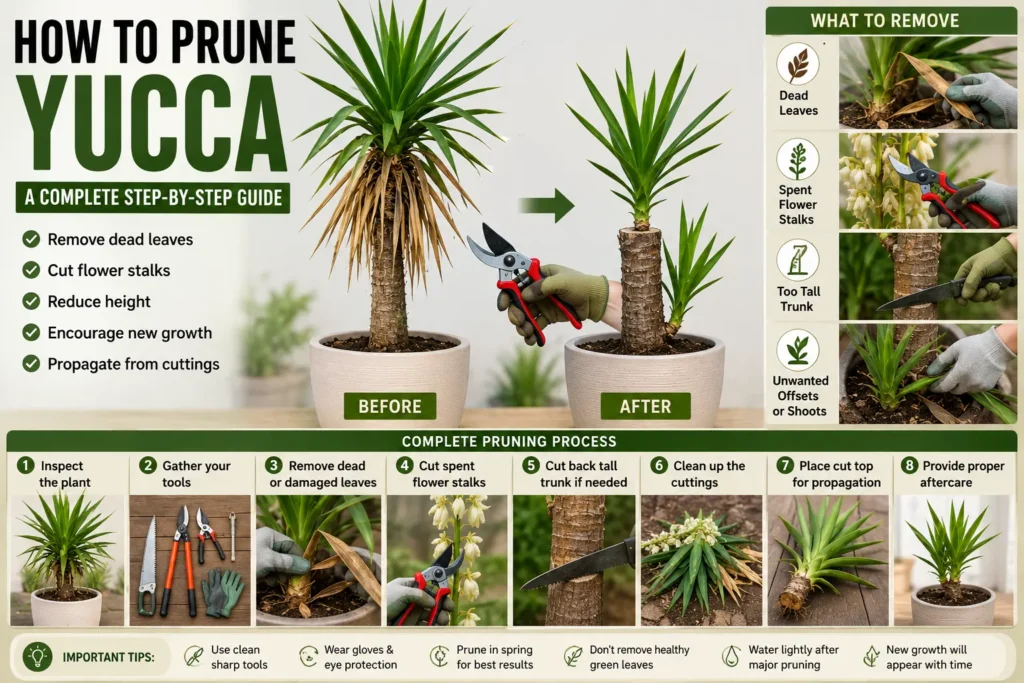
I find yucca plants fairly easy to maintain because they usually need very little pruning. Most of the time, I only remove dead or damaged leaves, clean up old flower stalks, or cut back a plant that has become too tall.
The key is knowing what to cut and what to leave alone. I would never remove healthy green leaves just to make the plant look smaller. Those leaves help the plant produce food and support new growth.
In this guide, I will show you how I prune yucca plants, when I do it, which tools I use, how I handle an overgrown indoor yucca, and what to expect after a major cut.
Quick Answer: How Do You Prune a Yucca?
To prune a yucca, I first inspect the plant and identify dead, damaged, diseased, or unwanted growth. I use clean, sharp pruning shears, loppers, or a pruning saw depending on the size of the part I need to cut. I remove fully dead leaves close to their base, cut spent flower stalks after flowering, and reduce an overgrown trunk with a clean cut when the plant needs to be shortened. I prefer major pruning in spring when active growth resumes, while dead or damaged material can be removed as needed.
Why Should You Prune a Yucca?
Yuccas are naturally low-maintenance plants, so I do not prune them on a fixed schedule.
Instead, I prune when there is a clear reason.
Remove Dead and Damaged Growth
Old yucca leaves eventually turn yellow, brown, and dry. Removing fully dead leaves makes the plant look cleaner and gets rid of material that no longer contributes to healthy growth.
Control Plant Size
An indoor yucca can eventually become too tall for its space. When that happens, cutting back the trunk can reduce the height and encourage new growth below the cut.
Improve the Shape
A yucca can become uneven when it grows toward a nearby light source.
For indoor plants, I also rotate the pot from time to time so the plant does not lean heavily in one direction.
Remove Spent Flower Stalks
After a yucca finishes flowering, the tall flower stalk eventually becomes dry and unattractive. I can cut it back once the flowering period is finished.
Prepare Cuttings for Propagation
If I have to shorten a trunk-forming yucca, I do not automatically throw away the healthy top section. A suitable cutting can sometimes be used to grow another yucca.
For the full rooting process, I would keep that information in my separate guide on how to propagate yucca.
When Is the Best Time to Prune a Yucca?
For major pruning, I prefer spring or the start of active growth.
The plant has more time to produce new growth during the growing season, and this is also the period commonly recommended for significant pruning.
Routine cleanup is different.
Best Time for Major Pruning
If I need to shorten a tall trunk or make a major structural cut, I would aim for spring.
This gives the plant a better growing period after the cut.
When to Remove Dead Leaves
I do not wait for a particular month if I see a completely dead leaf that needs removal.
Dead or damaged leaves can be removed as needed, although spring is a convenient time for general cleanup.
When to Remove Flower Stalks
I usually wait until the flowers have finished and the stalk has started to fade.
Then I follow the stalk down to its base and remove it carefully without cutting the surrounding leaves.
Should You Prune Yucca in Winter?
I avoid major pruning during cold or inactive periods when I can.
If a leaf is badly damaged or dead, however, I would remove it rather than leaving a serious problem on the plant simply because it is winter.
What You Need Before Pruning a Yucca

The tools I use depend on the size of the plant and the type of cut.
Pruning Shears
Sharp pruning shears work well for smaller leaves and thinner flower stalks.
Loppers
For thicker stems or tough growth, loppers give me more cutting strength.
Pruning Saw
If I need to cut through a thick yucca trunk, I prefer a pruning saw rather than forcing ordinary shears through it.
Gloves and Eye Protection
Yucca leaves can be stiff and sharply pointed. I wear protective gloves and, for larger outdoor plants, eye protection as well.
Cleaning Your Tools
Before I start, I make sure my cutting tools are clean and sharp.
A clean, sharp blade gives me a smoother cut and reduces unnecessary crushing of the plant tissue.
How to Prune a Yucca Step by Step

Step 1: Inspect the Plant
I start by looking at the entire yucca rather than cutting the first brown leaf I see.
I check the leaves, trunk, crown, flower stalks, and any new shoots.
I also look for pests, rot, soft areas, or other signs of a plant problem.
Step 2: Decide What Needs Cutting
This is where I make the biggest distinction.
I separate the plant material into three groups:
- Dead or badly damaged growth
- Growth that needs controlling
- Healthy growth that should remain
I only remove healthy growth if I have a clear reason, such as reducing the height of an overgrown trunk.
Step 3: Clean Your Pruning Tools
I clean my shears, loppers, or saw before making cuts.
If I am working on more than one plant, I clean the tools between plants as an extra precaution.
Step 4: Remove Dead and Damaged Leaves

I push the surrounding leaves aside so I can see where the dead leaf joins the plant.
If the leaf is completely dry and comes away easily, I can remove it carefully. If it does not detach cleanly, I use sharp pruning shears to cut it.
I avoid cutting into healthy green tissue.
Step 5: Remove Spent Flower Stalks
Once flowering has finished, I trace the flower stalk down toward the center of the plant.
I make the cut as close to the base as I safely can without cutting nearby leaves.
The stalk can be tough, so I use a suitable sharp tool rather than forcing a small pair of scissors through it.
Step 6: Cut Back an Overgrown Trunk
If my indoor yucca has become too tall, I choose the height where I want the plant to start producing new growth.
Then I make one clean cut through the trunk.
A healthy yucca can respond to this type of reduction, although the exact regrowth pattern varies from plant to plant. A cut-off top can also be used for propagation under suitable conditions.
Step 7: Clean Up the Cuttings
I remove the cut leaves, flower stalks, and other debris from around the plant.
Yucca cuttings can be surprisingly sharp, so I handle them carefully.
If I have removed a healthy trunk section for propagation, I keep it separate instead of mixing it with the waste.
Step 8: Check the Plant After Pruning
After pruning, I check the plant for accidental damage.
I also make sure it has suitable light and is not sitting in constantly wet soil.
Then I leave it alone and watch for new growth instead of making more cuts too soon.
How to Prune a Yucca That Has Grown Too Tall

This is one of the most common reasons I would do major yucca pruning indoors.
A trunk-forming yucca can keep growing upward until the leaves are almost touching the ceiling.
At that point, trimming individual leaves will not solve the problem. I need to reduce the height of the trunk.
Where to Cut the Trunk
I first decide the finished height I want.
Then I make a clean cut through the trunk at that point.
For a very tall, healthy indoor yucca, reducing the plant substantially can work. Guidance for indoor yuccas recommends reducing excessive height during spring growth, with the removed upper portion potentially suitable for propagation.
How Much of the Trunk Can You Remove?
There is no single cut height that works for every yucca.
I consider:
- The plant’s overall height
- Trunk thickness
- Number of existing stems
- Health of the plant
- Amount of foliage
- Available light
- How much height I actually need to remove
I would rather make one well-planned cut than repeatedly shorten the plant without a clear reason.
What Happens After Cutting the Trunk?

New growth may develop from the remaining stem.
The exact number and position of new shoots can vary, so I would not expect every yucca to produce the same result.
Light, temperature, plant health, species, and growing conditions can all affect regrowth.
How to Encourage New Shoots
After a major cut, I focus on normal care rather than trying to force new shoots.
I provide suitable light, avoid keeping the soil constantly wet, and give the plant time to respond.
I would not keep cutting the stem because new growth has not appeared quickly.
How to Prune Dead or Brown Yucca Leaves

Not every brown leaf needs to be removed immediately.
If the entire leaf has turned brown and dry, I am comfortable removing it.
If only the tip is brown, I usually leave most of the healthy leaf intact unless the appearance bothers me.
Completely Dead Leaves
I separate the dead leaf from the healthy foliage and trace it back to its base.
Then I cut it cleanly.
Older, dry leaves are often easier to remove than green growth.
Partially Brown Leaves
If a leaf still has a large amount of healthy green tissue, I do not remove the entire leaf just because the tip is brown.
The green portion is still useful to the plant.
Brown Leaf Tips
If only the tip is brown, I can trim the dry portion for appearance.
I follow the natural shape of the leaf instead of making a blunt, straight cut across the entire blade.
Should You Pull Dead Leaves Off?
Sometimes a fully dry leaf will come away with a gentle pull.
If it resists, I do not force it.
I use pruning shears to cut it instead. This gives me more control and reduces the chance of damaging nearby growth.
How to Prune a Yucca After Flowering

A flowering yucca can produce a tall stalk that rises from the center of the leaf rosette.
Once the flowers have finished, I can remove the spent stalk.
When to Remove the Yucca Flower Stalk
I prefer to wait until flowering is finished.
The stalk can then be removed without interfering with the display of flowers.
Where to Cut the Flower Stalk
I follow the stalk down toward where it emerges from the plant.
Then I make a clean cut near its base while taking care not to damage surrounding leaves.
Should I Remove the Flower Stalk Every Year?
I do not have to.
Removing a spent flower stalk is mainly a cleanup and appearance task. Some gardeners remove it because they prefer a cleaner plant after flowering.
The plant can also have different flowering patterns depending on its type and growing conditions.
How to Prune Different Types of Yucca
Yuccas are not all identical.
Some form trunks, while others grow as clumps or low rosettes.
Trunk-Forming Yuccas
These are the types I would consider for major height reduction.
If the plant becomes too tall indoors, the trunk can be cut back and allowed to produce new growth.
Clumping Yuccas
Clumping types often produce multiple rosettes from the base.
Here, I focus more on removing dead foliage, spent flower stalks, or unwanted shoots instead of cutting the whole plant down.
Indoor Yuccas
Indoor yuccas often need pruning because of height and space.
I would also rotate the container periodically so growth stays more balanced.
Outdoor Yuccas
Outdoor yuccas generally need less routine pruning.
I mainly remove dead or damaged growth, spent flower stalks, or unwanted shoots when the plant becomes too crowded. Some outdoor yuccas require very little pruning at all.
Should You Remove the Dead Leaves Around a Yucca Trunk?
You can, but I do not think every dead leaf needs to be removed.
Trunk-forming yuccas can develop a skirt of old, dried leaves around the trunk.
If I want a cleaner trunk, I can remove the dead leaves individually.
If they are dry and loose, some may come away with gentle handling. Others are easier to cut with pruning shears.
For outdoor plants, I also consider the local conditions before removing a large amount of old foliage.
Can You Cut the Top Off a Yucca?
Yes, a healthy trunk-forming yucca can be shortened by cutting through the trunk.
This is one of the most useful methods for an indoor yucca that has become too tall.
I would choose the cutting height carefully, use a clean sharp tool, and then give the remaining plant suitable growing conditions.
The removed top may also be suitable for propagation.
Can You Cut a Yucca Trunk in Half?
A healthy, established yucca can tolerate a significant trunk reduction.
However, I would not automatically cut every plant in half.
I first look at the plant’s health and decide how much height I actually need to remove. A severe cut is more suitable for a healthy, established plant than for a weak plant already struggling with poor light, root problems, pests, or disease.
Can You Propagate Yucca From Pruning Cuttings?
Yes, some healthy yucca cuttings can be used for propagation.
The top section removed from a tall indoor yucca can potentially become a new plant, while trunk sections can also be used in suitable propagation methods.
I would keep the propagation details in my separate how to propagate yucca guide so this article stays focused on pruning.
The basic point is simple: if I have removed healthy material during pruning, I do not always need to throw it away.
Yucca Pruning Aftercare
A yucca does not need an elaborate recovery routine after ordinary pruning.
After a major cut, though, I pay closer attention to the plant.
Light
I make sure an indoor yucca receives suitable bright light.
Good light supports normal growth and can help the plant recover from a major cut.
Watering
I do not start watering more simply because I pruned the plant.
Yucca plants prefer well-draining growing conditions, and keeping the soil constantly wet can create more problems.
For watering details, I would refer to my separate guide on how often to water a yucca plant.
Fertilizing
I avoid immediately piling on fertilizer after a major cut.
I let the plant settle and return to active growth first.
Monitoring New Growth
I watch the remaining trunk and crown for signs of new growth.
A slow response does not automatically mean the plant has failed.
Signs of Stress
After pruning, I watch for:
- Soft or rotting tissue
- Widespread leaf yellowing
- Sudden collapse
- Severe wilting
- Pest activity
- No improvement in a plant that was already weak
If the plant was unhealthy before pruning, I also check its soil, roots, light, watering, and pest status.
Common Yucca Pruning Mistakes
Cutting Healthy Green Leaves
This is one of the mistakes I try hardest to avoid.
Green leaves still contribute to the plant, so I do not remove them simply because I want a cleaner shape.
Using Dull Tools
A dull blade can crush or tear plant tissue instead of making a clean cut.
I prefer sharp tools that make the job easier and give me better control.
Making Too Many Cuts
I do not keep cutting simply because one part of the plant looks imperfect.
Yucca is naturally structured around its rosettes, so excessive trimming can make the plant look unnatural.
Pruning at the Wrong Time
Major cuts are best planned around active growth.
Spring is my preferred time for significant pruning when practical.
Ignoring Sharp Leaves
Yucca leaves can be surprisingly sharp.
I wear gloves and take care when reaching into the center of a large plant.
Overwatering After Major Pruning
Pruning does not mean the plant suddenly needs lots of water.
I continue to follow a normal watering routine and make sure excess water can drain away.
Cutting Without Checking the Plant’s Health
I would not make a major trunk cut on a plant that is already seriously stressed without first figuring out why it is struggling.
If pests, root problems, poor light, or watering issues are present, those problems need attention too.
How Long Does It Take a Yucca to Grow Back After Pruning?
There is no exact timeline that applies to every yucca.
The response can vary with:
- Yucca species
- Season
- Light
- Temperature
- Plant health
- Trunk size
- Location of the cut
- Growing conditions
I would look for signs of new growth rather than expecting a specific number of days.
If the plant remains firm and healthy, I give it time.
How Often Should You Prune a Yucca?
I do not prune yuccas on a monthly or yearly schedule just for the sake of pruning.
Instead, I check the plant and prune when needed.
For routine care, that might mean removing a few dead leaves.
For a tall indoor yucca, major trunk pruning may only be needed when the plant becomes too large for its space.
For outdoor yuccas, pruning may be even less frequent because many types naturally maintain their shape with little intervention.
Yucca Pruning Decision Guide
| What I see | What I would do |
| Completely dead leaf | Remove the leaf |
| Damaged leaf | Remove the damaged leaf if needed |
| Brown leaf tip | Trim only the dry portion if desired |
| Spent flower stalk | Remove the stalk after flowering |
| Yucca too tall | Consider cutting the trunk |
| Unwanted basal shoot | Remove it if needed for size control |
| Healthy green leaf | Usually leave it alone |
| Weak or unhealthy plant | Find the cause before major pruning |
| Healthy top removed during pruning | Consider using it for propagation |
Final Take
I find yucca pruning much easier when I treat it as selective cleanup rather than cutting the plant into a particular shape.
I remove dead and damaged leaves, clean up spent flower stalks, and leave healthy green foliage alone. If an indoor yucca becomes too tall, I make a planned trunk cut instead of trying to solve the height problem by trimming individual leaves.
The best approach is to inspect first, decide what actually needs cutting, use the right tool, make clean cuts, and give the plant time to produce new growth.
If I remove a healthy top or trunk section during major pruning, I can also put that material to use by propagating it rather than throwing it away.
Frequently Asked Questions
How do you prune a yucca?
I start by identifying what actually needs cutting. I remove dead or badly damaged leaves at their base, remove spent flower stalks after flowering, and cut back an overgrown trunk when the plant needs major height reduction.
When should I prune my yucca?
For major pruning, I prefer spring when the plant is entering active growth. Dead or damaged material can be removed when necessary.
Should I cut dead leaves off my yucca?
Yes, completely dead leaves can be removed. I cut them close to their base while avoiding healthy green tissue.
Can I cut brown tips off yucca leaves?
Yes. If only the tip is brown, I can trim the dry portion while leaving the healthy green section intact.
Can I cut the top off a yucca?
Yes. A healthy, tall, trunk-forming yucca can be shortened by cutting through the trunk. The removed top may also be suitable for propagation.
Can I cut a yucca trunk in half?
A healthy established yucca can tolerate substantial trunk reduction, but I would decide the final height carefully rather than automatically cutting every plant by half.
Will a yucca grow back after pruning?
A healthy yucca can produce new growth after pruning, but the exact response varies. Give the plant suitable light and normal care while waiting for new shoots.
Should I remove the yucca flower stalk?
After flowering, I usually remove the spent stalk if I want the plant to look cleaner. I cut it near the base while avoiding nearby leaves.
How do I prune a yucca that is too tall?
For a tall indoor yucca, I choose the height where I want the plant to remain and make a clean cut through the trunk. Spring is a good time for major height reduction when practical.
How do I prune a yucca without killing it?
I avoid unnecessary cuts, use clean sharp tools, remove dead material carefully, and only make major trunk cuts on a reasonably healthy plant. After pruning, I continue normal light and watering rather than overwatering.
Can I propagate yucca from pruning cuttings?
Yes. Healthy top and trunk sections can sometimes be used for propagation.
Should I remove all the brown leaves from my yucca?
I remove fully dead or badly damaged leaves, but I do not remove healthy green leaves simply because they are close to brown foliage.
How often should I prune a yucca?
There is no fixed schedule. I prune when the plant has dead growth, spent flowers, unwanted shoots, or excessive height.
Do outdoor yuccas need pruning?
Most outdoor yuccas need little regular pruning. I mainly remove dead or damaged leaves, spent flower stalks, or unwanted growth when necessary.
Do indoor yuccas need more pruning?
They can, especially when a trunk-forming yucca becomes too tall for the room. In that situation, reducing the trunk can be more useful than repeatedly trimming individual leaves.
What tools are best for pruning yucca?
I use pruning shears for smaller growth, loppers for thicker material, and a pruning saw for a large trunk. Gloves and eye protection are useful because yucca foliage can be sharp.