Skip to content

Two patios can look identical on the day they’re finished. Same grey porcelain, same proud homeowner with a cup of tea on it. Give them three winters, though, and one will still be flat while the other has a puddle by the back door and a slab that rocks every time you step on it.
The difference is almost never the slabs. It’s the 200mm or so of stuff you never see. In St Albans that hidden layer matters more than in a lot of places, because the ground here can switch from sticky clay to crumbly chalk within a single street. So here’s what should go under a patio, why it changes the price, and roughly what porcelain, sandstone, resin and block paving cost in 2026.
Start With the Hole, Not the Brochure
Most people choose the surface first. We get it. Slab samples are a fun bit. But the honest order on site is ground, then levels, then drainage, and only then the pretty stuff on top.
Anyone quoting for garden design in St Albans should be asking what’s under your lawn before they ask what colour you like. A typical patio build, from the top down:
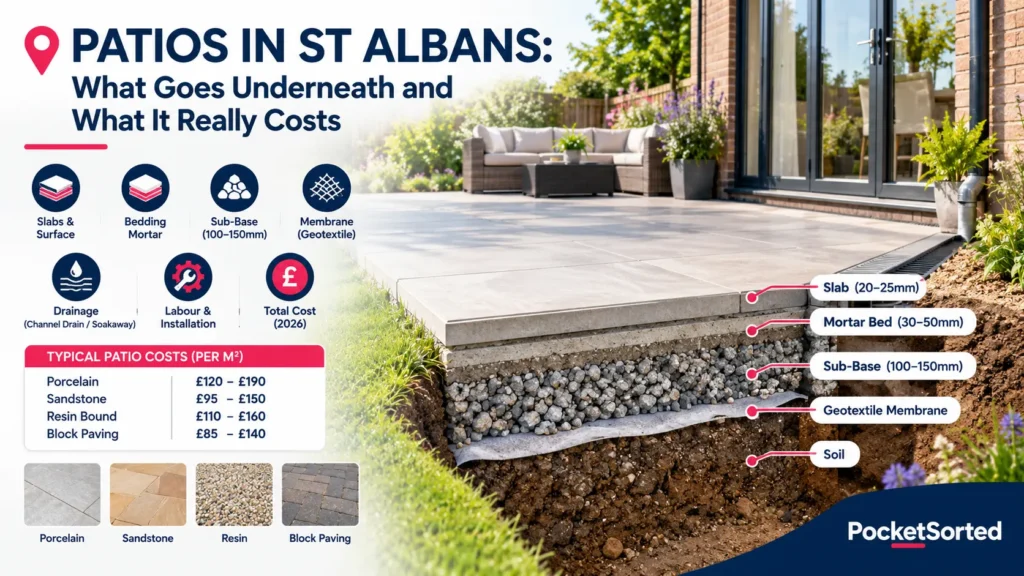
- Slabs. 20mm porcelain, or 22mm to 25mm for calibrated sandstone.
- Bedding. 30mm to 50mm of mortar, laid as a full bed. Not five dabs in the corners. Spot bedding is how slabs end up rocking and staining.
- Sub-base. 100mm to 150mm of MOT Type 1 (crushed stone graded down to dust, which locks tight when compacted), rolled in layers with a plate compactor.
- Membrane. A geotextile sheet on clay, to stop the sub-base slowly sinking into the mud below.
Add it up and you’re digging out 200mm to 250mm across the whole area. On a 30m² patio that’s somewhere around 7 to 8 tonnes of spoil once it bulks up. It all has to go somewhere, and muck away is often a bigger line on the quote than people expect.
Two levels to get right. The finished surface should sit at least 150mm below the damp-proof course of the house, and it needs a fall (a gentle slope) of about 1 in 60 to 1 in 80 away from the walls. Porcelain barely absorbs a drop, so that fall is doing all the work.
Clay-With-Flints: Why It Pushes the Price Up
Much of the higher ground across the city sits on clay-with-flints. It’s a stiff, orange-brown clay packed with flints that range from walnut size to something you’d struggle to lift one-handed. Digging it is slow. Mini-diggers bounce off the big flints, and in a wet February the spoil turns to something like toffee that clings to every bucket.
The bigger issue is water. Clay doesn’t drain, so rain running off a new patio has nowhere to go. Shed it towards the lawn and that edge becomes a bog by Christmas. We’d budget for a linear channel drain along the house side on most clay jobs, feeding a soakaway or, where permitted, an existing surface water drain. Never the foul sewer. It isn’t allowed, and it’s an awkward conversation if a buyer’s surveyor spots it.
Clay also shrinks and swells. Near big trees, especially the mature oaks and limes round Harpenden Road and Clarence Park, the ground can move noticeably in a dry summer. A deeper sub-base helps, as does leaving a little flexibility at the edges. Nothing makes clay behave perfectly, and anyone who promises otherwise is guessing.
When You Hit Chalk Instead
Further down the slopes, and in gardens falling towards the River Ver and Verulamium, the clay cap thins and you can be into pale chalk within 30cm. Good news, mostly. Chalk drains far better and makes a firm base when it’s dry.
Two catches, though. Chalk turns soft and greasy when saturated, and it can be frost-susceptible, so you still want a proper Type 1 layer on top rather than slabbing straight onto it. And Hertfordshire chalk is known for solution features (natural hollows where the chalk has dissolved over thousands of years). That’s why we’re wary of soakaways near houses. Building Regulations guidance puts them at least 5m from a building, and on chalk we’d treat that as a bare minimum rather than a target.
Porcelain, Sandstone, Resin or Block Paving
Our opinion? Porcelain is the safest bet for most back gardens now. It shrugs off stains and it’ll look much the same in 15 years. It’s also unforgiving to lay. Every slab needs a bonding primer on the back, and cutting it chews through diamond blades at a rate that would make you wince.
Indian sandstone is cheaper and warmer looking, and it suits older houses. It does weather, though, and it needs sealing if you want to keep anything like the showroom colour. Some people love the aged look. Others ring us in year three asking why it’s gone patchy.
Resin bound is lovely for paths and front gardens, and it’s permeable when laid on an open-graded base. Laid over an old cracked concrete slab, it’ll copy every crack within a year or two. Block paving is the workhorse for drives. Hard to beat when cars are involved, and individual blocks can be lifted and relaid when someone from the water board digs a hole in it.
The Front Garden Rule That Catches People Out
If you’re paving a front garden and the new or replaced hard surface is more than 5m² you need planning permission unless the surface is permeable or the water drains to a lawn or border within your property. That’s national permitted development rules, not a local quirk, and it applies to the slab-and-parking combos we see going in every month.
Permeable block paving, resin bound on a permeable base and loose gravel all get round it. Traditional slabs on concrete with the run-off heading onto the pavement don’t. In the city’s conservation areas, some streets also have Article 4 directions that strip out permitted development rights entirely, so an email to the district council before you dig is time well spent.
What It Costs in 2026
Rough supply-and-lay prices across this part of Hertfordshire, including excavation, sub-base and bedding:
- Porcelain patio: £120 to £190 per m²
- Indian sandstone patio: £95 to £150 per m²
- Resin bound, new base: £110 to £160 per m² (£70 to £100 over a sound existing base)
- Block paving: £85 to £140 per m²
- Channel drain: £70 to £130 per metre installed
- Soakaway: £1,000 to £2,500
- Steps in porcelain or sandstone: £350 to £650 per step
- Retaining wall, block or brick: £300 to £550 per m² of wall face
- Edging (setts or kerbs): £30 to £60 per metre
So a 25m² porcelain patio with a channel drain typically lands between £4,000 and £6,000. A 40m² sandstone terrace on a sloping Marshalswick plot, with two steps and a short retaining wall, can easily reach £9,000 to £13,000. Skips and grab lorries are usually priced on top, at around £350 to £450 a load locally.
Access changes everything. A Victorian terrace in Fleetville with a side return and no side gate means every bag of spoil and every slab goes through the house, usually over dust sheets and a very nervous carpet. That can add 15% to 25% to the labour. Better to raise it at the first visit than discover it on the quote.
Getting Quotes Without Getting Burnt
Get at least three written quotes, and make sure each spells out the dig depth, the sub-base thickness, the bedding method and where the water ends up. If one is far cheaper, it’s usually because one of those lines got thinner. Ask to see £2m public liability insurance and a waste carrier licence for the muck away, and get any workmanship guarantee in writing. Keep the deposit to 25% or less. And if someone knocks on the door with “leftover tarmac from a job round the corner”, you already know how that one ends.
If you’re weighing up a new patio or a front garden that needs to stay permeable, Superior Garden Design St Albans is a sensible first call before you order a single slab.
Frequently Asked Questions
How much does a new patio cost in St Albans in 2026?
Expect around £120 to £190 per m² for porcelain and £95 to £150 per m² for Indian sandstone, laid on a proper sub-base. A 25m² porcelain patio with a channel drain usually comes to £4,000 to £6,000. Tricky access or a sloping plot pushes that up.
How deep should you dig for a patio?
Usually 200mm to 250mm below the finished level. That allows for 100mm to 150mm of compacted MOT Type 1, a 30mm to 50mm mortar bed and the slab itself. Driveways need more, often 250mm to 300mm.
Do I need planning permission to pave my front garden?
Only if the new hard surface is over 5m², isn’t permeable, and the water doesn’t drain to a lawn or border on your property. Permeable block paving, resin bound on a permeable base and gravel avoid the need. In conservation areas, check for Article 4 directions first.
Is porcelain or sandstone better on clay soil in St Albans?
The base and drainage matter far more than the slab. Both work on clay with a geotextile membrane, 150mm of Type 1 and a channel drain along the house. Porcelain stays cleaner for longer, while sandstone is cheaper per m² but needs sealing.
Can I lay resin bound over my old concrete patio?
Sometimes, if the concrete is sound, level and free of cracks. Resin over a cracked or failing slab will show those cracks within a year or two. Over a good base it costs around £70 to £100 per m².