Skip to content

Choosing between Kentucky bluegrass, fescue, and ryegrass can be tricky because all three are cool-season grasses, but they perform very differently.
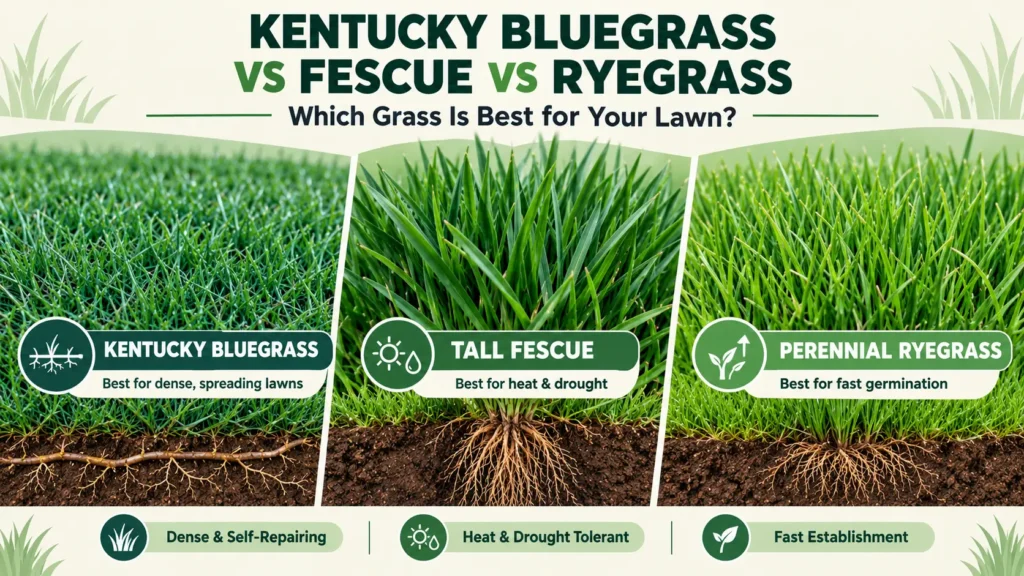
Kentucky bluegrass is a strong choice for dense, attractive lawns in cooler areas. Tall fescue handles heat, drought, and regular foot traffic better. Perennial ryegrass stands out for fast germination and quick establishment.
The best choice depends on your climate, sunlight, soil, water supply, and how you use the lawn. I would also look at whether you need grass that spreads and repairs itself or grass that needs reseeding after damage.
Quick Answer: Kentucky Bluegrass vs Fescue vs Ryegrass
For most homeowners, there is no single winner.
- Kentucky bluegrass: Best for dense, fine-textured lawns in cooler areas with good sunlight.
- Tall fescue: Best for heat, drought, partial shade, and lawns that get regular use.
- Perennial ryegrass: Best when fast germination, quick cover, and strong wear tolerance matter.
- Fine fescue: Best for shady areas and lower-use lawns.
Kentucky bluegrass spreads through underground rhizomes, so it can repair small damaged areas. Tall fescue and perennial ryegrass grow mainly in clumps, so bare areas often need reseeding.
Kentucky Bluegrass vs Fescue vs Ryegrass at a Glance
| Feature | Kentucky Bluegrass | Tall Fescue | Perennial Ryegrass |
| Growth speed | Slow | Medium-fast | Fast |
| Growth habit | Spreads by rhizomes | Bunch-type | Bunch-type |
| Self-repair | Good | Low | Low |
| Heat tolerance | Fair | Excellent | Low to fair |
| Drought tolerance | Good | Excellent | Fair |
| Shade tolerance | Fair | Good | Fair |
| Wear tolerance | Good | Good | Excellent |
| Texture | Fine to medium | Medium to coarse | Fine to medium |
| Germination | Slow | Moderate-fast | Fast |
| Best use | Dense cool-climate lawns | Heat, drought, busy lawns | Fast cover and wear |
| Main drawback | Summer stress | Does not spread | Summer stress |
These ratings can change with grass variety, soil, irrigation, mowing, and local climate, so treat the table as a starting point rather than a strict rule.
What Is Kentucky Bluegrass?
Kentucky bluegrass, also called Poa pratensis, is one of the main cool-season lawn grasses used in the United States.
It has a fine to medium texture and can form a thick, attractive lawn when conditions suit it. Its biggest advantage is its spreading growth habit. Underground stems called rhizomes allow the grass to move into nearby thin or damaged areas.
Kentucky Bluegrass Strengths
- Dense lawn growth
- Fine to medium leaf texture
- Good cold tolerance
- Good ability to recover from damage
- Strong appearance in suitable climates
- Spreads through rhizomes
- Works well in sunny areas
Kentucky Bluegrass Weaknesses
Kentucky bluegrass can struggle during long periods of summer heat and drought. It also establishes more slowly from seed than tall fescue or perennial ryegrass.
If your lawn gets very hot summers and limited irrigation, I would look closely at tall fescue before choosing Kentucky bluegrass.
Kentucky bluegrass also tends to perform best when the soil, fertility, and moisture level support active growth.
What Is Fescue Grass?
Fescue is not one grass species. It is a group of grasses that includes tall fescue and several types of fine fescue.
That difference matters because tall fescue and fine fescue can serve very different purposes.
Fine Fescue
Fine fescues have very thin blades and are useful in cooler areas, especially where shade is a concern.
They generally have lower wear tolerance than tall fescue, so I would not make fine fescue my first choice for a lawn that gets heavy daily traffic.
Fine fescue can make sense for:
- Shady areas
- Areas under trees
- Low-use lawns
- Fine-textured turf
- Lower-input lawn situations
Tall Fescue
Tall fescue is the main fescue grass homeowners usually mean in a three-way comparison with Kentucky bluegrass and perennial ryegrass.
It has a stronger heat tolerance and deep root system. It also performs well in sunny and partly shaded areas.
Tall fescue has a bunch-type growth habit. This means it does not spread through rhizomes like Kentucky bluegrass.
That is both a benefit and a drawback. The grass can form a strong lawn, but bare spots usually need new seed rather than waiting for nearby plants to spread into them.
Tall Fescue Strengths
- Strong heat tolerance
- Strong drought performance
- Good traffic tolerance
- Good performance in partial shade
- Strong root system
- Good choice for many transition-zone lawns
Tall Fescue Weaknesses
- Does not spread like Kentucky bluegrass
- Damaged areas may need reseeding
- Coarser than Kentucky bluegrass and perennial ryegrass
- Summer disease can become a problem under poor conditions
What Is Perennial Ryegrass?
Perennial ryegrass, or Lolium perenne, is a cool-season grass known for quick establishment and strong wear tolerance.
It is often useful when a homeowner needs grass to come up quickly. It can also play a role in overseeding and lawn renovation.
Perennial Ryegrass Strengths
- Fast germination
- Fast establishment
- Fine to medium texture
- Good wear tolerance
- Attractive green color
- Useful for overseeding
- Useful for quick lawn repairs
Perennial Ryegrass Weaknesses
Perennial ryegrass does not spread through rhizomes. It grows in bunches, so it cannot naturally fill a bare patch in the same way Kentucky bluegrass can.
It can also struggle during extended summer heat and drought. It may need careful irrigation when summer conditions become stressful.
Kentucky Bluegrass vs Fescue vs Ryegrass: Main Differences
The biggest differences come down to growth speed, climate tolerance, shade, traffic, and recovery.

Growth Speed and Germination
Perennial ryegrass is usually the quickest of the three to establish from seed.
Tall fescue generally establishes faster than Kentucky bluegrass, while Kentucky bluegrass takes longer to germinate and fill in. Typical germination can range from about 8 to 21 days for tall fescue and perennial ryegrass under suitable conditions, while Kentucky bluegrass can take roughly 15 to 30 days.
Actual results depend on soil temperature, moisture, seed quality, planting depth, and other conditions.
If I needed quick green cover, perennial ryegrass would be the first option I would consider.
Spreading and Self-Repair
This is one of the most useful differences between these grasses.
Kentucky bluegrass produces rhizomes, which are underground stems that help the plant spread. This gives it a better ability to fill small damaged areas over time.
Tall fescue and perennial ryegrass are mainly bunch-type grasses. If they develop a bare area, nearby plants will not spread into it in the same way. Reseeding is often the better fix.
So if self-repair matters to you, Kentucky bluegrass has a clear advantage.
Heat and Drought Tolerance
Tall fescue is the strongest choice among these three for hot and dry conditions.
Kentucky bluegrass can handle periods of drought, but summer heat can place more stress on it. Perennial ryegrass also needs care during hot, dry weather and generally does not match tall fescue for summer performance.
If your lawn regularly faces hot summers, I would give tall fescue serious consideration.
Shade Tolerance
Shade changes the choice.
Fine fescue is usually the better option when shade is the main problem. Tall fescue can handle partial shade, while Kentucky bluegrass generally performs better with good sunlight.
Perennial ryegrass can handle some shade, but it is not usually the first choice for a heavily shaded lawn.
If your lawn has a mix of sun and shade, a suitable grass blend may work better than planting one species across the entire yard.
Foot Traffic and Recovery
Heavy traffic creates two separate questions:
- How well does the grass handle wear?
- How well does it recover after damage?
Perennial ryegrass has strong wear tolerance and establishes quickly. Tall fescue also handles regular lawn use well. Kentucky bluegrass has good recovery because its rhizomes allow it to spread into damaged areas.
This is why I would not choose a grass based on traffic tolerance alone.
A lawn that gets heavy use may benefit from a species that handles wear well, while a lawn that often develops small bare patches may benefit from Kentucky bluegrass because of its spreading growth.
Which Grass Is Best for Your Lawn?

Your lawn conditions matter more than picking the grass with the highest rating in one category.
Best for Cool, Sunny Lawns: Kentucky Bluegrass
Choose Kentucky bluegrass if you want a dense, fine-textured lawn and live in a climate where cool-season grass performs well.
It is especially useful when appearance and natural recovery matter.
Best for Heat and Drought: Tall Fescue
Tall fescue is the better choice if your lawn faces hot summers, periods of drought, or partial shade.
Its strong root system and heat tolerance make it a common choice for lawns that need to handle difficult summer conditions.
Best for Fast Germination: Perennial Ryegrass
Choose perennial ryegrass when speed matters.
It establishes quickly from seed and has good wear tolerance, which makes it useful for lawn renovation, quick coverage, and some overseeding programs.
Best for Shade: Fine Fescue
If shade is your main problem, fine fescue deserves a close look.
It has fine blades and performs well in many cooler, shaded lawn settings. Heavy traffic can still be a problem, so consider how the area will be used before choosing it.
Best for Kids and Pets
For a lawn used regularly by kids and pets, I would usually look first at tall fescue or a suitable grass blend.
Perennial ryegrass also has strong wear tolerance, while Kentucky bluegrass offers good recovery. The best choice still depends on climate and how much summer stress the lawn receives.
Best Grass by US Region

The United States has large differences in temperature, rainfall, soil, and summer stress. That makes regional selection important.
Northern States
Kentucky bluegrass, tall fescue, fine fescue, and perennial ryegrass can all have a place in northern lawns.
Kentucky bluegrass is a strong choice for sunny lawns where a dense, spreading turf is wanted. Fine fescue can help in shade, while perennial ryegrass offers fast establishment.
Midwest and Northeast
Cool-season grasses are common choices across much of these regions.
Kentucky bluegrass can work well where summers are not too harsh and irrigation is available. Tall fescue can be useful where summer heat, drought, or partial shade creates more stress.
Transition Zone
The transition zone is harder because lawns can face both cold winters and hot summers.
Tall fescue often becomes a strong choice here because of its heat and drought performance. Kentucky bluegrass and perennial ryegrass may also be used in blends, depending on the local site.
Pacific Northwest
Cool-season grasses are common choices in many parts of the region.
Perennial ryegrass and fine fescue can work well in suitable conditions, while Kentucky bluegrass may also have a place where soil, sunlight, and summer conditions fit its needs.
Do not choose seed based only on the state name. Local climate and lawn conditions still matter.
Can You Mix Kentucky Bluegrass, Fescue, and Ryegrass?

Yes, grass blends can make sense.
Different grass species have different strengths. A blend can combine those traits instead of relying on one species to handle every condition.
Kentucky bluegrass can add spreading growth and recovery. Tall fescue can add heat and drought performance. Perennial ryegrass can add quick establishment and strong wear tolerance. Research on cool-season mixtures has also found that combinations of these grasses can offer useful performance under different stress conditions.
But I would not mix random seed bags without checking the recommended blend.
The grasses need to suit the same climate and management plan. Seed percentages, cultivars, mowing height, sunlight, and water needs all matter.
What Is the Best Grass for Low Maintenance?
There is no single low-maintenance winner for every lawn.
Fine fescue can work well in suitable cool and shaded locations with lower traffic. Tall fescue can reduce some summer water stress compared with grasses that struggle more in heat.
Kentucky bluegrass may need more attention in hot summer conditions, especially where irrigation is limited.
The lowest-maintenance grass is usually the one that matches the site. Choosing the wrong grass can create more work through watering, reseeding, mowing, and repair.
How to Identify Kentucky Bluegrass, Fescue, and Ryegrass

You can often get useful clues by looking closely at the grass blades and growth pattern.
Kentucky Bluegrass
Look for:
- Fine to medium blades
- Blue-green color
- Boat-shaped leaf tips
- Dense growth
- Spreading growth through rhizomes
The boat-shaped leaf tip is one of the more useful identification clues.
Tall Fescue
Look for:
- Wider blades
- Coarser texture
- Strong bunch growth
- Pronounced veins
- Taller, upright growth
Tall fescue generally looks broader and coarser than Kentucky bluegrass or perennial ryegrass.
Perennial Ryegrass
Look for:
- Fine to medium blades
- Smooth appearance
- Strong green color
- Upright bunch growth
- Quick establishment
A mixed lawn can make identification harder because several grass types may grow together.
When Should You Plant Kentucky Bluegrass, Fescue, or Ryegrass?
Cool-season grasses generally establish best when temperatures are mild.
For many areas, late summer to early fall provides a useful planting window because soil remains warm enough for seed growth while air temperatures become more suitable for cool-season grass.
Spring planting can also work, but young grass may face summer heat before it develops a strong root system.
I would avoid choosing planting dates from a national calendar alone. Your local soil temperature, expected weather, and growing season matter more.
Common Mistakes When Choosing Lawn Grass
Choosing by Color Alone
A dark green lawn may look appealing, but color does not tell you whether the grass suits your climate.
Look at heat, drought, shade, soil, traffic, and maintenance needs too.
Ignoring Shade
A lawn that gets six hours of sun is very different from one that spends most of the day under trees.
Check the amount of direct sunlight before buying seed.
Picking the Fastest Grass for a Long-Term Lawn
Perennial ryegrass can establish quickly, but fast germination does not automatically make it the best permanent lawn grass.
Think about summer heat, drought, recovery, and long-term care.
Expecting Tall Fescue to Fill Bare Spots by Itself
Tall fescue grows in bunches. It does not spread through rhizomes like Kentucky bluegrass.
If a section becomes bare, you may need to reseed it.
Ignoring the Difference Between Wear and Recovery
A grass can handle traffic but still have limited ability to repair itself.
Look at both traits before choosing seed for a busy lawn.
Mixing Grass Without Checking Compatibility
A mixture can work well, but the species should suit the same climate and lawn conditions.
Do not assume that adding three different grasses will automatically create a better lawn.
Which Grass Should You Choose?
If you want a simple answer, start with your lawn’s biggest problem.
- Cool climate and sunny lawn: Kentucky bluegrass
- Hot summers and drought: Tall fescue
- Partial shade and heat: Tall fescue
- Heavy wear: Perennial ryegrass or tall fescue
- Fast germination: Perennial ryegrass
- Self-repair: Kentucky bluegrass
- Shade and lower traffic: Fine fescue
- Mixed lawn conditions: A suitable grass blend
I would choose Kentucky bluegrass when a dense, spreading lawn is the main goal and summer conditions suit it. I would choose tall fescue when heat, drought, or regular lawn use creates the biggest challenge.
For fast establishment, perennial ryegrass has the clear advantage. If shade is the main issue, fine fescue deserves a closer look.
The right grass is the one that matches your climate, soil, sunlight, water, and lawn use. Once those factors are clear, the choice becomes much easier.
Frequently Asked Questions
Is Kentucky bluegrass better than fescue?
Neither is always better. Kentucky bluegrass is a strong choice for dense, spreading lawns in cooler areas, while tall fescue is usually better for heat, drought, and many high-use lawns.
Is fescue better than ryegrass?
Tall fescue is generally a better choice for heat and drought. Perennial ryegrass has the advantage when fast establishment and strong wear tolerance are the main goals.
Which grass grows fastest?
Perennial ryegrass generally establishes fastest from seed among these three. Tall fescue also establishes faster than Kentucky bluegrass under suitable conditions.
Which grass is best for drought?
Tall fescue is usually the strongest choice of these three for drought and summer heat.
Kentucky bluegrass can handle drought by slowing growth and going dormant, but it may need more water to maintain green growth during stressful summer weather.
Which grass is best for shade?
Fine fescue is a strong option for shaded areas. Tall fescue can also handle partial shade. Kentucky bluegrass generally needs more sunlight for good performance.
Which grass is best for heavy traffic?
Perennial ryegrass has strong wear tolerance, while tall fescue is also a good option for busy home lawns. Kentucky bluegrass has the added benefit of rhizomes that help it recover from some damage.
Can you mix Kentucky bluegrass and tall fescue?
Yes. Kentucky bluegrass and tall fescue can be used together in suitable lawn mixtures. The mix can combine Kentucky bluegrass’s spreading growth with tall fescue’s heat and drought performance.
Can you mix perennial ryegrass with fescue?
Yes, perennial ryegrass and tall fescue can be used together in some turf mixtures. The right mix depends on the climate, intended use, mowing, irrigation, and seed varieties.
Which grass needs the least maintenance?
Fine fescue can be a good lower-input choice in suitable cool, shaded areas. Tall fescue can also be a practical choice where summer heat and water use are major concerns.
The grass that needs the least work is usually the one that fits your site.