Skip to content
Growing cantaloupe at home is fairly simple once you get three things right: warm soil, plenty of sun, and steady moisture. The plants need room to spread, regular feeding, and good pollination before they can produce sweet, ripe fruit.
I recommend starting with the planting site rather than the seed itself. If the soil is cold or the garden does not get enough sun, even good seeds can struggle.
This guide covers how to grow cantaloupe from planting through harvest, including watering, fertilizing, pollination, pests, diseases, and common growing problems.
What Does Cantaloupe Need to Grow?

Cantaloupe is a warm-season crop in the Cucumis melo group. It grows best when the weather is warm and the plant gets plenty of direct sunlight.
For a home garden, give your cantaloupe plants:
- At least 6 hours of direct sun
- Warm soil
- Well-drained, fertile soil
- Regular moisture
- Enough space for vines to spread
- A long enough growing season for the selected variety
- Good bee activity for pollination
Iowa State University recommends at least six hours of direct sunlight and planting after frost danger has passed and soil temperatures have reached about 60–70°F.
I would also check the seed packet before planting. Different cantaloupe varieties can have different maturity times, vine sizes, disease resistance, and space needs.
When Should You Plant Cantaloupe?
The best time to plant cantaloupe is after the danger of frost has passed and the soil has warmed.
Do not rely only on the calendar. Soil temperature matters because cantaloupe seeds need warm conditions to germinate well.
A good target for home gardeners is around 60–70°F soil temperature. Utah State University recommends direct sowing when the soil reaches about 65°F.
Why warm soil matters
Cantaloupe is a heat-loving plant. Seeds planted in cold, wet soil can germinate slowly or fail to grow well.
Before planting, I recommend checking:
- Your local last-frost date.
- The current soil temperature.
- The expected weather for the next several days.
- The maturity time of your selected variety.
If your growing season is short, starting seeds indoors can give the plants a head start.
Choose the Right Site for Cantaloupe

Pick the sunniest part of the garden you have available.
Cantaloupe vines need lots of light to grow leaves, produce flowers, and develop fruit. A shaded location can lead to weak growth and poor fruit production.
The site should also drain well. Cantaloupe roots do not perform well in soil that stays wet for long periods.
I would avoid a low area where rainwater collects.
How much sun does cantaloupe need?
Give cantaloupe at least six hours of direct sunlight each day. More direct sun can be useful if the plant has enough water and the local climate is suitable.
If you are growing cantaloupe in a small garden, place it where its vines will not shade smaller vegetables.
Prepare the Soil Before Planting
Cantaloupe grows best in fertile, well-drained soil.
Before planting, I recommend getting a soil test if one is available in your area. A soil test can tell you whether the garden needs lime, nutrients, or other corrections.
University resource recommendations vary somewhat on the ideal pH range, so I would follow your local soil-test guidance instead of trying to force the soil to one exact number. Iowa State lists about 5.5–7.0 for home gardens, while Oklahoma State gives about 6.0–6.5 in its production guidance.
Prepare the planting area
Before sowing:
- Remove weeds and old plant debris.
- Loosen the planting area.
- Improve poor drainage if needed.
- Add organic matter according to your soil needs.
- Apply fertilizer based on a soil test when possible.
- Make sure the soil is warm before planting.
Avoid adding large amounts of fertilizer simply because you want faster growth. Too much nitrogen can produce lots of leaves and vines without giving you the fruit production you want.
How to Plant Cantaloupe Seeds

Once the soil is warm, you can sow cantaloupe seeds directly in the garden.
A common method is to plant several seeds in a small mound or hill and thin the seedlings after they emerge.
Recommendations vary slightly on the exact number of seeds and spacing. Utah State suggests planting 4–6 seeds about 1–2 inches deep and thinning to two plants, while Iowa State recommends about 4–5 seeds per hill and thinning to 2–3 healthy plants.
For that reason, I recommend using the seed packet as the final guide for your specific variety.
Step-by-step planting
- Prepare a warm, sunny planting area.
- Make a small mound or planting hill.
- Sow several seeds about 1 inch deep, unless the seed packet says otherwise.
- Water gently.
- Keep the soil consistently moist.
- Wait for the seedlings to emerge.
- Thin out weak seedlings.
- Keep the strongest plants.
Avoid pulling or disturbing the remaining seedlings too much during thinning.
How Far Apart Should Cantaloupe Plants Be?
Cantaloupe vines can spread several feet, so spacing matters.
The exact distance depends on the variety and whether you plan to let the vines grow along the ground or train them vertically.
Iowa State provides different spacing recommendations for home gardens, including roughly 1.5–2 feet between hills and 5–6 feet between rows in one guide. Its planting FAQ gives a wider range depending on the setup.
Because varieties have different growth habits, I would use the spacing printed on your seed packet when it differs from a general recommendation.
Crowded vines can make watering, pruning, harvesting, and disease checks harder.
Can You Start Cantaloupe Seeds Indoors?
Yes. Starting cantaloupe indoors can help gardeners with short growing seasons.
Iowa State recommends starting seeds indoors around 3–4 weeks before the expected outdoor planting date. It also warns that melons can be difficult to transplant because disturbing their roots can slow them down.
How to start cantaloupe indoors
Use individual containers so the roots have less disturbance.
Plant the seeds in a quality seed-starting mix and keep them warm and evenly moist.
As outdoor planting time gets closer, gradually expose the seedlings to outdoor conditions. This process is called hardening off.
Do not move tender seedlings straight from a protected indoor area into strong outdoor conditions.
When transplanting, handle the root ball gently.
How to Care for Cantaloupe Plants

Once the plants are established, care becomes a balance of water, nutrients, sunlight, and space.
The main jobs are:
- Watering
- Fertilizing
- Mulching
- Weed control
- Pollination
- Pest checks
- Disease monitoring
I recommend checking the plants several times each week rather than waiting until you see a serious problem.
How Often Should You Water Cantaloupe?
Cantaloupe needs consistent moisture, especially while the vines are growing and fruit is developing.
Utah State recommends deep, less-frequent watering and gives about 1–2 inches of water per week as a general guide. Actual needs vary with rainfall, soil type, temperature, and plant size.
Do not treat 1–2 inches as a fixed daily target. Check the soil and weather as well.
During early growth
Keep the soil evenly moist.
Do not allow newly planted seeds or young seedlings to dry out for long periods.
During flowering
Steady moisture becomes especially important.
Water stress during flowering can contribute to poor fruit set and misshapen fruit.
During fruit development
Continue providing enough moisture while the melons increase in size.
At the same time, avoid keeping the soil constantly saturated.
Near harvest
This is where many gardeners get confused.
As the fruit approaches maturity, avoid excessive watering. Too much irrigation close to harvest can contribute to cracking, fruit rot, and lower sugar levels.
Is Drip Irrigation Good for Cantaloupe?

Yes. Drip irrigation is a useful option for cantaloupe.
It sends water close to the root zone instead of wetting the entire plant.
This can help you:
- Keep moisture more consistent
- Keep leaves drier
- Reduce water waste
- Make watering easier when vines spread
If you use overhead irrigation, water early in the day so foliage has time to dry.
I would also avoid working around wet plants because moving through wet foliage can help spread some plant diseases.
How to Fertilize Cantaloupe
Start with the soil.
A soil test is the best way to see what nutrients your garden actually needs.
Cantaloupe needs nutrients for leaf growth, flowering, and fruit development, but adding more fertilizer does not always mean more fruit.
Utah State recommends applying fertilizer based on soil-test results and gives additional nitrogen as the plants develop runners. Oklahoma State also bases nutrient recommendations on soil testing.
A simple feeding approach
Before planting:
- Test the soil if possible.
- Add nutrients based on the test.
- Work the recommended fertilizer into the planting area.
During growth:
- Watch the leaves and vines.
- Follow the fertilizer instructions for your product.
- Avoid excessive nitrogen.
A plant that produces huge vines but very little fruit may be getting too much nitrogen or may have another issue such as poor pollination.
Should You Mulch Cantaloupe?
Yes. Mulch can make cantaloupe care easier.
Mulch helps retain soil moisture, reduce weeds, and keep developing fruit away from bare soil.
You can use:
- Straw
- Other suitable organic mulch
- Black plastic mulch
Plastic mulch can also help warm the soil and support earlier production. Utah State and Iowa State both recommend mulch as part of cantaloupe production.
If using organic mulch early in the season, make sure the soil has warmed enough first.
How Do You Pollinate Cantaloupe?

Cantaloupe plants produce separate male and female flowers on the same plant.
Bees and other pollinators move pollen from male flowers to female flowers.
The female flower has a small swelling behind it. That swelling can develop into a melon after successful pollination.
Why are my cantaloupe flowers falling off?
Do not panic if some flowers fall.
The first flowers are often male flowers, which naturally drop after producing pollen.
Female flowers look different because they have the small swollen area behind the flower.
If female flowers keep falling without producing fruit, possible causes include:
- Poor pollination
- Very hot weather
- Water stress
- Other plant stress
USU identifies poor pollination, high temperatures, and water stress as possible causes of poor fruit set.
How to Hand Pollinate Cantaloupe
If your garden has few pollinators, you can hand pollinate the flowers.
I would do this in the morning when flowers are open.
- Find a fresh male flower.
- Remove or open the petals carefully.
- Use the flower itself or a small soft brush to collect pollen.
- Transfer the pollen to the center of a fresh female flower.
- Avoid damaging the flower.
You do not need to hand pollinate every flower if bees are already doing the job.
The goal is to help when natural pollination appears poor.
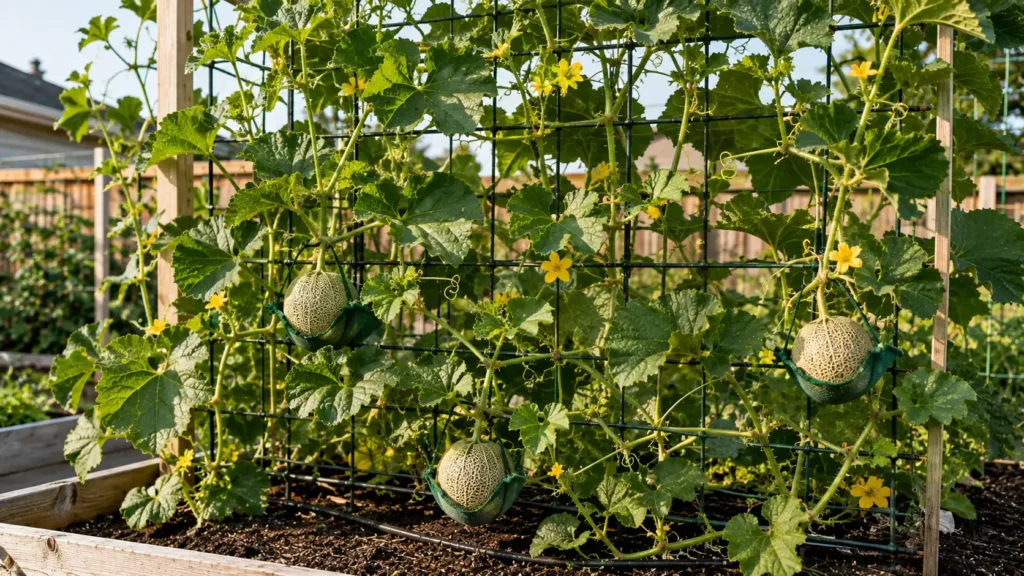
Can You Grow Cantaloupe on a Trellis?

Yes, but the support needs to be strong.
Cantaloupe vines can be trained vertically, which can save ground space in a small garden. Utah State notes that cantaloupes can be trained to a fence or trellis.
The main issue is fruit weight.
As the melons grow, support each fruit with a strong sling or similar material attached to the trellis.
I would avoid relying on thin string or a weak garden structure.
Why grow cantaloupe vertically?
A trellis can:
- Save ground space
- Improve airflow
- Make fruit easier to see
- Make harvesting easier
- Keep vines off wet soil
Choose a compact or suitable variety if you have limited space.
How to Grow Cantaloupe in a Small Garden
You do not need a huge field to grow cantaloupe.
For a small garden, consider:
- A compact variety
- A raised bed
- Vertical growing
- A large container
- Careful vine training
If the variety produces long runners, train them in one direction instead of allowing them to cover nearby crops.
Can you grow cantaloupe in containers?
Yes.
Use a large container with good drainage and place it in full sun.
Choose a suitable compact variety when possible. If you train the plant vertically, make sure the trellis is firmly attached and provide support for the developing fruit.
How to Control Weeds Around Cantaloupe
Young cantaloupe plants compete with weeds for water and nutrients.
Mulch is one of the easiest ways to reduce weed growth.
If you remove weeds by hand or with a hoe, work carefully around the plants. Cantaloupe has roots close to the surface, so deep cultivation can damage them.
I recommend removing weeds while they are still small.
Common Cantaloupe Pests
Several insects can attack cantaloupe.
Common problems include:
- Cucumber beetles
- Aphids
- Squash bugs
- Mites
Iowa State lists these among the common insect pests found on cantaloupe and other melons.
Check the underside of leaves as well as the tops.
Look for:
- Chewed leaves
- Small insects
- Sticky residue
- Yellowing
- Curling leaves
- Wilting
Early detection makes pest management easier.
Common Cantaloupe Diseases

Cantaloupe can suffer from several fungal, bacterial, and viral diseases.
Some important ones include:
- Powdery mildew
- Downy mildew
- Fusarium wilt
- Anthracnose
- Gummy stem blight
- Bacterial wilt
- Viral diseases
- Damping-off
Iowa State recommends good airflow, careful irrigation, crop rotation, sanitation, and regular scouting as part of disease prevention.
How to reduce disease problems
I recommend:
- Watering near the soil instead of constantly wetting leaves
- Watering early when possible
- Giving plants enough space
- Removing badly infected plant material
- Controlling weeds
- Rotating crops
- Choosing disease-resistant varieties when available
- Avoiding work among wet plants
Crop rotation can be especially useful for soil-borne diseases. Iowa State recommends avoiding planting melons and related cucurbits in the same area for about 3–4 years.
Why Is My Cantaloupe Plant Not Producing Fruit?
A healthy-looking cantaloupe plant can still fail to produce fruit.
The first things I would check are:
1. Are there female flowers?
Male flowers cannot produce melons by themselves.
Look for the small swelling behind a female flower.
2. Are pollinators visiting?
Poor bee activity can reduce fruit set.
3. Is the plant under water stress?
Both drought and excessive moisture can create problems.
4. Is the weather extremely hot?
High temperatures can interfere with fruit set.
5. Is the plant getting enough sunlight?
Cantaloupe needs strong sunlight for good growth and fruit production.
6. Is the plant receiving too much nitrogen?
Excess nitrogen can encourage leaf and vine growth without giving you the fruit production you want.
Why Are My Cantaloupes Cracking?
Cracking often becomes a problem when the fruit receives too much water, especially close to maturity.
Heavy rain can also create sudden changes in soil moisture.
Oklahoma State and Iowa State both connect excessive moisture near maturity with problems such as cracking and fruit quality issues.
Try to keep soil moisture steady throughout the season instead of allowing the plant to become very dry and then soaking it heavily.
Why Is My Cantaloupe Not Sweet?
A bland cantaloupe does not always mean you chose a bad variety.
Fruit sweetness can be affected by:
- Variety
- Sunlight
- Water management
- Plant stress
- Growing conditions
- Harvest timing
One point I would pay close attention to is irrigation near harvest.
Excessive watering close to maturity can reduce sugar concentration and flavor.
The cultivar also matters. Some varieties are naturally sweeter than others.
For detailed cultivar selection, see my guide to Best Cantaloupe Varieties for Home Gardens.
How Long Does Cantaloupe Take to Grow?
There is no single number that applies to every cantaloupe plant.
The time from planting to harvest depends on:
- Variety
- Temperature
- Sunlight
- Planting date
- Growing method
- Transplanting
- Local weather
Check the days-to-maturity information on your seed packet.
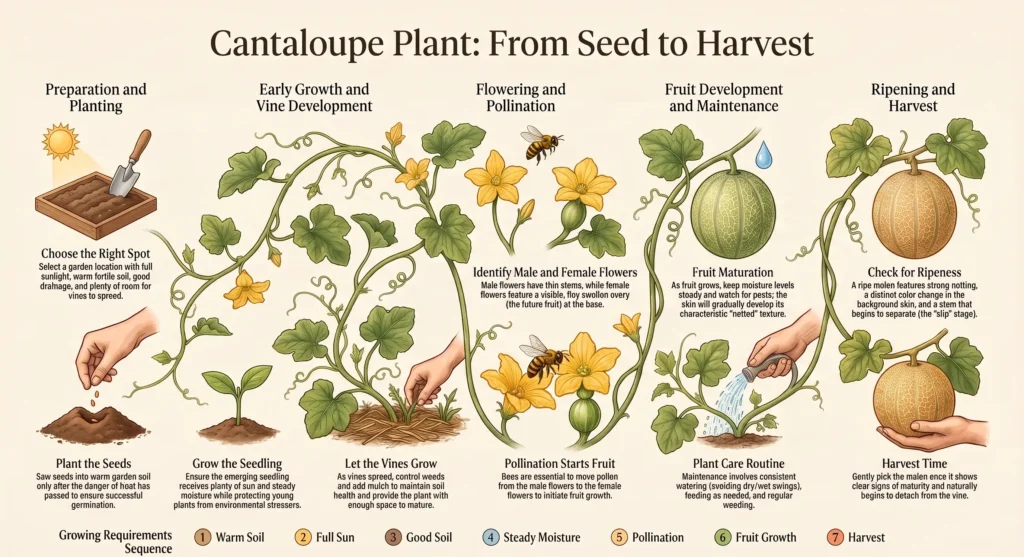
For a closer look at how the plant develops from seed to mature fruit, see the guide to the Cantaloupe Plant Life Cycle.
How Do You Know When Cantaloupe Is Ripe?

Harvest timing has a big effect on flavor.
For many cantaloupe types, one of the best signs is full slip.
This means the melon separates from the vine easily with gentle pressure.
If you need to pull hard, the fruit may not be ready.
Other signs can include:
- Strong melon aroma
- Change in background color
- Mature netting
- Slight softening near the blossom end
Iowa State notes that mature cantaloupes can develop a more yellow background color between the netting and that ripe fruit can separate easily from the vine.
What is full slip?
Full slip means the stem naturally separates from the ripe melon.
This is one of the easiest harvest signs for home gardeners because you do not have to guess based only on size.
Keep in mind that not every melon type uses the same harvest signs. This is another reason to check the information for your specific cultivar.
How to Harvest Cantaloupe
When the melon reaches the right stage:
- Check the fruit for mature color and netting.
- Smell the blossom end for a strong aroma.
- Check whether the stem has started to separate.
- Lift the melon gently.
- If it slips easily from the vine, harvest it.
- Handle the fruit carefully to avoid bruising.
If the melon does not separate easily, give it more time when the variety is known to reach full slip.
How Should You Store Fresh Cantaloupe?
After harvesting, handle cantaloupes carefully.
Keep uncut fruit in a cool, suitable place based on its ripeness, and refrigerate cut melon.
Once cut, keep the fruit refrigerated in a clean, covered container.
Wash the outside of the melon before cutting it, even though you do not eat the rind. Cutting through an unwashed rind can move surface dirt and microorganisms onto the flesh.
My Simple Cantaloupe Growing Checklist
If you want the short version, this is the process I would follow:
- Choose a sunny location.
- Check the soil and drainage.
- Wait until frost danger has passed.
- Make sure the soil is warm.
- Plant seeds about 1 inch deep unless your seed packet says otherwise.
- Give vines enough space.
- Thin seedlings after emergence.
- Keep soil moisture steady.
- Mulch to control weeds and conserve moisture.
- Feed according to soil needs.
- Protect pollinators and encourage bee activity.
- Check leaves and vines for pests and disease.
- Support fruit if growing vertically.
- Reduce excess irrigation as fruit approaches maturity.
- Watch for full slip and other ripeness signs.
- Harvest carefully.
Final Tips for Growing Cantaloupe
The biggest mistake I would avoid is treating cantaloupe like a crop that only needs water and fertilizer.
Start with the right conditions.
Give the plant warm soil, full sun, good drainage, enough space, and steady moisture. Then pay attention to pollination and fruit development.
If the plant grows lots of vines but produces no fruit, look at pollination and plant stress before adding more fertilizer.
If the fruit cracks, check your watering pattern.
If the fruit tastes bland, look at the variety, sunlight, harvest timing, and irrigation near maturity.
And when the melon reaches full slip, harvest it rather than waiting too long on the vine.
Frequently Asked Questions
What month do you plant cantaloupe?
The best month depends on your local climate. Plant after the danger of frost has passed and the soil has warmed to roughly 60–70°F.
Can I grow cantaloupe from seed?
Yes. Direct sowing is a simple method when the soil is warm enough. You can also start seeds indoors if your growing season is short.
How deep should cantaloupe seeds be planted?
About 1 inch is a common recommendation, although some resources guidance allows 1–2 inches. Follow the instructions for your specific seed variety.
How much sun does cantaloupe need?
Give cantaloupe at least six hours of direct sunlight each day.
How often should I water cantaloupe?
Keep the soil consistently moist, especially during flowering and fruit development. A general guide is about 1–2 inches of water per week, adjusted for rainfall, soil, temperature, and plant size.
Why is my cantaloupe flowering but not producing fruit?
Check for female flowers, pollinator activity, water stress, and extreme heat. Male flowers naturally fall after producing pollen, so their loss does not mean the plant has failed.
Can cantaloupe grow in a container?
Yes. Use a large container with good drainage, place it in full sun, and choose a suitable variety. A strong trellis can help save space.
Can cantaloupe grow on a trellis?
Yes. Cantaloupe vines can be trained vertically, but developing melons need strong support so their weight does not damage the vine.
How do I know when cantaloupe is ready to pick?
Look for mature color, aroma, and other variety-specific ripeness signs. For many cantaloupes, full slip is a strong harvest signal because the fruit separates easily from the vine.