Skip to content
Growing cantaloupe in a short growing season can be tricky because the plant needs warm soil, warm weather, plenty of sun, and enough time to produce ripe fruit before the first fall frost.
I don’t try to solve this by simply planting earlier.
That can create more problems if the soil and air are still cold. Instead, I focus on giving the plant a head start, warming the soil, choosing an early variety, and protecting young plants from cold weather.
My goal is simple: get the cantaloupe growing early enough that the fruit has time to mature before the season ends.
If you garden in a northern climate, high-elevation area, cool region, or any place with a short frost-free period, these steps can make a big difference.
Can You Grow Cantaloupe in a Short Growing Season?
Yes, you can grow cantaloupe in a short growing season.
The key is to make the most of every warm day.
Cantaloupe is a warm-season crop. It does poorly in cold soil and can be damaged by frost. Temperatures below about 50°F can slow growth, while very cold conditions can seriously injure the plant.
When I have a limited growing window, I don’t want the plant spending its first few weeks sitting still.
That’s why I focus on four things:
- Starting the plant early
- Choosing an early-maturing variety
- Warming the soil
- Protecting young plants from cold
These steps work together.
Starting seeds indoors gives me an earlier plant. Warm soil helps that plant establish faster. Mulch and row covers protect it from cool weather. Choosing a short-season variety gives the fruit more time to mature before fall.
How Long Does Cantaloupe Need to Mature?
The exact growing time depends on the variety and growing conditions.
Some cantaloupes mature faster than others, which makes the days-to-maturity number on the seed packet very important for short-season gardens.
I don’t treat that number as a guarantee.
Cool nights, cold soil, transplant stress, poor pollination, lack of sunlight, and other problems can delay the crop.
This is why I like to leave some extra time between the expected harvest and my first fall frost.
For example, if a variety needs around 80 days, I don’t want my planting date to give me exactly 80 warm days before frost. I want some extra time in case growth slows.
A short growing season gives me less room for mistakes.
Calculate Your Growing Window Before Planting

This is one of the first things I would do before buying seeds.
Find out:
- Your average last spring frost date
- Your average first fall frost date
- The approximate number of frost-free days
- The days to maturity for the cantaloupe variety
- How much extra time you can give the crop
For example, suppose your area normally has about 100 frost-free days.
A variety that needs 85 days may look like a good choice.
But that does not mean I should wait until the weather is perfect and then direct-sow the seeds.
The plant still needs time to germinate, establish roots, grow vines, flower, set fruit, and ripen the melons.
This is why early seed starting and transplanting can be so useful.
I think about the whole crop timeline instead of focusing only on the number printed on the seed packet.
Choose an Early-Maturing Cantaloupe Variety
Variety selection is one of the easiest ways to improve my chances of getting ripe fruit in a short season.
I look for:
- Short days to maturity
- Early fruit production
- Good performance in my climate
- Disease resistance when available
- Fruit size that suits my growing space
- A variety with enough time to mature before fall
I don’t automatically choose the variety with the biggest fruit.
A large, long-season melon may be a poor choice if frost arrives before it can ripen.
For a short-season garden, I would rather grow a reliable early melon than wait for a large melon that may never finish.
Examples of cantaloupe and muskmelon types commonly associated with earlier production include Earligold, Minnesota Midget, and other early cultivars, but I always check the current seed packet because maturity dates can vary by seed supplier and growing conditions.
I would keep the full variety comparison on your separate Best Cantaloupe Varieties for Home Gardens page.
Start Cantaloupe Seeds Indoors

If my growing season is short, starting cantaloupe seeds indoors can give me a valuable head start.
Penn State recommends starting cantaloupe indoors for an earlier harvest in areas with shorter growing seasons. Its guidance places indoor sowing about four to six weeks before the average last frost date, followed by hardening off before transplanting.
I don’t start them indoors simply because I can.
The timing matters.
Cantaloupe seedlings grow quickly once they have warmth and good light. If I start them too early, they can become large and difficult to transplant before outdoor conditions are ready.
I want a healthy young plant with a good root system, not an overgrown seedling waiting in a small pot.
My basic indoor-starting approach
I use a loose seed-starting mix and keep it lightly moist.
I give the seedlings plenty of light and warmth.
Once they have developed a few true leaves and outdoor conditions are suitable, I begin hardening them off.
I gradually expose the plants to outdoor conditions rather than moving them directly from a protected indoor space into full sun and wind.
For the complete seed-starting method, I would link to my How to Start Cantaloupe Seeds Indoors guide.
Don’t Plant Cantaloupe in Cold Soil
This is where I see a common short-season mistake.
The gardener looks at the calendar and thinks:
“Spring has arrived, so it’s time to plant.”
Cantaloupe doesn’t care what the calendar says.
The soil needs to be warm.
A soil temperature around 65°F is commonly recommended for planting cantaloupe.
If I put a warm-season crop into cold soil, I can lose some of the time I was trying to save.
The seeds may germinate slowly, or young plants may sit there without making much progress.
Soil temperature is often more useful than a fixed planting date.
Warm the Soil With Black Plastic Mulch

Black plastic mulch is one of the methods I would consider first for a short growing season.
It helps warm the soil, conserve moisture, control weeds, and support earlier production.
I prepare the bed first and lay the plastic tightly against the soil.
Good contact matters because I want the heat from the plastic to transfer into the soil.
Then I plant through openings made in the plastic.
This can work especially well with transplants because I am combining two season-extension methods:
an established plant + warmer soil.
I don’t use plastic mulch as a replacement for good soil preparation.
It is a tool that helps create better early-season conditions.
Use a Warm Microclimate
I also pay attention to where I place the plants.
A few feet can make a difference in a cool garden.
I look for areas that receive full sun and have some protection from cold winds.
A warm spot near a south-facing wall or other structure can sometimes give the plants more heat than an exposed part of the garden.
I avoid planting cantaloupe in a shaded area just because it is convenient.
Cantaloupe needs strong sunlight to grow well, and a short season gives me even less reason to waste the available light.
Use Raised Beds to Warm the Root Zone
Raised beds can be useful in a short-season garden.
The main reason I like them here is that the soil can warm earlier and drainage is easier to manage.
I can also combine a raised bed with black plastic mulch and row covers.
That gives me several ways to improve early-season conditions without needing a greenhouse.
I would keep the full raised-bed setup in my separate Growing Cantaloupe in Raised Beds article.
For this article, the main point is simple:
A warm, sunny raised bed can help me get the crop moving sooner.
Transplant Instead of Direct Sowing
If I have only a limited number of warm days, I don’t want to spend the early part of the season waiting for seeds to germinate.
Transplanting gives the plant a head start.
Utah State University specifically recommends transplants for short growing areas and reports that transplants mature earlier than seeded melons.
But transplanting has to be done carefully.
Cantaloupe roots don’t like rough handling.
When I move the seedlings outside, I want the root ball to stay intact.
I also harden off the plants before planting them permanently.
Penn State recommends waiting until nighttime temperatures are above about 50°F and the plants have developed several mature true leaves with an established root system.
The exact timing still depends on the local weather.
Protect Young Plants With Row Covers

Row covers are especially useful when I am trying to gain early growing time.
They can protect young cantaloupe plants from cool temperatures and help create warmer conditions around the crop.
There are several options:
- Floating fabric row covers
- Hoop-supported covers
- Low tunnels
- Plastic tunnels
- Hot caps
Row covers can improve early growth and protect young plants from cold.
I don’t treat a row cover as something I can install and forget.
The temperature underneath can rise quickly on a sunny day.
USU advises monitoring temperatures under covers, with ventilation needed when temperatures rise, while covers should be removed as plants begin flowering.
That last point matters because cantaloupe flowers need insect pollination.
Remove Row Covers Before They Block Pollination
This is an easy detail to miss.
A cover can help the plant early in the season, but I don’t want it trapping the flowers away from pollinators.
Once the cantaloupe begins flowering, I pay close attention to whether bees or other pollinators can reach the flowers.
University of Maryland specifically recommends removing row covers from cantaloupe and other cucurbit crops once flowering begins because they need insect pollination to produce fruit.
If pollinators are limited, I can hand-pollinate the female flowers.
I cover the full process in my Cantaloupe Plant Pollination article.
Give Cantaloupe the Warmest Growing Conditions You Can
Once the plant is established, I focus on keeping growth steady.
Cantaloupe grows best with warm conditions.
Penn State notes that temperatures below 50°F or above 95°F can slow growth and maturation.
This gives me an important lesson:
More heat is not always better.
I want warm conditions, but I also want to avoid extreme heat stress.
A sunny, sheltered site is usually a better choice than a location that gets intense heat but poor airflow.
Keep Watering Consistent
I don’t let short-season cantaloupes bounce between very dry soil and excessive moisture.
The plant needs enough water to keep growing, flowering, and developing fruit.
At the same time, I don’t keep the root zone soaked.
USU recommends deep, infrequent irrigation and notes that mulch can help conserve soil moisture.
If I use plastic mulch, drip irrigation or a soaker hose under the mulch can make watering easier.
The important thing is consistency.
A plant that repeatedly stops growing because of water stress is losing valuable days.
For the full watering method, I would link to my Watering Cantaloupe article.
Keep the Plant Healthy During the Short Season
In a long growing season, a small setback may not matter as much.
In a short season, it can cost me a large part of the harvest window.
So I check the plants regularly.
I look for:
- Aphids
- Cucumber beetles
- Spider mites
- Leaf damage
- Powdery growth
- Yellowing leaves
- Wilting
- Poor fruit development
I also keep weeds under control.
Weeds compete for water, nutrients, light, and space.
Black plastic mulch can help reduce weed growth while also warming the soil.
If I see a pest or disease problem, I deal with it early rather than waiting for the plant to become badly damaged.
Help the Plant Set Fruit Early

Once the vines start growing, I watch for flowers.
Male flowers generally appear before female flowers, so I don’t panic if the first flowers don’t produce melons.
The female flower has a small swollen area behind it. That swelling is the developing fruit.
Once female flowers appear, I want reliable pollination.
This matters even more in a short growing season because late fruit may not have enough time to ripen before frost.
If bees are active, I let them do the work.
If cool weather or row covers limit pollination, I can hand-pollinate.
I don’t keep covers over flowering plants simply because I want extra warmth.
A warm plant with no pollinated flowers isn’t helping me much.
Don’t Overload a Short-Season Plant With Fruit
Once fruit begins to form, I look at the overall health of the plant.
If the plant is small and struggling, I don’t want it carrying more fruit than it can reasonably support.
I would rather have a healthy plant developing a manageable number of fruits than a weak plant trying to support too many.
This also makes sense for large-fruited varieties.
A small, early cantaloupe may be a better fit for a short growing season than a large melon that needs much longer to finish.
What If the First Frost Is Approaching?

This is where I change my priorities.
Early in the season, I’m trying to build healthy vines.
Near the end, I’m watching the fruit.
If the weather forecast shows an approaching frost, I check:
- Which fruits have already set
- Which fruits are close to maturity
- Which fruits are still very small
- How much healthy foliage remains
- Whether temporary frost protection is practical
Cantaloupe is sensitive to frost, so I don’t assume the vines will survive a freeze without damage.
A row cover can provide some frost protection, but I still watch the forecast carefully.
If a fruit is close to maturity, protecting the plant for a little longer may be worthwhile.
If a tiny fruit has only recently formed, I don’t assume that covering it for one cold night will magically make it mature.
Can Cantaloupe Ripen Before the First Frost?
Yes, but the crop needs to be started early enough.
This is why I don’t wait until the middle of summer to plant a long-season variety.
I work backward from the expected first frost.
For example:
First frost → expected maturity → extra safety time → transplanting → indoor seed starting
That is how I plan a short-season crop.
I don’t try to rush the final week.
I try to prevent the plant from losing those weeks earlier in the season.
What I Do Differently in a Very Short Season

If my growing season were especially short, I would combine several methods rather than rely on one trick.
My approach would look like this:
- Choose an early-maturing variety.
- Start seeds indoors several weeks before the last frost.
- Grow strong transplants rather than oversized seedlings.
- Prepare a sunny, warm garden bed.
- Use black plastic mulch.
- Transplant once the soil and weather are suitable.
- Protect young plants with row covers or a low tunnel.
- Remove covers when flowering begins.
- Make sure flowers are pollinated.
- Keep water and nutrition steady.
- Watch pests and diseases closely.
- Monitor the fruit as fall approaches.
Each step saves or protects a small amount of growing time.
Together, they can make a short-season garden much more workable.
Common Short-Season Cantaloupe Problems
I planted early, but the plants barely grew
I would check the soil temperature first.
Early planting doesn’t help if the soil is still too cold.
My seedlings became large before I could plant them
I probably started them too early.
Next time, I would adjust the seed-starting date and make sure the seedlings receive enough light.
My plants grew well but fruit came too late
I would look at the variety’s days to maturity and the planting date.
A long-season variety may simply not fit my growing window.
My row-covered plants grew quickly but then struggled
I would check the temperature under the cover.
A low tunnel can become much hotter than the outside air on a sunny day.
My cantaloupe flowered but didn’t make fruit
I would check pollination first.
I would also look at temperature, water stress, and overall plant health.
The first frost is coming and my melons are still green
I would check each fruit for maturity rather than treating every green melon the same.
I would protect the plant if practical and continue monitoring the fruit.
My vines are healthy but the season is running out
I would avoid making major changes just to force ripening.
At that stage, I focus on keeping the plant healthy and protecting the fruit that has already developed.
My Short-Season Cantaloupe Strategy
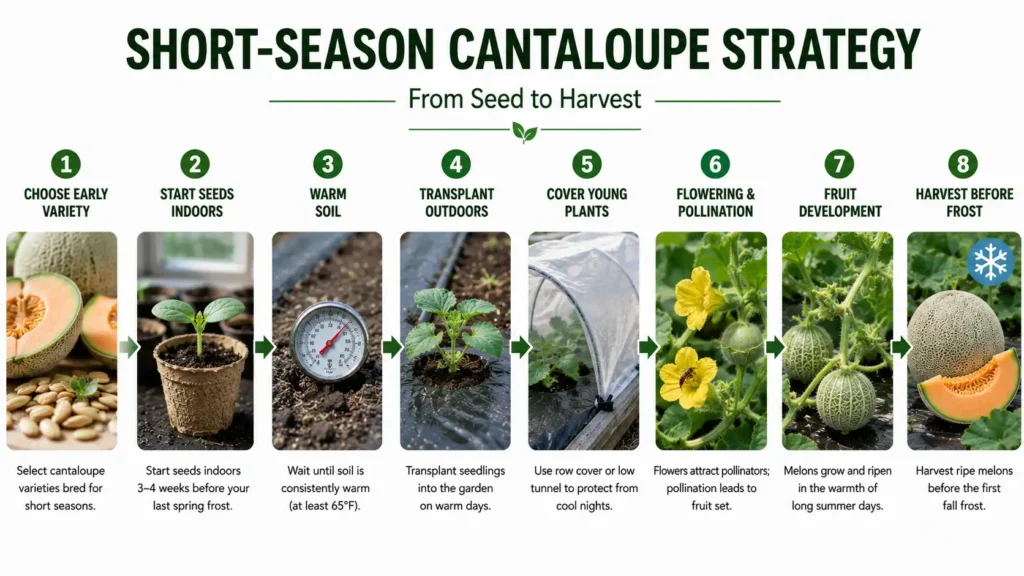
When I think about growing cantaloupe in a short growing season, I don’t think of one magic method.
I think about saving time at every stage.
I choose an early variety instead of a long-season one.
I start seeds indoors so the plant is already growing when outdoor conditions become suitable.
I warm the soil with black plastic mulch.
I use row covers or a low tunnel to protect young plants from cold.
I remove the covers once flowers need pollinators.
Then I keep the plants healthy with steady moisture, good sunlight, suitable nutrition, and regular pest checks.
The biggest lesson for me is that early planting alone isn’t the answer.
The plant needs warm soil and warm air to actually grow.
If I plant too early into cold conditions, I may lose the same time I was trying to gain.
A better plan is to create a head start under controlled conditions and then move the plant outside when it can continue growing.
Short-Season Cantaloupe Growing Checklist
Before planting, I check:
- First and last frost dates
- Days to maturity of my variety
- Available warm growing days
- Indoor seed-starting date
- Soil temperature
- Sunny planting location
- Black plastic mulch
- Row cover or low tunnel
- Watering method
- Pollination plan
- Expected harvest window
If I can check most of these boxes before planting, I feel much better about the crop.
Final Thoughts
Growing cantaloupe in a short growing season is mostly a timing problem.
I don’t try to force the plant to grow at an unnatural speed. Instead, I give it the best possible start and protect the crop from the cold conditions that can slow it down.
An early variety gives me more time.
Indoor seed starting gives me a head start.
Warm soil helps the transplant establish.
Black plastic mulch helps hold warmth around the roots.
Row covers protect young plants from cold.
Good pollination gets fruit started early.
Steady water, sunlight, and healthy foliage help that fruit continue developing.
When I put all of these pieces together, I have a much better chance of getting ripe cantaloupe before the first fall frost, even when the normal growing season is short.
Frequently Asked Questions
What is the best way to grow cantaloupe in a short season?
I would combine an early-maturing variety with indoor seed starting, warm soil, black plastic mulch, and temporary row covers. The goal is to get the plant growing as soon as conditions are suitable and protect it from early-season cold.
Can cantaloupe grow in a short summer?
Yes. The best results come from choosing a variety with a suitable maturity period and giving the plant an early start. Transplants can be especially useful in short growing areas.
How early can I plant cantaloupe?
I don’t use a single calendar date. I check soil temperature and frost risk first. Cantaloupe is a warm-season crop, and soil around 65°F is commonly recommended for planting.
Should I start cantaloupe indoors in a short season?
Yes. This is one of the methods I would prioritize. Starting indoors gives the plant a head start and can help it produce fruit earlier than direct sowing.
Does black plastic help cantaloupe grow faster?
Black plastic mulch warms the soil, conserves moisture, and controls weeds. It can also support earlier cantaloupe production, especially when combined with transplants.
Do row covers help cantaloupe?
Yes. Row covers can protect young plants from cold and create warmer conditions around the crop. I remove them once the plants begin flowering so pollinators can reach the flowers.
Can I grow cantaloupe in Zone 4?
It can be possible, but the short growing season makes variety choice and season extension especially important. I would use an early variety, start the plants indoors, warm the soil, and protect young plants from cold.
Can I grow cantaloupe in Zone 5?
Yes, but the exact approach depends on the local climate and length of the frost-free period. I would focus on early varieties and transplanting rather than relying only on direct sowing.
How do I get cantaloupe to ripen before frost?
I start by choosing an early variety and working backward from the first expected fall frost. Then I give the crop a head start indoors, warm the soil, protect young plants, and avoid delays caused by cold, drought, pests, or poor pollination.
Can cantaloupe survive a light frost?
I don’t count on it. Cantaloupe is sensitive to frost, so I use temporary protection when a cold night threatens the crop.
Is a greenhouse better for a short growing season?
A greenhouse can give me much more control over temperature and the start of the season. But I don’t need a greenhouse for every short-season garden. Black plastic, row covers, low tunnels, good site selection, and early transplants can also help extend the useful growing period.