Skip to content
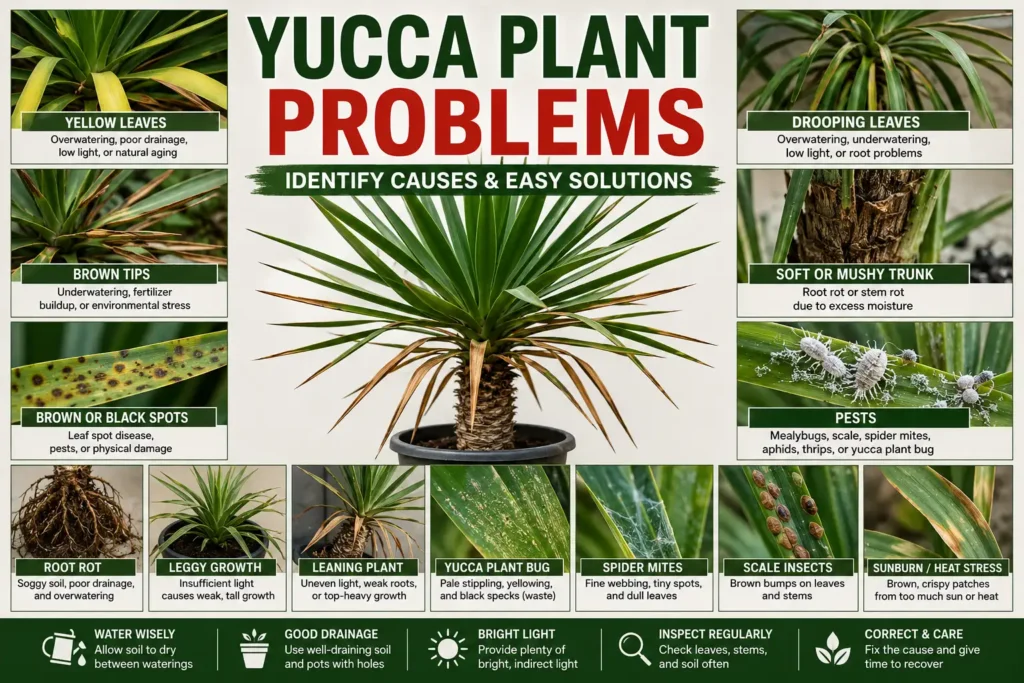
Yucca plants are tough and usually easy to care for, but they can still develop problems. Yellow leaves, brown tips, drooping foliage, brown spots, soft stems, root rot, pests, and slow growth are some of the issues I would check first.
The tricky part is that one symptom can have several causes. For example, yellow yucca leaves can come from natural aging, too much water, poor drainage, low light, or root damage. I always look at the symptom together with the soil, roots, light, and recent changes before deciding what is wrong.
Quick Answer: What Is Wrong With My Yucca Plant?
Most yucca plant problems come from excess moisture, poor drainage, unsuitable light, temperature stress, pests, disease, or natural leaf aging. Yellow lower leaves can be normal as older foliage dies off, while sudden widespread yellowing and limp leaves can point to overwatering. Brown tips may come from watering problems, fertilizer buildup, strong light, or other stress. Brown spots can be linked to leaf spot disease, while a soft or mushy trunk is a serious warning sign of rot.
The fastest way I would diagnose a yucca is to check these six things:
- Leaves: Look at the color, texture, and location of the damage.
- Soil: Check whether it is wet, dry, or staying wet for too long.
- Roots: Inspect them if the plant has severe yellowing, wilting, or a soft base.
- Light: Check whether the plant gets enough suitable light.
- Pests: Look closely at the leaf undersides, stems, and leaf bases.
- Recent changes: Think about recent watering, repotting, feeding, moving, or weather changes.
Yucca Plant Problems at a Glance
| Symptom | Possible cause | What I would check first |
| Yellow lower leaves | Natural aging, watering issues | Which leaves are turning yellow |
| Widespread yellow leaves | Overwatering, poor drainage, low light | Soil moisture |
| Brown leaf tips | Dry soil, fertilizer buildup, light stress | Soil and recent feeding |
| Brown or black spots | Leaf spot, pests, physical damage | Spot pattern |
| Drooping leaves | Low light, overwatering, underwatering | Soil and light |
| Soft or mushy trunk | Rot | Trunk and roots |
| White cottony patches | Mealybugs | Leaf bases and stems |
| Brown bumps | Scale | Stems and leaves |
| Fine webbing | Spider mites | Leaf undersides |
| Pale stippling and black specks | Yucca plant bug | Leaves |
| Leggy growth | Insufficient light | Plant position |
| Slow growth | Low light, root problems, season | Light and roots |
| Sudden leaf drop | Water, roots, temperature stress | Recent changes |
| Leaning plant | Uneven light, weak growth, top-heavy growth | Light and root support |
How to Tell If Your Yucca Has a Real Problem
Not every damaged or yellow leaf means your yucca is sick.
As yuccas grow, older lower leaves can naturally yellow, dry, and fall away. This is different from a plant that suddenly develops yellow, limp foliage throughout the rosette.
I use the location and speed of the damage as two simple clues.
If one or two old lower leaves are drying while the newer leaves remain firm and green, I would monitor the plant.
If several leaves change color at once, especially when they become soft or limp, I would investigate the roots, soil moisture, light, and drainage.
Signs That Usually Need Attention
Watch more closely if you see:
- Several leaves turning yellow at the same time
- New leaves becoming weak or limp
- A soft trunk
- A foul smell from wet soil
- Brown or black spots spreading across leaves
- Large areas of leaf tissue dying
- A sudden loss of foliage
- Visible insects
- Fine webbing
- White cotton-like material
- Poor growth combined with pale foliage
Why Are My Yucca Leaves Turning Yellow?

Yellow yucca leaves are one of the most common problems, but the color alone does not tell you the cause.
I would first look at which leaves are yellow, how quickly they changed, and how wet the soil is.
Natural Aging
If only the oldest lower leaves turn yellow and dry while the upper growth stays healthy, natural aging may be responsible.
Yucca plants gradually shed older leaves as they grow. This can leave a few dry or yellow leaves around the base without indicating a serious problem.
You can remove completely dry leaves if they pull away easily or use clean pruning shears.
Overwatering
If several leaves suddenly become yellow and limp, especially when the soil stays wet, overwatering is a strong possibility.
Yucca plants do not like constantly wet roots. Poor drainage can leave the root zone saturated for too long and increase the risk of root damage.
Check:
- Is the soil still wet several days after watering?
- Does the pot have drainage holes?
- Is the pot sitting in water?
- Does the soil feel heavy and soggy?
- Are the lower leaves becoming soft?
If the answer is yes, I would stop adding water until the soil has dried to an appropriate level and then correct the drainage problem.
Underwatering
A very dry yucca can also develop yellow or damaged leaves.
Check the soil before assuming that yellowing means too much water. If the growing medium is extremely dry and the leaves are becoming dry and crispy, the plant may need a better watering routine.
Low Light
A yucca growing in poor light may develop weak, soft, or drooping foliage. Low light can also contribute to poor overall growth.
Move the plant to a brighter suitable location gradually if it has been growing in a dim room.
Root Problems
If the soil seems wet but the plant still looks dehydrated, inspect the roots.
Damaged roots may fail to move enough water to the foliage. This can create a confusing situation where the plant looks thirsty even though its soil is wet.
Can Yellow Yucca Leaves Turn Green Again?
Usually, a completely yellow yucca leaf will not return to its original green color.
The goal is to find and correct the cause before more leaves become damaged.
For example, if overwatering caused the yellowing, fixing the drainage and watering problem can protect the healthy foliage that remains. If low light caused weak growth, improving the light can help future leaves develop better.
I would judge recovery by new healthy growth, not by waiting for a badly yellow leaf to turn green again.
A slightly yellow leaf can often remain on the plant until it becomes mostly dry or dead.
Why Are My Yucca Leaves Turning Brown?

Brown yucca leaves can have several causes.
I would look at whether the whole leaf is brown, only the tips are brown, the edges are brown, or distinct spots are developing.
Brown Leaf Tips
Brown tips can occur because of watering problems, excessive fertilizer, strong light, pests, or other environmental stress.
Start by checking:
- Soil moisture
- Recent fertilizer use
- Light exposure
- Pest activity
- Whether the damage is limited to the tips
If the soil is bone dry, correct the watering routine.
If the soil stays wet, improve drainage rather than simply watering more.
If you recently applied a large amount of fertilizer, avoid adding more until the plant has recovered.
Brown Edges vs. Brown Tips
The location of the damage can give you a useful clue.
Brown tips affect the very ends of the leaves. This can happen because of dry conditions, fertilizer or salt buildup, watering problems, or other stress.
Brown edges run along the sides of the leaf. They can also result from dry conditions, environmental stress, strong light, or damaged tissue.
Brown spots are different because they usually appear as separate areas within the leaf rather than only along the edge.
I would not diagnose the plant from the brown color alone. I would check the soil, light, feeding, and leaf pattern together.
Dry, Crispy Brown Leaves
Crispy foliage often points toward dry conditions, but I would still check the soil and roots before deciding.
A yucca with very dry soil and crispy leaves needs a different response from one with wet soil and brown, soft foliage.
Brown Leaves After Moving the Plant
A sudden change in light can stress a yucca.
If an indoor plant is moved from a dim room into intense direct sun, some foliage may develop damage. I prefer to increase light gradually when a plant has been growing in low light.
Why Does My Yucca Have Brown or Black Spots?

Brown or black spots deserve a closer look because they can come from disease, pests, physical damage, or environmental stress.
Leaf spot is one possible cause. It can begin as small clear or yellowish areas that develop into yellow, purple, gray, or brown lesions.
Wet foliage can also create conditions that favor some leaf spot problems.
Signs That Point Toward Leaf Spot
Look for:
- Multiple defined spots
- Spots spreading across older leaves
- Yellow or purple edges around lesions
- Brown or gray centers
- Dark points within older lesions
- A scorched appearance
- Several affected leaves
To reduce the chance of continued spread:
- Remove heavily damaged leaves
- Keep fallen infected foliage away from the plant
- Avoid prolonged overhead watering
- Improve airflow around outdoor plants
- Keep foliage as dry as practical
Small Spots vs. Large Spreading Lesions
The size and pattern of the spots can also help.
A single small brown mark may come from physical damage.
Several small spots appearing on different leaves may point to pests or disease.
Large lesions that continue spreading deserve closer attention, especially if several leaves are affected at the same time.
I would take photos of the affected leaves and compare the pattern over several days. If the spots continue to expand, the problem is more likely active rather than old damage.
Brown Spots From Physical Damage
Not every brown spot is a disease.
Leaves can be damaged by:
- Bending
- Scraping
- Cutting
- Cold
- Strong heat
- Sun exposure
- Contact with hard surfaces
If the damage is isolated and does not continue spreading, physical damage may be more likely.
Why Are My Yucca Leaves Drooping?

Drooping yucca leaves can result from several different conditions.
Low Light
Low light can cause sagging or drooping foliage, especially on indoor yuccas.
If the plant is in a dark corner, check its light before changing the watering routine.
Overwatering
Wet soil combined with drooping leaves is a warning sign.
If roots remain in saturated soil for too long, they can become damaged. The plant may then struggle to move water normally.
Underwatering
A yucca that has been left extremely dry can also develop limp or drooping leaves.
The important point is to check the soil instead of guessing from the leaves alone.
Why Is My Yucca Trunk Soft or Mushy?

A soft or mushy yucca trunk is one of the problems I would take seriously.
A healthy trunk should feel firm. If the base becomes soft, wet, or mushy, root or stem rot may be developing.
Common Causes of a Soft Yucca Trunk
- Frequent watering
- Poor drainage
- Waterlogged soil
- Damaged roots
- Prolonged moisture around the trunk
- Fungal or other rot-related problems
If the trunk is soft, I would stop treating the problem as a simple leaf issue.
Check the roots and growing medium. If the roots are dark, soft, or badly damaged, the plant may need urgent attention.
Yucca Plant Root Rot
Root rot is one of the more serious yucca plant problems.
The condition is commonly linked with excessive moisture and poor drainage. Damaged roots can become soft and unable to support normal water and nutrient movement.
Signs of Root Rot
Look for:
- Yellow leaves
- Limp foliage
- Wet soil that stays wet
- Soft roots
- Dark or decaying roots
- A soft trunk base
- Unpleasant soil odor
- Sudden decline despite wet soil
How I Would Check for Root Rot
If the plant is in a container, carefully remove it and inspect the root ball.
Healthy roots should have a firm structure. Severely damaged roots may be dark, soft, and easy to pull apart.
If only part of the root system is damaged, remove the affected roots with clean tools and move the plant into fresh, well-draining growing medium. If the damage is extensive, recovery becomes much harder.
For the complete container process, I would use my separate guide on how to repot a yucca plant rather than repeating every repotting step here.
Healthy Roots vs. Rotten Roots

| Healthy roots | Damaged or rotten roots |
| Firm | Soft or mushy |
| Hold their shape | Break apart easily |
| Support the plant well | May fail to support healthy growth |
| No obvious rotten smell | May have an unpleasant smell |
| Look structurally intact | May look dark and decayed |
I would not remove healthy roots simply because they are darker than expected. The texture matters too. Soft, collapsing tissue is much more concerning than color alone.
Why Is My Yucca Not Growing?

Slow growth does not always mean your yucca is unhealthy.
Growth naturally slows during periods when the plant receives less suitable light or experiences unfavorable temperatures. However, persistent slow growth can also point to poor roots, low light, unsuitable soil, or other growing problems.
Low Light
A yucca needs suitable light for strong growth.
An indoor plant sitting far from a window may stay alive but produce weak or slow growth.
Root Problems
A plant with damaged roots may have enough leaves to survive but lack the healthy root system needed for strong new growth.
Poor Growing Conditions
Check:
- Light
- Soil drainage
- Root health
- Watering
- Temperature
- Recent repotting
- Fertilizer use
Do not increase fertilizer simply because growth seems slow. Fix the growing conditions first.
Why Is My Yucca Growing Tall or Leaning?

A yucca can become tall or lean for several reasons.
Uneven Light
If light mainly reaches the plant from one direction, growth may lean toward the brighter area.
Turn indoor plants periodically if doing so suits the plant and location.
Low Light
Long, weak growth can also develop when a plant does not receive enough light.
If the leaves become widely spaced and the plant looks stretched, check the light level.
Top-Heavy Growth
A large yucca can become difficult to support as its trunk and foliage develop.
If the plant leans badly, check whether the roots are secure and whether the container provides enough stability.
Yucca Plant Pests

Yuccas are generally tough plants, but pests can still cause visible damage.
The main pests I would check for include:
- Yucca plant bugs
- Mealybugs
- Scale insects
- Spider mites
- Aphids
- Thrips
Yucca Plant Bug
Yucca plant bugs can cause pale, speckled foliage and yellowing. They can also leave small black specks of waste on the leaves.
If you see fine pale stippling combined with black specks, inspect the leaves closely for insects.
Mealybugs

Mealybugs look like small white, cottony patches.
They often hide:
- Around leaf bases
- Along stems
- In leaf joints
- Under foliage
Small infestations can sometimes be removed manually. Keep checking the plant because hidden insects can remain after the first treatment.
Scale Insects

Scale can look like small brown, tan, or dark bumps attached to stems and leaves.
They can be easy to mistake for part of the plant.
If the bumps do not move when touched and appear attached to the plant, inspect them closely.
Spider Mites

Spider mites are tiny and difficult to see individually.
Look for:
- Fine webbing
- Tiny pale speckles
- Dull foliage
- Leaf discoloration
- Dry-looking leaves
Pay particular attention to the undersides of leaves.
Aphids and Thrips
Aphids can gather around tender growth and flowers. Thrips can cause small areas of discoloration and damaged foliage.
If you suspect pests, inspect the whole plant rather than treating only the most damaged leaf.
How to Tell Pest Damage From Disease

Pest damage and disease can sometimes look similar, so I look for a few specific clues.
| What you see | Possible cause |
| Fine webbing | Spider mites |
| White cotton-like patches | Mealybugs |
| Small hard bumps | Scale |
| Pale stippling with black specks | Yucca plant bug |
| Tiny insects around new growth | Aphids |
| Silvering or fine damaged areas | Thrips |
| Defined brown or gray lesions | Leaf spot or other disease |
| One isolated damaged area | Physical damage may be involved |
This is not a perfect diagnosis from appearance alone, but it gives you a better starting point.
If you see insects, inspect the entire plant. If you see spreading lesions without visible pests, disease becomes more likely.
Yucca Plant Diseases
Disease is less common than basic growing problems, but it can still affect yuccas.
The main disease-related concerns include:
- Yucca leaf spot
- Root rot
- Stem or trunk rot
- Other fungal leaf problems
Yucca Leaf Spot
Leaf spot can create defined brown or gray lesions that make the foliage look scorched. Some forms develop darker structures within older spots.
Wet conditions can encourage disease development, especially when foliage remains wet for extended periods.
To reduce the chance of continued spread:
- Remove heavily damaged leaves
- Keep fallen foliage away from the plant
- Avoid keeping leaves wet for long periods
- Improve airflow around outdoor plants
- Keep the growing area clean
Root and Stem Rot
Root and stem rot are more closely linked with moisture problems.
If the plant is sitting in wet soil and the trunk or roots are becoming soft, correct the moisture and drainage problem first.
Indoor Yucca Plant Problems

Indoor yuccas have a slightly different set of common problems.
The biggest issues I would check are:
Low Light
A dark room can lead to weak, drooping, or stretched growth.
Overwatering
Indoor pots often dry more slowly than outdoor soil. A watering routine that works outdoors may keep an indoor yucca wet for too long.
Brown Tips
Brown tips can develop from several forms of stress, including watering problems, fertilizer buildup, strong light, and pests.
Pests
Inspect indoor plants regularly for:
- Mealybugs
- Scale
- Spider mites
- Aphids
- Thrips
For the full indoor setup, use my guide on how to grow and care for yucca plants indoors.
Outdoor Yucca Plant Problems

Outdoor yuccas usually have more room for their roots and often receive better light, but they can still develop problems.
Excess Rain
Repeated rain or irrigation can keep the soil and foliage wet.
Poor drainage can create root problems, while prolonged leaf wetness can encourage some leaf spot diseases.
Cold Damage
Some yucca species tolerate cold well, while others are less suited to freezing conditions.
If the leaves become damaged after a freeze, wait until the affected tissue has clearly died before deciding what to prune.
Heat and Sun Stress
Yucca plants generally like bright conditions, but a plant that has been grown indoors or in shade can be damaged if suddenly exposed to intense sunlight.
Increase exposure gradually when possible.
Outdoor Pests
Check outdoor yuccas for:
- Yucca plant bugs
- Aphids
- Snails
- Scale
- Other local pests
For full outdoor growing conditions, use my separate guide on growing yucca outdoors.
Why Is My Yucca Losing Leaves?
Leaf loss can be natural or a warning sign.
Normal Leaf Loss
Older lower leaves can yellow, dry, and eventually fall as the plant grows.
Problem-Related Leaf Loss
More concerning signs include:
- Many leaves dropping at once
- New leaves collapsing
- Yellow leaves combined with wet soil
- Soft stems
- Root damage
- Sudden changes in temperature
- Serious pest activity
Look at the entire plant before deciding what caused the leaf loss.
Why Are My Yucca Leaves Curling?
Curling can happen when the plant is stressed.
Possible causes include:
- Dry soil
- Root damage
- Excessive heat
- Low humidity indoors
- Pests
- Sudden environmental changes
Check the soil first. Then inspect the leaf undersides and stems for insects.
If the soil is wet and the leaves are curling, I would inspect the roots rather than adding more water.
Why Does My Yucca Have Pale Leaves?
Pale foliage can come from insufficient light, pest activity, nutritional issues, or general stress.
If the entire plant looks pale and growth is weak, check the light first.
If the foliage has fine pale speckles rather than an even color change, inspect for pests such as spider mites or yucca plant bugs.
How to Save a Yucca Plant That Looks Like It Is Dying

When a yucca looks severely stressed, I would avoid making several changes at once.
Use this order instead.
1. Check the Soil
Feel the soil several inches below the surface.
Is it:
- Completely dry?
- Slightly dry?
- Damp?
- Saturated?
This gives you the first clue about watering.
2. Check the Roots
If the soil stays wet or the trunk is soft, inspect the roots.
Look for dark, soft, damaged tissue.
3. Inspect the Leaves
Look for:
- Spots
- Webbing
- Cottony patches
- Scale
- Speckling
- Crispy edges
- Yellowing
- Physical damage
4. Check the Light
Look at where the plant sits.
A yucca in a dim location may develop weak growth, while a plant suddenly exposed to intense sunlight may suffer leaf damage.
5. Check the Trunk
Press the trunk gently.
A firm trunk is much less concerning than a soft, collapsing base.
6. Remove Dead Material
Remove leaves that are completely dead or heavily damaged when appropriate. Use clean pruning tools.
7. Correct the Main Cause
Do not simply add water, fertilizer, or a pest treatment without identifying the likely problem.
If the soil is too wet, fix drainage.
If the plant is too dark, improve its light.
If pests are present, deal with the infestation.
If roots are damaged, address the root problem.
8. Give the Plant Time
A damaged yucca will not recover overnight.
Once the main cause has been corrected, watch the new growth rather than expecting damaged leaves to become green again.
How Long Does a Yucca Plant Take to Recover?
There is no single recovery time for every yucca.
A plant with minor leaf damage may continue growing normally once the cause is corrected. A plant with serious root or trunk damage may take much longer and may not recover fully.
Recovery depends on:
- How severe the damage is
- How much of the root system remains healthy
- Light conditions
- Watering
- Temperature
- Plant size
- Season
- Whether new growth is healthy
I would look for firm new growth and healthier leaves rather than waiting for old damaged leaves to repair themselves.
When Should I Remove Damaged Yucca Leaves?
I would remove leaves when they are:
- Completely brown
- Completely dry
- Severely diseased
- Collapsed
- Heavily damaged by pests
I would leave partially green leaves in place unless there is a good reason to remove them.
Green tissue can still contribute to the plant, even when part of the leaf looks damaged.
Use clean, sharp pruning shears and avoid cutting healthy leaves unnecessarily.
Can a Damaged Yucca Recover?
Yes, a yucca can recover from many common problems if the main cause is corrected before the damage becomes severe.
Recovery is more likely when:
- The trunk remains firm
- Some healthy roots remain
- New growth is still developing
- The problem is caught early
- The plant receives suitable light
- Watering and drainage are corrected
A few damaged leaves do not automatically mean the plant is lost.
I would pay more attention to the condition of the roots, trunk, and newest growth than to older damaged foliage.
How to Prevent Yucca Plant Problems
Good basic care prevents many problems before they become serious.
Use Well-Draining Soil
Yuccas do better when excess water can move away from the roots.
Avoid Constantly Wet Soil
Do not water simply because a calendar says it is time.
Check the growing medium first.
Provide Suitable Light
Give indoor yuccas a bright location and provide outdoor plants with suitable light for their species.
Avoid Excess Fertilizer
More fertilizer does not mean faster or healthier growth.
Excess fertilizer can contribute to leaf-tip damage and salt buildup.
Inspect the Plant Regularly
I recommend checking the leaves and stems every week or two.
Early pest problems are much easier to manage than a large infestation.
Keep Outdoor Foliage Clean
Remove heavily diseased leaves and fallen debris when leaf spot is a concern.
Avoid Prolonged Leaf Wetness
If your yucca is outdoors, avoid irrigation that repeatedly keeps the leaves wet for long periods.
Yucca Plant Problems: Natural or Serious?
| What you see | Usually natural | Needs attention |
| One old lower leaf turns yellow | ✓ | |
| Old leaf dries and falls | ✓ | |
| Several leaves turn yellow quickly | ✓ | |
| New leaves become limp | ✓ | |
| A few dry leaf tips | Check the cause | |
| Soft trunk | ✓ | |
| Widespread brown spots | ✓ | |
| Cottony white insects | ✓ | |
| Fine webbing | ✓ | |
| Pale stippling with black specks | ✓ | |
| Plant leaning toward light | Check light | |
| Sudden leaf loss | ✓ |
Yucca Plant Problems: Symptom-to-Cause Guide
| If you see this | Check these causes first |
| Yellow lower leaves | Natural aging, watering |
| Yellow leaves across the plant | Overwatering, poor drainage, low light |
| Brown tips | Dry soil, fertilizer, light, pests |
| Brown edges | Dry conditions, light, environmental stress |
| Crispy leaves | Dry conditions, strong light |
| Brown spots | Leaf spot, pests, physical damage |
| Black spots | Disease, damaged tissue |
| Drooping leaves | Watering, low light, root damage |
| Soft trunk | Rot |
| Wet soil + yellow leaves | Overwatering or root problems |
| Dry soil + crispy leaves | Underwatering |
| Pale speckled leaves | Pests |
| White cottony patches | Mealybugs |
| Brown bumps | Scale |
| Fine webbing | Spider mites |
| Leggy growth | Low light |
| Slow growth | Low light, roots, season |
| Sudden leaf loss | Water, roots, temperature stress |
A Simple Yucca Problem Diagnosis Flow

If I were checking a struggling yucca, I would work through the symptoms in this order.
Are the Leaves Yellow?
Yes:
Check whether they are older lower leaves or newer leaves.
- Older lower leaves only → natural aging may be involved
- Several leaves → check soil moisture and light
- Yellow leaves + wet soil → check for root problems
- Yellow leaves + pests → inspect foliage closely
Are the Leaves Brown?
Yes:
Look at where the browning occurs.
- Tips only → check watering, fertilizer, and stress
- Edges → check dry conditions and light
- Separate spots → inspect for pests, disease, or physical damage
- Whole leaf → check the overall condition of the plant
Are the Leaves Drooping?
Yes:
Check soil moisture first.
- Very dry → underwatering may be involved
- Wet for a long time → overwatering or root problems may be involved
- Soil seems fine → check light and pests
Is the Trunk Soft?
Yes:
Check the roots and soil immediately.
A soft trunk can indicate serious rot.
Are There White Patches?
Yes:
Inspect for mealybugs.
Are There Small Brown Bumps?
Yes:
Check for scale.
Is There Fine Webbing?
Yes:
Inspect for spider mites.
Are There Pale Speckles and Black Specks?
Yes:
Check for yucca plant bugs.
Are There Spreading Brown or Gray Spots?
Yes:
Inspect for leaf spot or another disease problem.
This simple process helps prevent one of the most common mistakes: treating the wrong cause.
Final Take
Most yucca plant problems become easier to solve once I stop treating the symptom by itself.
A yellow leaf does not always mean overwatering. A brown tip does not always mean underwatering. Drooping foliage does not always mean the plant needs more water. The surrounding clues matter.
I would start with soil moisture, drainage, light, roots, pests, and the location of the damage. From there, the pattern usually gives you a much better idea of what is happening.
The good news is that many yucca problems are linked to growing conditions rather than an irreversible disease. Correcting the main issue early can give the plant a much better chance of producing healthy new growth.
Frequently Asked Questions
Why is my yucca plant dying?
A dying yucca may have root rot, severe watering problems, poor drainage, low light, pest damage, disease, or temperature stress. Start by checking the soil, roots, trunk, leaves, and light before changing the care routine.
Why are my yucca leaf tips turning brown?
Brown tips can be linked with watering problems, fertilizer buildup, strong light, pests, and other environmental stress. Check the soil, recent feeding, light exposure, and leaves for insects.
What does an overwatered yucca look like?
An overwatered yucca may develop yellow, limp leaves while the soil stays wet for long periods. Severe cases can develop root or trunk rot.
How do I know if my yucca has root rot?
Look for wet soil, yellow or limp foliage, a soft trunk base, and dark or soft roots. If the plant looks dehydrated even though the soil remains wet, inspect the roots.
Why does my yucca have brown spots?
Brown spots can result from leaf spot disease, pests, physical damage, or environmental stress. Defined spots that spread across several leaves deserve closer inspection.
What are the bugs on my yucca?
Common pests include yucca plant bugs, mealybugs, scale insects, spider mites, aphids, and thrips. Look at the shape of the insect and the type of damage before choosing a treatment.
What does yucca plant bug damage look like?
Yucca plant bugs can cause pale or yellow stippling on the leaves and may leave small black specks of waste on the foliage.
Can a yucca recover from root rot?
A yucca can sometimes recover if root damage is caught early and the remaining roots and plant tissue are healthy. Severe rot can be much harder to reverse.
Can a yucca recover from yellow leaves?
The yellow leaves themselves usually will not become green again. However, the plant can recover if you correct the cause early and protect the healthy foliage and new growth.
Should I cut off damaged yucca leaves?
Remove leaves that are completely dead or heavily damaged. Partially green leaves can usually remain unless they have a disease or pest problem that requires removal.
Why is my yucca growing sideways?
Uneven light can cause a yucca to lean toward the brighter side. A top-heavy plant or unstable root system can also lean.
Why are my yucca leaves curling?
Curling may result from dry soil, root stress, heat, pests, or sudden environmental changes. Check soil moisture and inspect the foliage closely for insects.
Why does my yucca have pale leaves?
Pale foliage can come from low light, pests, nutritional issues, or general stress. If the leaves have fine pale speckles rather than an even color change, inspect them closely for pests.
How long does a yucca take to recover?
Recovery depends on the cause and severity of the problem. Minor stress may improve after the growing conditions are corrected, while serious root or trunk damage can take much longer. Watch for healthy new growth as the main sign of recovery.
How do I save a dying yucca?
Start by checking soil moisture, drainage, roots, trunk condition, pests, and light. Correct the main cause first, remove dead material when needed, and give the plant time to produce healthy new growth.