Skip to content
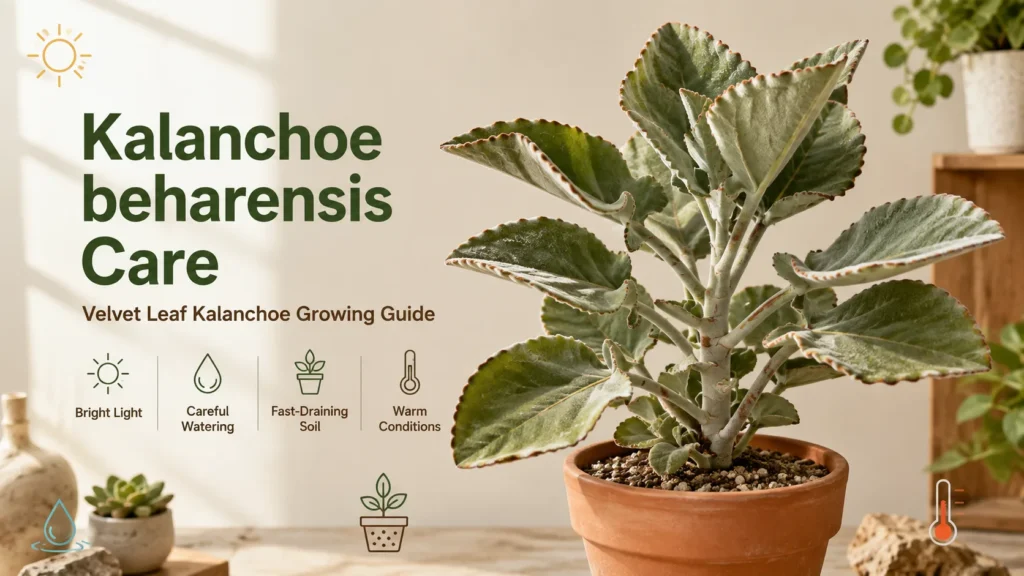
Kalanchoe beharensis is a striking succulent known for its large, soft, velvety leaves. It can grow much larger than many Kalanchoe plants, but it stays manageable in a container with the right care.
I would focus on three things first: bright light, fast-draining soil, and careful watering. Once those are right, this Velvet Leaf Kalanchoe needs little day-to-day care.
Quick Answer: How Do You Care for Kalanchoe beharensis?
Kalanchoe beharensis grows best in bright light, fast-draining succulent soil, and warm conditions. I would let the soil dry well before watering again and always use a pot with a drainage hole. Protect the plant from frost, avoid wet soil, and feed lightly during active growth.
What Is Kalanchoe beharensis?
Kalanchoe beharensis is a succulent perennial from Madagascar. It belongs to the Crassulaceae family and is best known for its large, textured leaves.
You may see it sold under names such as Velvet Leaf Kalanchoe, velvetleaf, felt bush, feltbush, or velvet elephant ear. These names refer to its soft leaf surface and unusual shape.
Unlike florist Kalanchoe, this plant is grown mainly for its foliage. Its large leaves give it a very different look from smaller flowering types such as Kalanchoe blossfeldiana.
Kalanchoe beharensis can also become quite large. In suitable outdoor conditions, mature plants can develop woody stems and a shrub-like form. Container-grown plants usually stay smaller and are easier to manage.
How to Identify Kalanchoe beharensis

The leaves are the easiest way to identify this plant.
Leaves
Kalanchoe beharensis has large, fleshy leaves with a triangular or lance-shaped form. The surface has a soft, hairy coating that gives the plant its velvet-like feel.
The foliage can range from olive green to gray-green. Older plants may also develop brown tones around parts of the leaves, especially with strong light.
The leaf edges can look ruffled or uneven. The leaves grow along upright stems, giving mature plants a more tree-like appearance than many small Kalanchoe species.
Stems and Growth Habit
Young plants usually look compact, but Kalanchoe beharensis can become tall as it ages. Its stems can become woody, while the large leaves remain the main feature.
This growth habit is one reason I would give the plant enough space as it matures. A small nursery plant can look very different after several years.
Kalanchoe beharensis vs Kalanchoe tomentosa
These two plants can confuse new growers because both have fuzzy leaves.
| Feature | Kalanchoe beharensis | Kalanchoe tomentosa |
| Common name | Velvet Leaf Kalanchoe | Panda Plant |
| Leaf size | Large | Small |
| Growth habit | Upright and shrub-like | Compact and bushy |
| Leaf shape | Large and triangular | Smaller and elongated |
| Main feature | Large velvety leaves | Fuzzy leaves with darker edges |
| Mature size | Can become large | Usually much smaller |
If you see a Kalanchoe with very large, soft, triangular leaves, Kalanchoe beharensis is a better match. Kalanchoe tomentosa usually has much smaller leaves and a more compact form.
Kalanchoe beharensis Care Requirements
The basic Kalanchoe beharensis care routine is simple. The main risk is giving the plant more water than its roots can handle.
Light

Kalanchoe beharensis likes plenty of light. It can grow in bright filtered light, bright indirect light, or stronger sun after it has adjusted to it.
I would place an indoor plant near your brightest window. A south- or west-facing window can work well, but watch the leaves when moving a plant from lower light into strong sun.
If the plant has been indoors for a long time, increase direct sun slowly. A sudden change can cause leaf damage even in a sun-tolerant succulent.
Good light also helps the plant keep a strong shape. Too little light can lead to weak, stretched growth.
Watering
Watering is where many Kalanchoe beharensis plants run into trouble.
I would give the plant a thorough watering, then let the soil dry well before watering again. The roots need access to air between watering sessions.
Do not follow a strict calendar if the growing conditions change. A plant in a bright, warm room with a small pot may dry much faster than one in a cool room with a large pot.
Before watering, check the soil.
If it is still damp several inches below the surface, I would wait. If the soil has dried well and the plant is in a pot with good drainage, it is usually time to water.
Too much moisture can lead to root rot. Yellow leaves, soft growth, and a wet potting mix that stays damp for too long are signs that you should check the roots and drainage.
Soil

Kalanchoe beharensis needs soil that drains quickly.
A cactus or succulent potting mix is a good starting point. I like a mix with plenty of coarse material such as perlite, pumice, or coarse grit because it gives water a clear path out of the root zone.
Avoid heavy soil that stays wet for long periods.
The goal is simple: the soil should hold enough moisture for the roots to absorb water but dry out well afterward.
Pot and Drainage
Always choose a pot with a drainage hole.
The container should be large enough for the root system without leaving a huge amount of unused wet soil around it. Oversized pots can stay wet for too long after watering.
Terracotta can be a useful choice because it allows some moisture to escape through the sides.
When repotting, move up only slightly in pot size. A much larger container is not needed just because the plant has grown a little.
Temperature and Humidity
Kalanchoe beharensis prefers warm conditions. It comes from Madagascar and is best treated as a warm-climate succulent.
Normal indoor temperatures usually work well.
I would protect it from frost and prolonged cold. If you grow it outdoors and cold weather is expected, move a container indoors or place it in a protected warm area.
You also do not need to create a very humid environment. Normal indoor air is usually fine as long as the plant gets good airflow.
Fertilizer
Kalanchoe beharensis does not need heavy feeding.
During active growth, you can use a balanced fertilizer or one made for cacti and succulents. I prefer light feeding rather than frequent heavy applications.
The plant can grow well without constant fertilizer, so missing an occasional feeding is not a serious problem. The bigger concern is overfeeding.
Reduce or stop feeding during the plant’s slower growth period.
Growing Kalanchoe beharensis Indoors
Kalanchoe beharensis can make a good indoor plant if you have enough light.
I would place it near a bright window rather than in a dark corner. Its large leaves make it a strong focal plant, but remember that the standard species can eventually become much larger than a typical small Kalanchoe houseplant.
Use a pot with a drainage hole and a gritty succulent mix.
Keep some space around the plant so air can move freely through the foliage. This also makes it easier to inspect the leaves for pests.
If your plant becomes tall and sparse, check the light before reaching for the pruning shears. Weak light is often the first thing I would look at when growth becomes stretched.
Growing Kalanchoe beharensis Outdoors

In warm, frost-free areas, Kalanchoe beharensis can grow outdoors.
A bright patio, container garden, rock garden, or protected outdoor bed can work well. Give it soil that drains quickly and choose a site with plenty of light.
If the plant has been grown indoors, do not place it straight into intense outdoor sun. Give it time to adjust.
Outdoor plants may also need more frequent watering during hot, dry periods. Still, I would check the soil rather than watering simply because several days have passed.
The plant should never sit in water after heavy rain.
How Big Does Kalanchoe beharensis Get?
This species can become much larger than many Kalanchoe plants.
In its native environment, it can grow into a large shrub or small tree. Cultivated plants are often much smaller, especially when grown in containers.
The plant can reach around 0.5 to 1 meter in cultivated settings, while plants grown in suitable warm outdoor conditions can become considerably larger.
Container growing gives you more control over its size.
If you want a manageable indoor plant, regular pruning and a suitable pot can help keep its shape under control.
Does Kalanchoe beharensis Flower?
Yes, mature Kalanchoe beharensis can produce flowers, but the foliage is usually the main reason people grow it.
The flowers appear on tall branching clusters above the foliage. They are small and urn-shaped, with greenish-yellow coloring.
Flowering can vary with age, light, temperature, and growing conditions.
I would not buy this plant mainly for flowers. If you want large, colorful flower clusters, Kalanchoe blossfeldiana or Calandiva is a better choice.
Kalanchoe beharensis is more about its large velvet-like leaves and unusual shape.
How to Propagate Kalanchoe beharensis

Kalanchoe beharensis can be propagated by several methods.
For a home grower, I would start with offsets or cuttings because these methods are more practical than growing a large plant from seed.
Propagation From Offsets
Offsets are small new plants that develop around the base of the parent plant.
If your Kalanchoe beharensis produces an offset with its own roots, you can separate it from the parent plant and grow it in its own container.
Spring is a good time to do this. After separating the offset, allow any damaged or cut area to dry before planting it into a fast-draining mix.
This is one of the easiest ways to make a new plant.
Propagation From Stem Cuttings
Stem cuttings can also work well.
Choose a healthy stem and make a clean cut. Allow the cut area to dry and form a callus before placing the cutting into a suitable succulent mix.
Do not keep the cutting constantly wet. Give it bright light and allow the growing medium to stay on the drier side while roots begin to form.
Propagation From Leaf Cuttings
Kalanchoe species can also be propagated from leaf cuttings. For succulent leaf propagation, it helps to let the cut surface callus before planting.
Choose a healthy leaf and handle it carefully so the base remains intact.
Allow the cut end to dry for a day or two, then place it on or into a suitable gritty growing medium.
This method usually takes more patience than using an established offset.
Growing From Seed
Seed propagation is possible, but it is slower for someone who simply wants another houseplant.
Seeds need a suitable growing medium, warmth, moisture, and good light after germination.
For most home growers, I would choose an offset or cutting first.
Popular Kalanchoe beharensis Varieties
There are several forms and cultivars associated with this species.
Kalanchoe beharensis ‘Fang’
‘Fang’ is one of the best-known forms.
It has large leaves with noticeable fang-like structures along the underside. The leaves can show bronze tones on top with silvery-green coloring underneath.
It can also become larger than a typical small houseplant, so give it enough room as it grows.
Other Forms
You may also find smaller or differently colored forms of Kalanchoe beharensis in specialist plant collections.
Before buying one, check its mature size and growing habit. Cultivars can look quite different from the standard species.
Common Kalanchoe beharensis Problems

Most problems come from poor light, excess water, unsuitable soil, or pests.
Yellow Leaves
A few older yellow leaves can be normal, but widespread yellowing deserves attention.
If the soil stays wet for a long time, check your watering routine and drainage first.
If the plant is also soft or losing leaves, inspect the roots for signs of rot.
Soft or Mushy Leaves
Soft leaves often point to too much moisture.
Check whether the pot has a drainage hole and whether the soil dries properly between watering sessions.
If the roots have started to rot, remove damaged roots and move the plant into fresh, well-draining soil.
Leaf Drop
Leaf drop can happen after stress.
Check:
- Watering
- Light
- Temperature
- Recent changes in location
- Root health
Do not assume that every dropped leaf means the plant needs more water.
Leggy Growth
Long stems with large gaps between leaves usually mean the plant needs more light.
Move it closer to a bright window or give it more suitable outdoor light after a gradual adjustment.
Pruning can improve the shape, but fixing the light is more useful for future growth.
Brown or Damaged Leaves
Brown areas can have several causes.
Strong sudden sun, physical damage, watering problems, or other stress can affect the leaves.
Look at the full growing setup rather than treating the damaged leaf alone.
Root Rot
Root rot is one of the main problems to watch for.
The usual warning signs include:
- Soft stems
- Mushy leaves
- Yellowing
- A bad smell from the soil
- Roots that are dark and soft
If you suspect root rot, remove the plant from the pot and inspect the roots. Cut away badly damaged areas with a clean tool and repot the healthy parts in fresh, fast-draining soil.
Mealybugs
Mealybugs can appear around stems, leaf joints, and other sheltered areas.
Inspect the plant regularly, especially if it is kept indoors with limited airflow.
Remove visible pests and keep an eye on the plant for signs of a returning infestation.
Aphids
Aphids may gather around new growth and flower stems.
Check new leaves often because early detection makes pest control much easier.
Spider Mites
Spider mites can become a problem in warm, dry indoor conditions.
Look for fine webbing, tiny pests, or leaves that look dull and stressed.
Good airflow and regular plant checks can help you spot a problem early.
Is Kalanchoe beharensis Toxic?
I would treat Kalanchoe beharensis as a plant that should not be eaten.
If you have pets or young children that may chew plants, keep it out of reach. This is especially sensible because Kalanchoe species can contain compounds that may cause problems if eaten.
If you are unsure about a suspected plant poisoning, contact a qualified professional rather than trying to treat the problem yourself.
Final Thoughts
Kalanchoe beharensis is a good choice if you want a succulent with unusual foliage rather than a plant grown mainly for flowers.
I would keep the care routine simple: give it plenty of light, use fast-draining soil, water only after the soil has dried well, and protect it from frost. With those basics in place, the Velvet Leaf Kalanchoe can become a large and striking plant with very little daily work.
Kalanchoe beharensis FAQs
Is Kalanchoe beharensis easy to grow?
Yes. It is generally a low-maintenance succulent when given bright light, dry periods between watering, and fast-draining soil.
Can Kalanchoe beharensis grow indoors?
Yes. Give it a bright window, good drainage, and enough room for its mature size.
How big does Kalanchoe beharensis get?
It can become a large shrub or small tree outdoors, while container plants usually stay much smaller.
Does Kalanchoe beharensis need full sun?
It can handle strong light and full sun after gradual adjustment. Bright filtered light can also work well.
How often should I water Kalanchoe beharensis?
Water thoroughly when the soil has dried well, then let excess water drain away.
Can Kalanchoe beharensis grow from a leaf?
Yes. Kalanchoe species can be propagated from leaf cuttings, although the process takes patience.
Does Kalanchoe beharensis flower?
Yes. Mature plants can produce small flowers on tall branching stems, but the foliage is the main attraction.
Is Kalanchoe beharensis safe around pets?
I would keep it away from pets that may chew plants and treat ingestion as a potential safety concern.