Skip to content
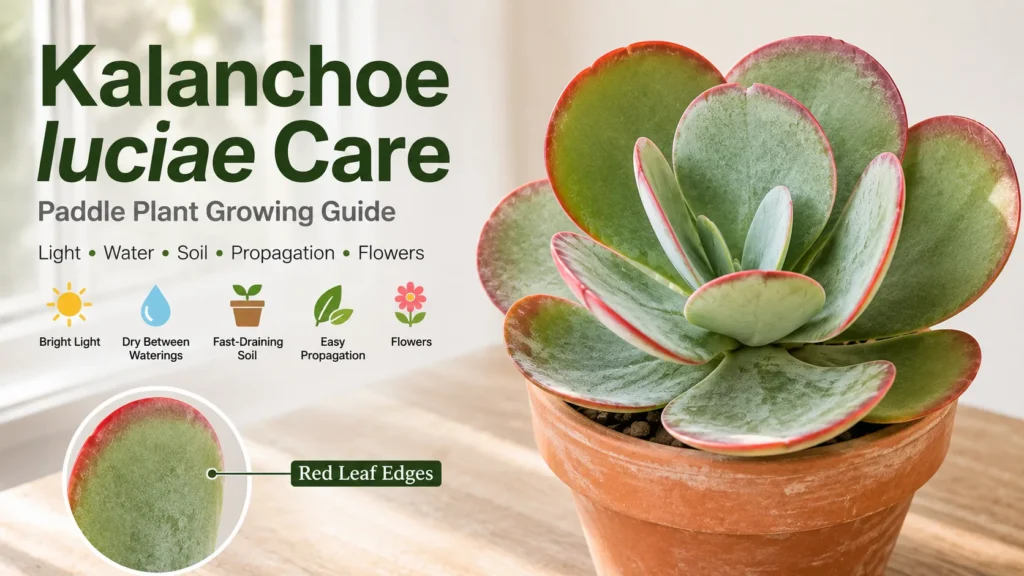
Kalanchoe luciae is a striking succulent with thick, paddle-shaped leaves and red or pink edges. It is often sold as the Paddle Plant or Flapjack Plant, and it is one of the easier succulents to grow if you get the light, water, and drainage right.
I like Kalanchoe luciae because its leaves can change color as growing conditions change. With enough bright light, the green leaves can develop strong red edges, giving the plant a very different look from one grown in shade.
Quick Answer: How Do You Care for Kalanchoe luciae?
Kalanchoe luciae grows best in bright light or full sun, fast-draining succulent soil, and a pot with a drainage hole. I let the soil dry well before watering again. Protect it from frost, avoid soggy soil, and give it more light if the plant becomes stretched or loses its red leaf edges.
What Is Kalanchoe luciae?
Kalanchoe luciae is a succulent in the Crassulaceae family. It forms a basal rosette of thick, rounded leaves that look a little like paddles.
The plant is native to southern Africa and is well suited to dry, sunny conditions. Mature plants can become fairly large, with a tall flower stalk rising from the center when they reach flowering age.
You may see this plant sold under several common names, including:
- Paddle Plant
- Flapjack Plant
- Flapjack succulent
- Red Pancake Plant
- Desert Cabbage
One thing I would check before buying is the plant label. Kalanchoe luciae is often confused with Kalanchoe thyrsiflora, and both plants can be sold as Paddle Plant or Flapjack.
How to Identify Kalanchoe luciae

The easiest way to recognize Kalanchoe luciae is by its thick, paddle-shaped leaves.
The leaves are usually gray-green to green and have rounded tips. They may also have a light powdery coating. In bright light, the edges can turn pink, red, or deep red.
The plant grows as a compact rosette when it gets enough light. Mature plants can send up a tall flowering stem from the center.
Why Do Kalanchoe luciae Leaves Turn Red?

Red leaf edges are normal for Kalanchoe luciae.
Strong light can bring out deeper red and purple tones along the leaf edges. Plants grown with less light often stay greener and may lose some of that strong color.
I would not move a green plant straight into harsh full sun just to make it red. A sudden change in light can cause sun damage. Increase the light slowly and watch the leaves.
The red color is part of what makes this Kalanchoe luciae succulent so attractive.
Kalanchoe luciae vs Kalanchoe thyrsiflora

These two plants cause a lot of confusion.
Both have thick paddle-shaped leaves, both belong to the Kalanchoe genus, and both can be sold under names such as Paddle Plant and Flapjack. Many plants labeled Kalanchoe thyrsiflora in garden centers are actually Kalanchoe luciae.
Here are the main differences:
| Feature | Kalanchoe luciae | Kalanchoe thyrsiflora |
| Leaves | Large, rounded paddles | Usually smaller and more cupped |
| Leaf color | Green to gray-green | Blue-gray to chalky green |
| Red edges | Often strong in bright light | Usually much less noticeable |
| Leaf coating | Lighter powdery coating | Heavier white or gray coating |
| Flowers | White to pale yellow-green | Bright yellow |
| Flower scent | Usually not noticeable | Sweetly scented |
| Common names | Paddle Plant, Flapjack | Paddle Plant, Flapjack |
The flowers can help with identification. Kalanchoe luciae produces pale flowers, while Kalanchoe thyrsiflora produces brighter yellow, scented flowers.
For everyday care, both plants have similar needs, so getting the name wrong does not usually cause a major care problem.
Kalanchoe luciae Care Requirements
Kalanchoe luciae is fairly easy to grow once you match its care to its natural growth habit.
It is a drought-tolerant succulent, so I focus on strong light, quick drainage, and letting the soil dry before watering again.
Light

Give Kalanchoe luciae plenty of bright light.
Outdoors, it can grow well in full sun when it has been introduced to that level of light gradually. Indoors, place it near your brightest window.
A plant that gets too little light may become stretched and lose its compact shape. Its red leaf edges may also become less noticeable.
If your plant has been growing indoors in weaker light, increase direct sun slowly rather than moving it straight into strong afternoon sunlight.
Watering

Kalanchoe luciae does not need frequent watering.
I let the soil dry well before watering again. When it is time to water, I water thoroughly and allow the extra water to drain from the bottom of the pot.
The main mistake I would avoid is keeping the soil wet for long periods. Succulents store water in their leaves, so constantly wet roots can lead to root problems.
Do not follow a fixed weekly schedule without checking the soil. Your watering needs will change with light, temperature, pot size, soil, and season.
Soil
Use a fast-draining soil made for succulents or cacti.
A good mix should allow water to pass through quickly instead of staying wet around the roots. You can improve a regular potting mix with materials such as perlite, pumice, or coarse grit.
The goal is simple: the roots need moisture when you water, followed by plenty of air and a drying period.
Pot and Drainage
Choose a pot with a drainage hole.
Terracotta can work well because it allows the soil to dry faster, but the most important feature is proper drainage.
Avoid using a large pot simply because you want the plant to grow faster. A pot that holds too much wet soil can stay damp for too long.
I prefer a pot that gives the root system enough room to grow without leaving a large amount of unused wet soil around it.
Temperature and Humidity
Kalanchoe luciae prefers warm growing conditions and does not handle freezing weather well.
If you grow it outdoors, protect it from frost and prolonged cold. In colder areas, a container makes it easier to move the plant indoors when temperatures drop.
You do not need high humidity for this succulent. Good airflow and well-draining soil are more useful than trying to create a humid environment.
Fertilizer
Kalanchoe luciae does not need heavy feeding.
During active growth, you can use a balanced fertilizer made for succulents at a light rate. Avoid overfeeding, especially when the plant is growing slowly.
Good light and proper watering matter more than frequent fertilizer.
Growing Kalanchoe luciae Indoors

Kalanchoe luciae can grow well indoors if you give it enough light.
Place it close to a bright window where it can receive strong natural light. A south- or west-facing window can work well, depending on your home and the amount of direct sun it receives.
Watch the plant instead of relying only on the window direction. If the stems stretch, the rosette becomes loose, or the red edges fade, the plant may need more light.
Use a pot with drainage and a fast-draining succulent mix. Keep the plant away from areas where water regularly sits around the pot.
Growing Kalanchoe luciae Outdoors
Kalanchoe luciae works well in containers, succulent gardens, rock gardens, and other spots with good drainage.
Give it plenty of sun, but introduce a plant grown indoors to outdoor sunlight slowly. This helps reduce the risk of leaf scorch.
In areas with cold winters, grow it in a container so you can move it to a protected place.
Outdoor plants may need more frequent watering during periods of strong heat and active growth, but the soil should still dry between waterings.
Does Kalanchoe luciae Flower?
Yes, Kalanchoe luciae can produce flowers.
When the plant reaches maturity, a tall flower stalk can grow from the center of the rosette. The stalk can become much taller than the main plant, making the change easy to notice.
The flowers are small and appear in dense groups. Kalanchoe luciae flowers are generally white to pale yellow-green.
Flowering usually happens after the plant has reached maturity and received suitable growing conditions.
Why Does Kalanchoe luciae Die After Flowering?

Kalanchoe luciae is monocarpic. This means the flowering rosette eventually dies after it flowers.
This can look alarming if you have never grown a monocarpic succulent.
The plant is not necessarily dying because of poor care. Before or around flowering, it can produce small plantlets or offsets around the base. These young plants can continue growing after the main rosette finishes its life cycle.
If your Kalanchoe luciae sends up a tall flower stalk, check around the base for offsets. Those young plants can give you a new generation of the plant.
How to Propagate Kalanchoe luciae

There are several ways to propagate Kalanchoe luciae.
For most home growers, I would focus on offsets and healthy leaf cuttings. Seeds are possible but take more time and care.
Propagating From Offsets
Offsets are small plants that develop around the base of the parent plant.
When an offset is large enough to handle, carefully separate it from the parent plant. If it has roots of its own, the process is even easier.
Let any damaged or cut area dry before planting it in a fast-draining succulent mix. Start with careful watering and give the new plant bright light without exposing it to harsh sun too quickly.
Propagating From Leaf Cuttings
You can also try growing Kalanchoe luciae from a healthy leaf.
Choose a mature leaf and remove it carefully from the plant. The base of the leaf should remain intact.
Let the cut end dry and form a callus before placing the leaf on suitable succulent soil. Keep conditions bright and avoid keeping the soil constantly wet.
Leaf propagation can take patience, so I would not worry if you do not see a new plant right away.
Propagating From Seeds
Kalanchoe luciae can also grow from seed.
The seeds are very small, and seed propagation takes more time than using offsets or cuttings. For a home grower who simply wants another plant, offsets are usually the easier option.
Kalanchoe luciae Varieties
You may see several named forms of Kalanchoe luciae in plant collections and nurseries.
Kalanchoe luciae ‘Fantastic’
‘Fantastic’ is a variegated form with cream, green, and pink tones on the leaves.
Its color can change with growing conditions. Bright light helps maintain a compact form, while the exact leaf pattern can vary.
Because variegated plants have less green tissue, they may grow more slowly than the straight species.
Kalanchoe luciae ‘Dragonfire’
‘Dragonfire’ is another cultivated form valued for its colorful foliage.
You do not need a different basic care routine for it. Give it strong light, fast-draining soil, careful watering, and protection from frost.
Common Kalanchoe luciae Problems

Kalanchoe luciae is fairly tough, but poor growing conditions can still cause problems.
Yellow Leaves
Yellow leaves often point to a watering problem, especially if the soil stays wet for a long time.
Check the drainage and allow the soil to dry before watering again.
Mushy Leaves
Soft, mushy leaves are more concerning than normal wrinkles.
Check the roots and soil if the problem continues. Constantly wet soil can lead to root rot, so improve drainage and reduce watering if the mix stays wet.
Wrinkled Leaves
Wrinkled or slightly soft leaves can mean the plant needs water.
Check the soil first. If the soil is completely dry and the plant looks thirsty, give it a thorough watering and let the excess drain away.
Do not water automatically just because one leaf looks wrinkled.
Brown Leaf Edges
Brown patches can come from strong sun, sudden changes in light, physical damage, or other stress.
If you recently moved the plant from a low-light location into strong sun, give it time to adjust and increase exposure more gradually.
Green Leaves With No Red Color
A green Kalanchoe luciae is not automatically unhealthy.
Lower light often produces greener leaves with less red coloration. If you want stronger red edges, gradually increase the amount of bright light the plant receives.
Leggy Growth
Long stems and large gaps between leaves usually mean the plant needs more light.
Move it to a brighter location and give it time to adjust.
Root Rot
Root rot is often linked to poor drainage and frequent watering.
Use a fast-draining succulent mix, a pot with a drainage hole, and a watering routine based on soil dryness rather than a fixed calendar.
Mealybugs and Other Pests
Mealybugs and aphids can sometimes affect Kalanchoe plants. Check around leaf joints and other hidden areas if you notice unusual spots, insects, or sticky residue.
Early detection makes pest problems easier to manage.
Is Kalanchoe luciae Toxic to Pets?
I would keep Kalanchoe luciae away from pets and children who may chew or eat plants.
Kalanchoe species can be toxic when eaten, so placing the plant somewhere out of reach is a simple safety step.
Final Thoughts
Kalanchoe luciae is a good choice if you want a succulent with bold foliage and changing color. I would focus on three things first: give it plenty of light, use fast-draining soil, and let the soil dry between waterings.
If the leaves develop red edges, the plant stays compact, and the soil drains quickly, you are generally giving your Paddle Plant the conditions it needs. If it flowers and the main rosette later declines, check for offsets rather than assuming the whole plant is lost.
Kalanchoe luciae Care FAQs
Is Kalanchoe luciae easy to grow?
Yes. It is a fairly low-maintenance succulent when given strong light, dry periods, and good drainage.
Why is my Kalanchoe luciae not turning red?
It may not be getting enough strong light. Increase light gradually and avoid sudden exposure to harsh sun.
Can Kalanchoe luciae grow indoors?
Yes. Place it near a bright window and use fast-draining soil.
How often should I water Kalanchoe luciae?
Water when the soil has dried well. Avoid using a fixed weekly schedule.
Does Kalanchoe luciae die after flowering?
Yes. The flowering rosette eventually dies, but offsets can grow into new plants.
Can I propagate Kalanchoe luciae from a leaf?
Yes. Leaf propagation is possible, although offsets are usually easier for home growers.
What is the difference between Kalanchoe luciae and Kalanchoe thyrsiflora?
Kalanchoe luciae often develops red leaf edges and has pale flowers, while Kalanchoe thyrsiflora usually has heavier powdery leaves and yellow, scented flowers.