Skip to content
Cantaloupe plants are fairly easy to care for once they get established, but they need the right balance of sunlight, water, soil, nutrients, and space to produce good fruit.
I pay the most attention to watering and plant health. A cantaloupe vine can look healthy one week and start showing yellow leaves, wilting, disease, or poor fruit set if growing conditions change.
Cantaloupe, also called muskmelon, is a warm-season vine that grows best in full sun and fertile, well-drained soil.
In this guide, I’ll cover the main parts of cantaloupe plant care, from watering and fertilizer to vine management, flowering, fruit development, pests, diseases, and common problems.
What Does a Cantaloupe Plant Need?
A healthy cantaloupe plant needs:
- Full sun
- Warm growing conditions
- Fertile, well-drained soil
- Regular moisture
- Enough room for the vines
- Proper nutrition
- Good airflow
- Pollination
- Regular pest and disease checks
I don’t try to fix one problem without looking at the whole plant. For example, yellow leaves can come from several causes, so I check the soil, roots, leaves, weather, and watering pattern before adding fertilizer.
How Much Sun Does Cantaloupe Need?

Cantaloupe plants need full sun for good growth and fruit production.
UC IPM recommends at least 4 to 6 hours of sunlight per day, while Utah State University recommends a sunny growing location.
If possible, I would choose a spot that receives strong sunlight for most of the day.
Avoid planting cantaloupes where trees, fences, buildings, or other crops shade the vines for long periods.
Good sunlight helps the plant produce the energy it needs for:
- Leaf growth
- Flowering
- Fruit development
- Fruit quality
If a vine receives too little light, it may produce lots of weak growth but struggle to make good fruit.
What Soil Is Best for Cantaloupe?
Cantaloupes grow best in fertile, well-drained soil.
Sandy loam or other soils that drain well can work especially well. UC IPM recommends soil with a pH around 6.0 to 6.5.
I would focus more on drainage than trying to create a perfect soil type.
The roots need access to water, but they should not sit in saturated soil.
How to improve poor soil
If your garden soil is heavy clay or very sandy, adding suitable organic matter can improve its structure.
Compost and other well-decomposed organic materials can help improve soil condition. A soil test is also useful because it can show whether nutrients need to be added.
Avoid adding large amounts of fertilizer without knowing what your soil needs.
How Often Should You Water Cantaloupe Plants?

Watering is one of the most important parts of cantaloupe care.
Cantaloupes need consistent moisture, especially while the vines are growing, flowering, and setting fruit.
Utah State University gives a general guideline of about 1 to 2 inches of water per week, with deep and less-frequent irrigation preferred.
I would treat that as a starting point rather than a strict schedule.
Your actual watering needs depend on:
- Rainfall
- Temperature
- Soil type
- Plant size
- Wind
- Mulch
- Container or garden-bed growing
Water deeply
Instead of giving the plant a small amount of water every day, aim to wet the root zone deeply.
UC IPM recommends watering deeply enough to encourage deeper rooting.
Check the soil before watering.
If the upper soil is dry and the deeper root zone is also losing moisture, it is time to water.
Water at the soil
I prefer drip irrigation or a soaker hose when possible.
These methods put water near the root zone without constantly wetting the leaves.
UC IPM recommends avoiding overhead watering that wets the foliage and fruit.
Wet leaves can create conditions that favor some fungal and bacterial diseases.
Do not let the plant swing from very dry to very wet
This is a common problem.
A plant that becomes severely dry and then receives a large amount of water can experience stress.
Water stress during fruit set can lead to small or misshapen melons, while excessive water can contribute to fruit splitting.
How Much Water Does Cantaloupe Need During Fruit Development?
Fruit development is a stage where I pay close attention to soil moisture.
The plant still needs water, but the goal is steady moisture rather than constant saturation.
Keep checking:
- Soil moisture
- Recent rainfall
- Leaf condition
- Fruit development
- Weather conditions
As the fruit approaches maturity, some Extension guidance recommends reducing irrigation. Utah State University notes that reducing water as fruits ripen can improve flavor.
I would still avoid letting the plant become severely dry.
The goal is to reduce excess water, not to stress the plant.
How to Fertilize Cantaloupe Plants
Cantaloupes are productive plants, so they need adequate nutrients.
But I would not keep adding fertilizer every time the plant looks slow.
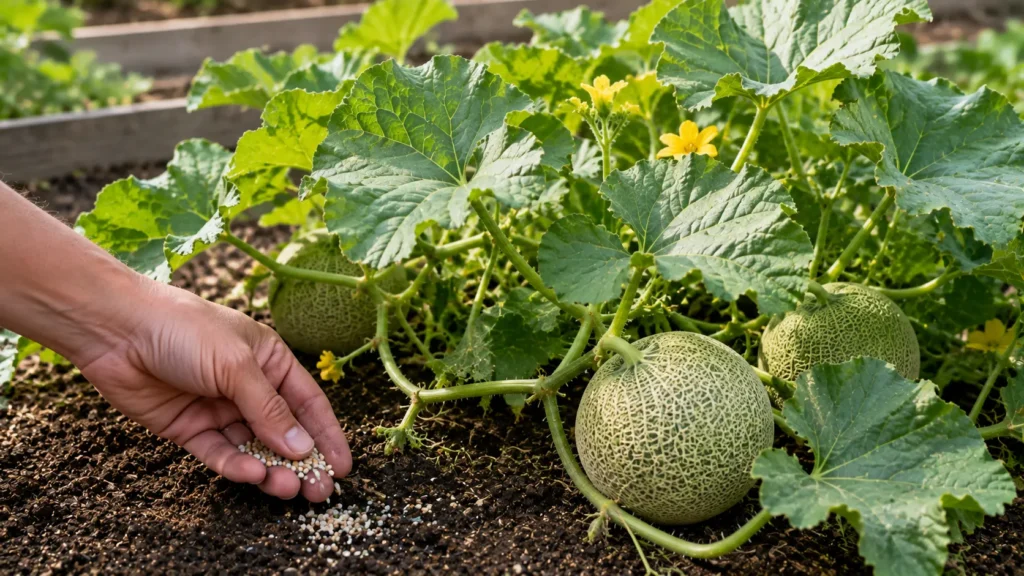
Start with a soil test when possible. This gives you a better idea of what the soil actually needs. Utah State University recommends using soil-test results to guide fertilizer applications.
Nitrogen and vine growth
Nitrogen supports leafy and vine growth.
After cantaloupe plants develop runners, some Extension recommendations call for side-dressing with additional nitrogen.
But more nitrogen is not always better.
Too much nitrogen can encourage excessive leaf and vine growth when your goal is also to develop flowers and fruit.
I prefer to follow a soil test and the fertilizer label rather than guessing.
How to apply fertilizer
Keep fertilizer away from direct contact with the plant stem.
If you are side-dressing, place the fertilizer beside the plant rather than directly against it, then water it in as directed.
UC IPM recommends keeping fertilizer from touching stems because concentrated fertilizer can cause damage.
Should You Mulch Around Cantaloupe Plants?

Yes. Mulch can be useful for cantaloupe care.
A good mulch layer can:
- Reduce weeds
- Slow moisture loss
- Keep soil conditions more stable
- Reduce soil splashing onto leaves and fruit
- Help keep developing fruit cleaner
Organic mulch and plastic mulch are both used with cantaloupes.
One detail matters with organic mulch.
Utah State University recommends waiting until the soil has warmed before applying organic mulch because an early mulch layer can keep the soil too cool.
Keep mulch from sitting tightly against the plant stem.
How Much Space Do Cantaloupe Vines Need?
Cantaloupe plants produce long runners.
If you grow them directly on the ground, give the vines enough room to spread without being crowded by other plants.
Crowded foliage can reduce airflow and make it harder to inspect the plant for pests and diseases.
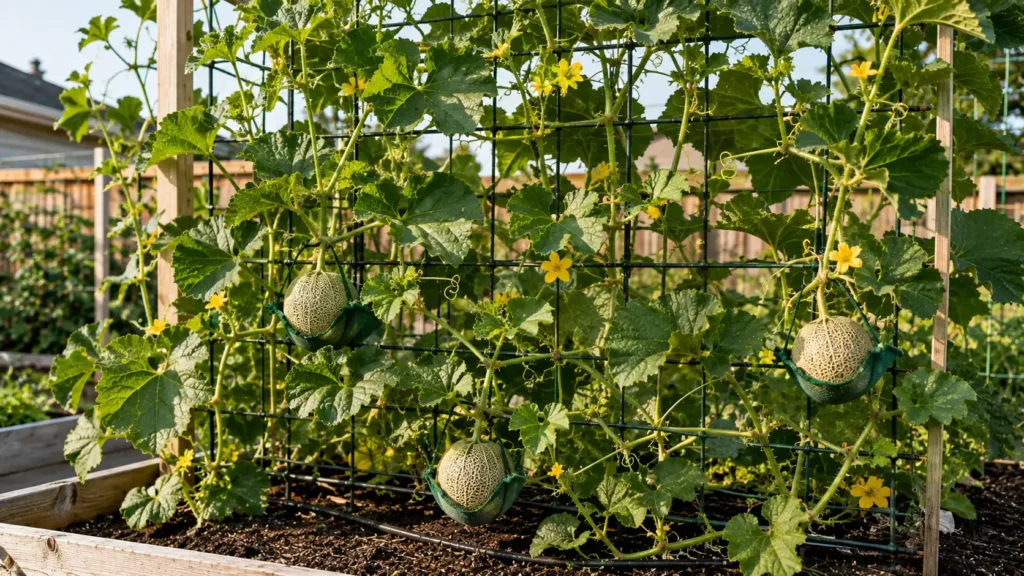
If space is limited, some gardeners grow cantaloupes vertically.
Can You Grow Cantaloupe on a Trellis?
Yes, cantaloupes can be grown vertically with suitable support.
NC State Extension notes that cantaloupe vines can be grown on the ground or supported with structures such as cages or trellises.
The main issue is the weight of the developing fruit.
If I grow a melon vertically, I make sure the support is strong enough and provide support for the fruit as it gets larger.
A weak trellis can bend or collapse under the weight of mature melons.
For a normal garden with plenty of space, letting the vines spread across the ground is often simpler.
Should You Prune Cantaloupe Plants?
Cantaloupes do not need heavy routine pruning in a home garden.
I would remove:
- Dead leaves
- Severely damaged growth
- Clearly diseased plant parts
I would not cut healthy leaves just because the vine looks crowded.
Those leaves help the plant produce energy for fruit development.
Heavy pruning can also remove useful foliage without solving the real problem.
If the plant is producing too much vine growth and very little fruit, I would first check sunlight, nitrogen, watering, pollination, and variety before reaching for the pruning shears.
How to Care for Cantaloupe During Flowering

Flowering is an important stage because the plant needs successful pollination before it can produce fruit.
Cantaloupe plants produce separate male and female flowers. The female flower has a small swelling behind it that can develop into a melon after successful pollination.
How to support pollination
I would focus on creating conditions that allow pollinators to work naturally.
You can:
- Avoid unnecessary insecticide use when flowers are open.
- Keep the plant healthy.
- Avoid severe water stress.
- Grow suitable flowering plants nearby.
- Avoid disturbing flowers.
Poor pollination can lead to flowers dropping without producing fruit.
Cold, rainy, or cloudy weather can also reduce pollination in melons.
What if my cantaloupe plant has flowers but no fruit?
Don’t assume the plant needs more fertilizer.
First check whether the flowers are being pollinated.
Also check:
- Recent weather
- Water stress
- Plant health
- Insect activity
- Whether female flowers are present
If natural pollination is poor, hand pollination can sometimes help.
How to Care for Cantaloupe While Fruit Is Growing

Once small melons begin forming, I focus on keeping the plant stable.
The main goals are:
- Maintain steady soil moisture.
- Keep the leaves healthy.
- Watch for pests.
- Check for disease.
- Keep weeds under control.
- Avoid excess nitrogen.
- Protect developing fruit.
Healthy leaves are especially important because the plant needs them to support fruit development.
I would avoid removing healthy foliage just to make the vine look cleaner.
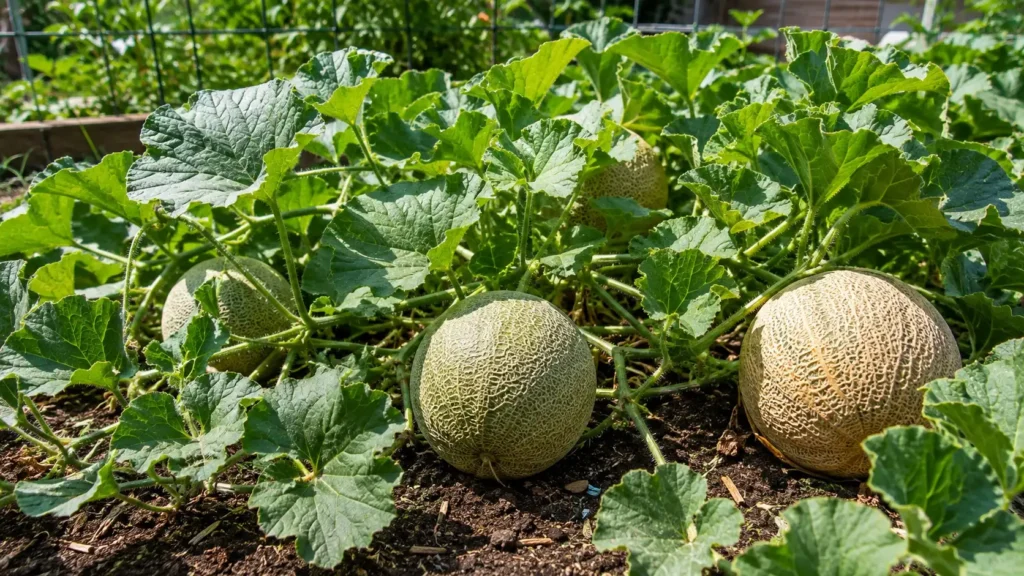
Protect fruit sitting on the soil
If the melons are resting directly on the ground, a layer of suitable mulch can help keep the fruit cleaner and reduce direct contact with wet soil.
Keep checking underneath the fruit as it develops.
Look for:
- Soft spots
- Rot
- Insect damage
- Cracks
- Excess moisture
How to Care for Cantaloupe Near Harvest
As the fruit gets close to maturity, the care routine becomes more about protecting the plant and fruit.
Keep checking for pests and disease.
Avoid severe water stress, but also avoid excessive irrigation.
Too much water close to maturity can increase the risk of fruit splitting.
I would also avoid heavy fertilizer applications late in the season unless a soil test or specific growing plan calls for them.
For exact harvest signs, use a dedicated cantaloupe harvesting guide rather than trying to cover every maturity test here.
Common Cantaloupe Plant Pests

Several insects can attack cantaloupe plants.
UC IPM lists pests such as aphids, cucumber beetles, squash bugs, spider mites, thrips, whiteflies, cutworms, and leafminers among the insects that can affect cantaloupes.
The most useful approach is regular scouting.
| Pest | What you may notice | What I would check |
| Aphids | Curling leaves, sticky residue, clusters of small insects | Young leaves and stems |
| Cucumber beetles | Holes and feeding damage | Leaves, flowers, and young fruit |
| Squash bugs | Insects or eggs on leaves | Leaf undersides and stems |
| Spider mites | Speckled, pale, or bronzed leaves | Leaf undersides during hot, dry weather |
| Thrips | Damaged or distorted plant tissue | Flowers and young leaves |
Don’t spray an insecticide simply because you see one insect.
First identify the pest and determine whether the damage is serious enough to require control.
Common Cantaloupe Plant Diseases
Cantaloupes can develop several diseases, including:
- Powdery mildew
- Downy mildew
- Fusarium wilt
- Anthracnose
- Bacterial wilt
- Gummy stem blight
- Root rot
- Cucurbit viruses
UC IPM lists these and other diseases and disorders affecting cantaloupe.
How to reduce disease problems
Good plant care can reduce disease pressure.
I recommend:
- Give plants enough space.
- Keep foliage as dry as practical.
- Water at the soil.
- Control weeds.
- Remove badly infected plant material.
- Avoid working among wet plants.
- Rotate crops when possible.
- Start with healthy seed or transplants.
University of Minnesota recommends good spacing, proper watering, mulching, crop rotation, and early disease checks as part of home-garden disease management.
Why Are My Cantaloupe Leaves Turning Yellow?
Yellow leaves do not always mean the plant needs nitrogen.
Possible causes include:
- Water stress
- Poor drainage
- Nutrient problems
- Disease
- Root damage
- Natural aging of older leaves
I would first look at where the yellowing occurs.
If only a few older leaves are yellow while new growth looks healthy, the problem may be different from a plant where most new leaves are turning yellow.
Then check the soil.
Is it dry?
Is it constantly wet?
Does the plant have healthy new growth?
Are there spots on the leaves?
Are insects present?
This quick check can prevent you from treating the wrong problem.
Why Is My Cantaloupe Plant Wilting?
Wilting can have several causes.
Common possibilities include:
- Dry soil
- Extreme heat
- Root problems
- Poor drainage
- Disease
- Insect damage
If the plant wilts during the hottest part of the day but recovers later, heat may be playing a role.
If it stays wilted even when the soil has enough moisture, I would inspect the roots and stems and look for signs of disease or pests.
Sudden wilting can be a warning sign of serious disease. University of Minnesota lists bacterial wilt and squash vine borer damage among possible causes of wilt in melons.
Why Does My Cantaloupe Plant Have Flowers but No Fruit?
This usually points me toward pollination or plant stress before fertilizer.
Cantaloupes need pollination for fruit development.
Poor fruit set can be linked to poor pollination, and unfavorable weather can make pollination harder.
Check:
- Are female flowers appearing?
- Are pollinators visiting?
- Has the weather been cold, rainy, or cloudy?
- Has the plant suffered water stress?
- Is the plant receiving enough sunlight?
If the plant has plenty of healthy flowers but very few developing melons, pollination is worth checking first.
Why Is My Cantaloupe Fruit Splitting?
Fruit splitting can happen when the plant receives too much water, particularly as the fruit approaches maturity.
UC IPM notes that excessive water can cause cantaloupe fruit to split.
The best approach is to keep moisture consistent rather than allowing the soil to become very dry and then flooding it.
Check rainfall before adding irrigation.
If heavy rain has already soaked the root zone, you may not need to water again.
What Is Blossom-End Rot on Cantaloupe?
Blossom-end rot is a disorder that causes damaged tissue at the blossom end of developing fruit.
I would not immediately assume that the soil simply lacks calcium.
Calcium movement into developing fruit can be affected by water and plant-growth conditions. Uneven moisture can make the problem worse.
The first things I would check are:
- Soil moisture consistency
- Irrigation
- Root health
- Fertilizer use
- Overall plant stress
A soil test can help determine whether a nutrient problem actually exists.
How Do You Keep Cantaloupe Plants Healthy?

If I wanted a simple cantaloupe plant care routine, I would use this checklist:
- Give the plant full sun.
- Grow it in well-drained soil.
- Keep the root zone evenly moist.
- Water deeply instead of giving shallow daily watering.
- Use drip irrigation or a soaker hose when practical.
- Use mulch to control weeds and conserve moisture.
- Use soil-test results to guide fertilizer.
- Avoid excessive nitrogen.
- Give vines enough space.
- Support fruit if growing vertically.
- Watch flowers for successful pollination.
- Check leaves and stems for pests each week.
- Look for disease early.
- Avoid working around wet foliage.
- Reduce excessive watering as fruit approaches maturity.
These simple habits cover most of the day-to-day work.
Cantaloupe Plant Care by Growth Stage
The plant’s needs change as it develops.
| Growth stage | Main care priority |
| Young plant | Moisture, sunlight, root health |
| Vine growth | Water, nutrients, weed control, space |
| Flowering | Pollination, moisture, plant health |
| Fruit development | Steady water, healthy foliage, fruit protection |
| Near maturity | Avoid excess water, monitor fruit and disease |
I find this approach easier than following the same care routine throughout the season.
For example, a young plant needs help establishing roots, while a fruiting plant needs stable moisture and healthy foliage to support the developing melons.
Cantaloupe Plant Care Mistakes to Avoid
Overwatering
Wet soil does not mean healthy soil.
Poor drainage and excess water can create root and disease problems.
Underwatering during fruit set
Water stress at fruit set can affect fruit size and shape.
Too much nitrogen
Excess nitrogen can push the plant toward heavy vine growth instead of balanced fruit production.
Poor airflow
Crowded plants and wet foliage can increase disease pressure.
Heavy pruning
Don’t remove healthy leaves without a good reason.
Ignoring pests until damage is severe
A quick weekly inspection can help you spot problems before they spread.
Watering on autopilot
Rain changes the amount of irrigation your plant needs.
Always check the soil and recent weather before watering.
Treating every yellow leaf with fertilizer
Yellowing has many possible causes.
Diagnose the problem first.
Final Cantaloupe Plant Care Checklist
Cantaloupe care does not have to be complicated.
I would focus on a few basics throughout the season:
Sun: Give the plant a sunny location.
Soil: Keep the soil fertile and well drained.
Water: Maintain steady moisture without keeping the soil saturated.
Fertilizer: Use soil-test results when possible and avoid excessive nitrogen.
Vines: Give them room to spread or provide a strong support.
Flowers: Protect pollinators and watch for good fruit set.
Fruit: Keep developing melons clean and protected.
Pests: Check the plant regularly.
Diseases: Keep foliage dry when possible and remove infected material early.
Late season: Avoid excess water as fruit approaches maturity.
If I see a problem, I don’t treat the first symptom I notice. I check the plant, soil, watering pattern, weather, and recent growth together. That simple habit can prevent many common cantaloupe care mistakes.
Frequently Asked Questions About Cantaloupe Plant Care
How often should you water cantaloupe plants?
A general guideline is around 1 to 2 inches of water per week, but actual needs depend on rainfall, soil, temperature, plant size, and other conditions. Deep watering is preferred over shallow watering.
Do cantaloupes need full sun?
Yes. Cantaloupes grow best in a sunny location. UC IPM recommends at least 4 to 6 hours of sunlight each day.
Do cantaloupe plants need fertilizer?
They need adequate nutrients for healthy growth, but the amount depends on the soil. I recommend using a soil test when possible rather than applying fertilizer blindly.
Should I prune my cantaloupe plant?
Heavy pruning is usually unnecessary in a home garden. Remove dead or diseased growth, but keep healthy leaves that help support fruit development.
Do cantaloupe plants need a trellis?
No. Cantaloupes can grow across the ground. A strong trellis can save garden space, but developing fruit needs additional support.
Why does my cantaloupe plant have lots of flowers but no melons?
Poor pollination is one possible reason. Weather, plant stress, and a lack of pollinator activity can affect fruit set.
Why are my cantaloupe leaves turning yellow?
Possible causes include water stress, poor drainage, nutrient problems, disease, root damage, or normal aging. Look at the soil and the pattern of yellowing before choosing a treatment.
Can you overwater cantaloupe plants?
Yes. Too much water can create poor soil conditions and may increase fruit splitting.
Should I reduce watering when cantaloupes are almost ripe?
Yes, avoid excessive irrigation as the fruit approaches maturity. Utah State University recommends reducing watering as the fruit ripens, while UC IPM warns that excess water can contribute to splitting.
What is the best fertilizer for cantaloupe?
There is no single fertilizer that fits every garden. A soil test is the better starting point. If additional nutrients are needed, follow the test recommendations and fertilizer label.