Skip to content
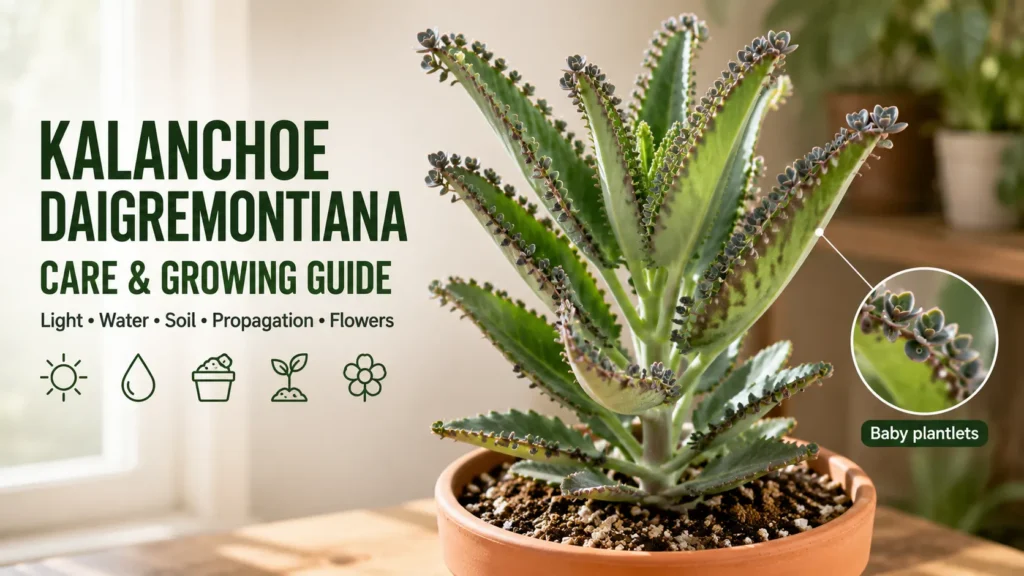
Kalanchoe daigremontiana is a striking succulent best known as Mother of Thousands. Its thick, pointed leaves produce tiny plantlets along the leaf edges, so one plant can quickly produce many new plants. It is easy to grow, but good drainage, bright light, careful watering, and plantlet control make a big difference.
I recommend growing it in a pot where you can control its spread. If you give it enough light and let the soil dry between waterings, this succulent can stay healthy with fairly little care.
Quick Answer
Kalanchoe daigremontiana grows best in bright light, fast-draining succulent soil, and a pot with drainage holes. I recommend watering it well only after the soil has dried out. Keep it warm, protect it from frost, and remove fallen plantlets if you do not want new plants appearing around the pot. It is also toxic if eaten, so keep it away from pets and small children.
What Is Kalanchoe daigremontiana?
Kalanchoe daigremontiana is a succulent from Madagascar. It belongs to the Crassulaceae family, the same plant family that includes many familiar succulent plants.
You may know it by several common names, including Mother of Thousands, Alligator Plant, Mexican Hat Plant, Devil’s Backbone, and Maternity Plant. It has also been known by the older botanical name Bryophyllum daigremontianum.
The plant usually grows upright with thick, triangular leaves. Mature plants can reach around 3 feet tall, although indoor plants often stay smaller depending on light, pot size, and growing conditions.
The feature that makes this plant special is the small plantlets that form along the edges of mature leaves. These tiny plants can develop roots while still attached to the parent leaf. They may later fall onto the soil and start growing on their own.
How to Identify Kalanchoe daigremontiana

Kalanchoe daigremontiana is fairly easy to spot once you know what to look for.
Look for:
- Thick, fleshy leaves
- Long triangular or lance-shaped leaves
- Notched or toothed leaf edges
- Small plantlets along the leaf margins
- Green, gray-green, or purple-green leaves
- Purple markings, often on the underside of the leaves
- Upright growth
- Pink to lavender, bell-shaped flowers on mature plants
The plantlets are the biggest clue. If you see rows of tiny baby plants growing along the edge of a thick triangular leaf, you are likely looking at Mother of Thousands.
Kalanchoe daigremontiana vs Mother of Millions

Mother of Thousands and Mother of Millions are often confused because both can produce baby plants along their leaves.
| Feature | Mother of Thousands | Mother of Millions |
| Botanical name | Kalanchoe daigremontiana | Kalanchoe delagoensis |
| Common name | Mother of Thousands | Mother of Millions |
| Leaf shape | Broad and triangular | Narrow and tubular |
| Leaf edges | Many small plantlets | Plantlets mainly near leaf tips |
| Leaf color | Green to purple-green | Often green with darker markings |
| Growth form | Upright | More narrow and upright |
There are also hybrids between these types, which can make identification harder. If I were trying to identify one, I would look at the leaf shape first, then check where the plantlets form.
Kalanchoe daigremontiana Care Requirements

The care routine is simple once you treat this plant like the succulent it is.
The main rule I follow is simple: give it plenty of light, use fast-draining soil, and do not keep the roots wet for long periods.
Give Kalanchoe daigremontiana Bright Light
Kalanchoe daigremontiana prefers bright light. Indoors, place it near a bright window where it can receive plenty of natural light.
A few hours of gentle direct sun can work well, but harsh afternoon sun through glass can scorch the leaves. Bright indirect light or partial sun is a safer choice if the window receives strong midday heat.
Low light can cause weak, stretched growth. The stem may become longer and thinner, and the leaves may spread farther apart.
If your plant looks tall and loose instead of compact and upright, I would check the light before changing its watering routine.
How Often Should You Water Kalanchoe daigremontiana?

Water Kalanchoe daigremontiana only after the soil has dried out.
Instead of following a fixed calendar, I prefer checking the soil first. Indoor temperature, pot size, light, soil type, and season can all change how quickly the soil dries.
When the soil is dry, water thoroughly until some water comes through the drainage hole. Then empty any water sitting in the saucer.
This plant stores water in its thick leaves, so it can handle dry periods. The bigger risk is usually watering too often. Constantly wet soil can lead to root rot.
During cooler or less active periods, the plant usually needs less water.
Signs You May Be Overwatering
Watch for:
- Soft leaves
- Mushy stems
- Yellowing leaves
- Dark or damaged roots
- Soil that stays wet for a long time
- A bad smell from the soil
If these signs appear together, I would check the roots rather than simply adding more fertilizer or water.
Signs of Underwatering
A thirsty plant may develop:
- Wrinkled leaves
- Drooping leaves
- Dry soil pulling away from the pot
- Thinner-looking foliage
One slightly wrinkled leaf does not always mean the plant needs water. Check the soil before watering.
Use Fast-Draining Soil
Kalanchoe daigremontiana needs soil that drains quickly.
A cactus or succulent potting mix is a simple choice for indoor growing. You can also improve drainage by adding materials such as perlite or coarse mineral grit to a suitable potting mix.
The goal is to give the roots air and prevent water from staying around them for too long.
Avoid heavy garden soil in an indoor pot. It can hold too much moisture around the roots.
Choose a Pot With Drainage
A drainage hole is one of the most useful features you can give this plant.
Choose a pot that fits the root system without leaving a huge amount of unused soil around it. Too much wet soil around a small root system can take longer to dry.
Terracotta can also be useful because it allows some moisture to leave through the pot walls.
I would rather use a simple pot with good drainage than an attractive container that has nowhere for excess water to escape.
Temperature and Humidity
Kalanchoe daigremontiana likes warm conditions.
A general indoor range around 65–75°F works well, while the plant can tolerate a wider range when conditions are suitable. It is not frost-tolerant, so cold weather can damage it.
If you grow it outdoors, bring it inside before frost or prolonged cold reaches the plant.
It does not need high humidity. In fact, keeping the air relatively dry is usually a better fit for this succulent than placing it in a constantly damp environment.
Does Kalanchoe daigremontiana Need Fertilizer?
Kalanchoe daigremontiana does not need heavy feeding.
If the plant is actively growing, you can use a diluted balanced fertilizer according to the product directions. I would avoid frequent or strong feeding because this is a low-maintenance succulent.
A healthy plant with good light, suitable soil, and proper watering can grow well without a complicated feeding routine.
If growth is weak, check the light and roots before assuming fertilizer is the problem.
How to Propagate Kalanchoe daigremontiana

Propagation is one of the easiest parts of growing Mother of Thousands.
The plant produces tiny plantlets along the leaf margins. Many already have small roots when they detach, which gives them a strong start.
What Are the Baby Plantlets?
The tiny growths along the leaf edges are plantlets. They are miniature versions of the parent plant.
Once they become large enough, they can fall from the leaf and land in nearby soil. If the conditions are right, they can form roots and begin growing as new plants.
This is why a single Mother of Thousands can produce far more plants than you may expect.
How to Remove the Plantlets
If you want to grow more Kalanchoe daigremontiana, you can gently remove mature plantlets from the leaf edge.
I would wait until a plantlet has developed a small root system or looks strong enough to survive on its own.
Then:
- Gently remove the plantlet from the leaf.
- Place it on top of dry or lightly moist succulent soil.
- Keep it in bright, indirect light.
- Avoid soaking the soil.
- Give it time to establish roots.
You do not need complicated propagation equipment for this plant.
How to Plant the Plantlets
Once a plantlet has roots, place the root area against fast-draining soil.
Do not bury the entire baby plant. Give the young roots contact with the soil while keeping the leaves above the surface.
Keep the soil lightly managed while the plant establishes. Once it starts growing, treat it more like the mature succulent.
How to Stop Mother of Thousands From Spreading
This is one area where Kalanchoe daigremontiana needs more attention than many common succulents.
The plantlets can drop from the leaves and grow wherever they land. If several fall into nearby pots, you may soon have many new plants.
If you want to keep the plant contained, I recommend:
- Growing it in its own pot
- Checking the area around the pot regularly
- Removing fallen plantlets
- Removing unwanted plantlets before they root
- Keeping the plant away from other pots
- Avoiding outdoor planting in places where it can spread easily
In warm, frost-free areas, its easy reproduction can make it difficult to control.
For that reason, I prefer container growing unless you are sure the local conditions allow safe outdoor planting.
Does Kalanchoe daigremontiana Flower?

Yes, mature Kalanchoe daigremontiana can flower.
The flowers are usually bell-shaped and may appear in pink to lavender shades. They grow in clusters on tall flower stems and can appear during cooler parts of the year or around winter and spring, depending on growing conditions.
This plant is also monocarpic, which means the main plant can die after flowering.
That may sound alarming, but the plant often produces many plantlets before reaching this stage. You can keep the next generation growing after the parent plant finishes its life cycle.
How to Encourage Flowering
Flowering depends on the plant’s age, health, light, temperature, and seasonal conditions.
I would focus on the basics first:
- Give the plant plenty of bright light.
- Avoid constant overwatering.
- Use fast-draining soil.
- Keep the plant healthy during active growth.
- Avoid heavy feeding.
- Give it suitable seasonal conditions.
Do not force flowering by stressing the plant with extreme dryness or poor light.
Common Kalanchoe daigremontiana Problems

Most problems come down to light, water, drainage, or pests.
Yellow Leaves
Yellow leaves can develop for several reasons, but overwatering is one of the first things I would check.
Look at the soil. If it remains wet for many days, check the pot drainage and root condition before watering again.
Older lower leaves can also change color naturally, so look at the whole plant rather than judging it from one leaf.
Soft or Mushy Leaves
Soft leaves are often a sign that the plant is holding too much moisture.
Check the soil and stem. If the soil is wet and the stem is becoming soft, root or stem rot may already be developing.
Move quickly by reducing watering and checking the root system if needed. Overwatering is a common cause of root rot in this plant.
Wrinkled Leaves
Wrinkled leaves can point to a lack of water, especially when the soil has been completely dry for a long time.
But do not water automatically. Check the roots and soil first.
If the soil is wet while the leaves are wrinkled, the problem may be root damage rather than a lack of water. Damaged roots cannot take up water properly.
Brown Leaf Tips
Brown areas can come from several causes, including strong direct sunlight, watering problems, or environmental stress.
If the brown areas appear mainly on the side facing intense afternoon sun, I would move the plant to bright filtered light or gentler sun. Prolonged intense sunlight can cause leaf scorch.
Leggy Growth
Leggy growth usually means the plant is not receiving enough light.
Move it closer to a bright window or improve its light source.
Do not solve a light problem by adding more water or fertilizer. Those changes will not replace the light the plant needs.
Root Rot
Root rot is usually linked to excess moisture and poor drainage.
If you suspect root rot, remove the plant from its pot and check the roots. Healthy roots should not be soft and rotten.
Trim away damaged roots with clean tools, remove wet or unsuitable soil, and repot the plant in fresh, fast-draining succulent soil.
Give the plant time to dry and recover before returning to a normal watering routine.
Mealybugs, Aphids and Spider Mites
Kalanchoe daigremontiana can attract pests such as mealybugs, aphids, and spider mites.
Check the undersides of leaves, leaf joints, and new growth.
If you spot pests early, remove affected material and treat the plant with a suitable houseplant pest-control method according to the product directions.
Do not ignore a small pest problem just because the plant looks mostly healthy.
Growing Kalanchoe daigremontiana Outdoors
Kalanchoe daigremontiana can grow outdoors in warm climates, but it needs protection from frost.
It is generally suited to USDA Zones 9–11, and it prefers warm conditions. In colder areas, container growing makes it easier to bring the plant indoors when temperatures drop.
Outdoor growing also brings another issue: uncontrolled propagation.
Before planting it in the ground, consider how easily its plantlets can spread. In warm areas without regular frost, fallen plantlets can establish new plants and become difficult to control.
For this reason, I would choose a container if you want better control.
Is Kalanchoe daigremontiana Toxic?
Yes. Kalanchoe daigremontiana can be toxic if eaten, and it should be kept away from pets and small children.
Do not treat Mother of Thousands as an edible plant or use it as a home remedy.
I also recommend washing your hands after handling the plant, especially if you have sensitive skin.
If a pet or child may have eaten part of the plant, seek appropriate professional help rather than waiting for symptoms.
Final Thoughts
Kalanchoe daigremontiana is one of the more unusual succulents you can grow. Its care is fairly simple, but its ability to produce plantlets means you need to think about containment as well as light, water, and soil.
I would keep it in a bright spot, use fast-draining succulent soil, water only after the soil dries, and remove unwanted plantlets before they take root. With that basic routine, Mother of Thousands can stay healthy while giving you plenty of new plants to grow or share.
Kalanchoe daigremontiana Care FAQs
How big does Kalanchoe daigremontiana get?
It can reach about 3 feet tall, although indoor plants often stay smaller.
Can Kalanchoe daigremontiana grow indoors?
Yes. Give it bright light, fast-draining soil, and careful watering.
How often should I water Mother of Thousands?
Water when the soil has dried out. Avoid keeping it constantly wet.
What are the little plants on my Kalanchoe leaves?
They are plantlets that can grow into new Mother of Thousands plants.
Can I remove the plantlets?
Yes. Remove them gently if you want to propagate them or stop unwanted spread.
Does Mother of Thousands die after flowering?
The main plant can die after flowering because it is monocarpic.
Can I grow Mother of Thousands outside?
Yes, in warm, frost-free areas. Use a container if you want better control of its spread.
Is Kalanchoe daigremontiana poisonous?
Yes. Keep it away from pets and children and do not eat the plant.
Why is my Mother of Thousands getting leggy?
Low light is a common cause. Move it to a brighter location.